
Sabratha’s Roman theatre and the Mediterranean city around it
Published on 08/16/2026 at 13:57 | Editorial responsibility: Rafael Müller, Editor-in-Chief AD HOC NEWS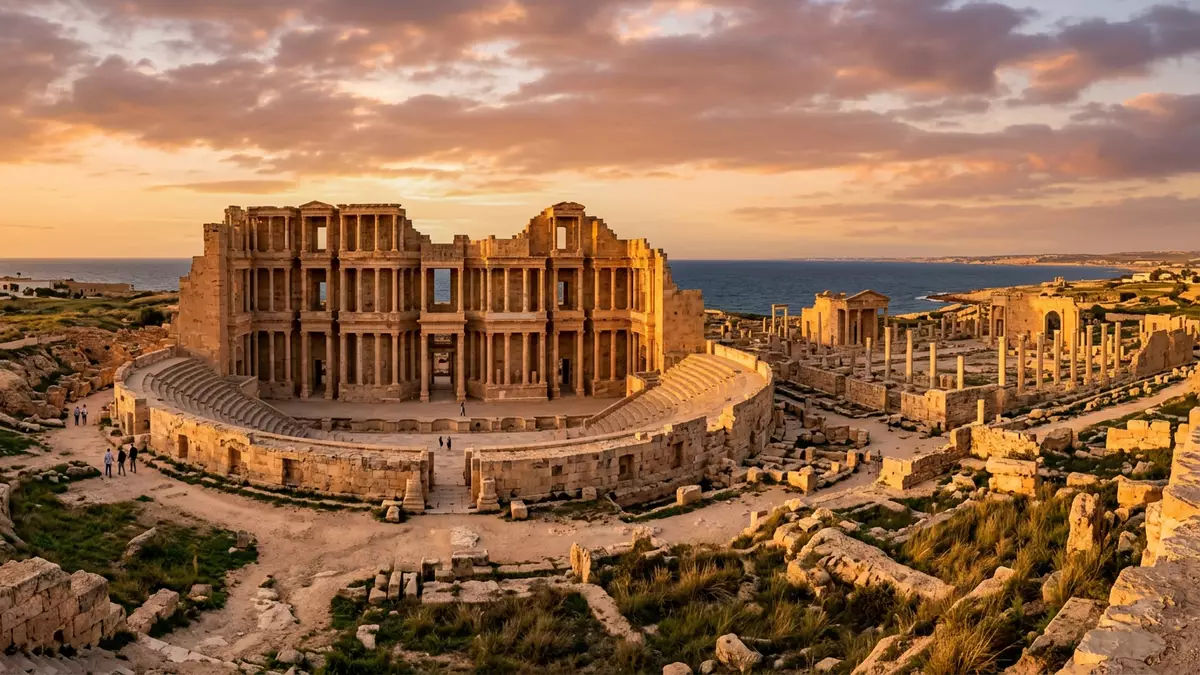
Sabratha on Libya’s north-western coast is an ancient port city where a towering Roman theatre rises above a spread of Phoenician, Roman and Byzantine ruins beside the Mediterranean Sea. In this archaeological site, inscribed as the Archaeological Site of Sabratha on the UNESCO World Heritage List in 1982, the theatre’s high colonnaded backdrop dominates a landscape of temples, forums and basilicas.
Theatre as stone backdrop to an ancient harbour
The Roman theatre of Sabratha stands close to the shoreline, forming a monumental wall of stone and columns between the archaeological zone and the sea. Its restored scaenae frons, the architectural backdrop to the stage, climbs in three tiers of columns and niches, giving a vertical rhythm that frames the open sky above the orchestra and cavea.Roman theatre of Sabratha The theatre is part of the Archaeological Site of Sabratha, which is recognised as a World Heritage property for its combination of Phoenician foundations and later Roman monumental architecture.Archaeological Site of Sabratha
The city began as a Phoenician trading post on the Tripolitanian coast, acting as an outlet for goods from the African interior before its incorporation into the short-lived Numidian Kingdom of Massinissa and then the Roman Province of Africa.Phoenician trading post Under Roman rule in the second and third centuries AD, prosperity from maritime and inland trade supported large public works, among them this theatre, an amphitheatre, temples and civic buildings laid out between the harbour and the surrounding countryside.Roman public monuments
Architecture of the theatre and the wider ruins
The theatre’s cavea, the stepped seating area for spectators, rises in curving tiers around the orchestra, while the stage platform carries a line of sculpted reliefs along its base that mark the division between performers and audience.theatre of Sabratha Behind the cavea, passages and entrances once managed the flow of spectators through the structure, and the overall plan shows how Roman theatre design was adapted to a coastal Libyan setting with views towards the sea and the inland plain.
Beyond the theatre, the Archaeological Site of Sabratha preserves a dense cluster of monuments from different periods, including a forum, temples dedicated to deities such as Liber Pater and Isis, baths, council buildings and Christian basilicas with mosaic floors.temples and basilicas These structures reflect a sequence of Phoenician, Roman and Byzantine occupation, with Punic mausoleums, Roman civic architecture and later churches sharing the same coastal terrace above the Mediterranean.multi-period remains
Sabratha within Roman Tripolis and modern Libya
In antiquity, Sabratha formed part of the triad of cities known as Tripolis, alongside Oea, the site of modern Tripoli, and Leptis Magna further east along the coast.Tripolis trio This coastal strip in what was then the Roman Province of Africa linked Mediterranean shipping lanes with caravan routes heading inland towards oases such as Ghadames, supplying Rome with commodities and animals from the Saharan and sub-Saharan regions.trade routes to the interior
The theatre’s construction is tied to this period of prosperity in the second century AD, when Roman patrons invested in large entertainment structures in provincial cities.construction in the second century Italian archaeologists undertook major excavation and reconstruction work between 1927 and 1937, reassembling the colonnaded stage wall to its present three-level form and making the theatre one of the most striking monuments on the Libyan coast.reconstruction in the 1930s
Visiting Sabratha: what travellers from Western Europe should know
- Sabratha lies on Libya’s Tripolitanian coast west of Tripoli, reached by road from the capital and by local transport towards the coastal town and archaeological zone.
- Within the archaeological site, movement involves walking across uneven ancient paving, packed earth and stone steps, including climbs through the theatre’s entrances and up the seating tiers.
- The Mediterranean setting brings strong sun and exposure on the open terraces, with limited shade among the ruins and a contrast between open coastal views and more enclosed interior spaces.
- The official language is Arabic and the currency is the Libyan dinar. Entry requirements depend on your nationality; UK travellers can check the FCDO travel advice at gov.uk/foreign-travel-advice, Irish travellers the Department of Foreign Affairs at ireland.ie.
Searching for Sabratha on social platforms
These links open searches for Sabratha on each platform.Frequently asked questions about Sabratha
Where is Sabratha and what kind of place is it?
Sabratha is an ancient coastal city in north-western Libya, west of Tripoli, known for its Roman, Phoenician and Byzantine ruins within a recognised archaeological site.
What can visitors expect on a visit to Sabratha?
Visitors encounter a large Roman theatre with a restored three-tier colonnaded backdrop, surrounded by forums, temples, baths and basilicas laid out beside the Mediterranean Sea.
What makes Sabratha distinctive among ancient sites?
Sabratha combines a towering Roman theatre with multi-period ruins in a compact coastal setting, and the whole Archaeological Site of Sabratha is inscribed as a UNESCO World Heritage property.


