
Sabratha’s Roman theatre on the edge of the Mediterranean
Published on 08/23/2026 at 12:43 | Editorial responsibility: Rafael Müller, Editor-in-Chief AD HOC NEWS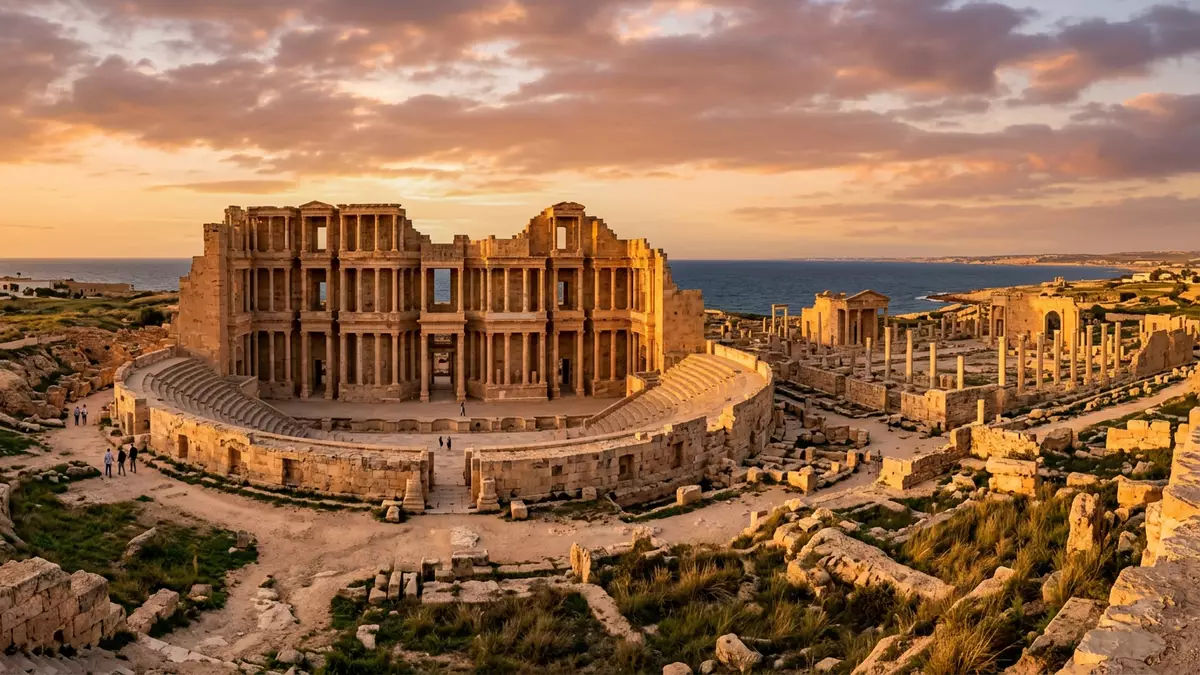
On Libya’s north-western coast, Sabratha stretches along the Mediterranean with a Roman theatre rising above a spread of ancient ruins and sea. Within the Archaeological Site of Sabratha, this theatre’s high backdrop of columns stands among streets, temples and basilicas that trace the city’s life from Phoenician trading post to Roman colony and Byzantine town in a compact coastal setting.
A Roman stage facing the sea
The Roman theatre of Sabratha stands near the shoreline, where its stone tiers and soaring stage backdrop form a monumental edge between the ancient city and the Mediterranean. The building belongs to the Roman period of the city and is generally dated to the late second or early third century AD, when Sabratha was part of the province of Africa Proconsularis.Sabratha was Romanized and rebuilt in the 2nd and 3rd centuries AD
The theatre’s plan follows the Roman model, with a semicircular cavea of stone seating rising from the orchestra and focusing on the broad stage. Behind the stage, the scaenae frons forms an architectural wall of columns and niches reconstructed to near its full height, so that visitors see a vertical composition of multiple storeys of Corinthian columns in stepped alignments.The theatre has a three-storey architectural backdrop with Corinthian columns The combination of the curving seating, the broad stage and the towering backdrop creates a stone frame that opens towards sea and sky.
Phoenician port, Roman colony, Byzantine city
Sabratha began as a Phoenician coastal trading post on the Tripolitanian shore, linked to routes from the African interior to the Mediterranean.The site originated as a Phoenician trading-post serving the African hinterland It later formed part of the short-lived Numidian kingdom of Massinissa before coming under Roman control, when Julius Caesar incorporated the city into the Roman province of Africa. Under Roman rule, Sabratha developed as the westernmost of the three cities of Tripolis alongside Oea and Leptis Magna, with new public monuments marking its prosperity.Sabratha was the western-most of the three cities of ancient Tripolis
The ruins visible around the theatre record this layered history. Streets lead from the theatre towards a forum area lined with civic buildings, while temple platforms, bath structures and Christian basilicas stand in different quarters of the archaeological zone.The archaeological site of Sabratha includes the Forum, temples and a Christian basilica The combination of Phoenician foundations, Roman monumental architecture and later Byzantine remains gives the site a stratified character that reflects successive Mediterranean cultures anchored to this stretch of coast.
A World Heritage coastal cityscape
The Archaeological Site of Sabratha is inscribed on the UNESCO World Heritage List as a cultural property under criterion (iii), recognising its testimony to the civilisation that grew from Phoenician beginnings through Roman and Byzantine phases.The Archaeological Site of Sabratha has been a UNESCO World Heritage Site since 1982 The United Nations listing, granted in 1982, formally acknowledges both the city’s long history and the preservation of its coastal ruins within a defined archaeological zone.
The site lies on Libya’s Mediterranean coast in the Zawiya District, west of Tripoli, within reach of the modern town that bears the same name.Sabratha stands about 70 km west of Tripoli on the Mediterranean coast From the higher rows of the cavea, the view takes in the curve of the shoreline, stretches of Roman masonry and the faint outline of later structures, so the theatre, city and sea appear as one continuous landscape of stone and water.
Visiting Sabratha: what travellers from Western Europe should know
- Sabratha stands on Libya’s north-western Mediterranean coast west of Tripoli, reached by road towards the modern town and its adjacent archaeological zone.
- The archaeological area includes uneven Roman paving, worn stone steps and stretches of exposed rock, so moving between the theatre, forum and other monuments involves walking on irregular surfaces.
- The official language is Arabic and the currency is the Libyan dinar.
- Entry requirements depend on your nationality; UK travellers can check the FCDO travel advice at gov.uk/foreign-travel-advice, Irish travellers the Department of Foreign Affairs at ireland.ie.
Searching for Sabratha on social platforms
These links open searches for Sabratha on each platform.
Frequently asked questions about Sabratha
Where is Sabratha located?
Sabratha lies on Libya’s Mediterranean coast in the Zawiya District, west of Tripoli, near the modern town that carries the same name.
What should visitors expect at the site?
Visitors encounter a large Roman theatre with a reconstructed multi-storey colonnaded backdrop, surrounded by forums, temples, baths and basilicas laid out beside the sea.
What makes Sabratha distinctive among ancient sites?
Sabratha combines a towering Roman theatre, layered Phoenician, Roman and Byzantine remains and a coastal setting where stone architecture meets the Mediterranean.


