
San Miguel de Allende and its pink-stone skyline
Published on 09/23/2026 at 11:06 | Editorial responsibility: Rafael Müller, Editor-in-Chief AD HOC NEWS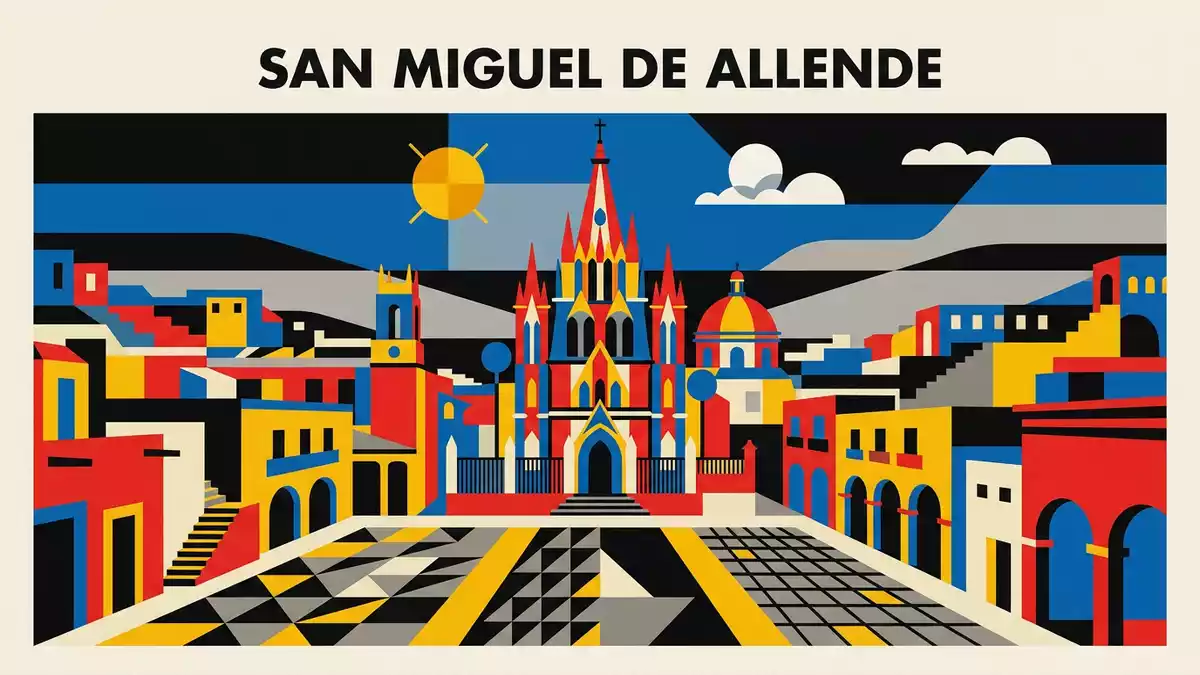
San Miguel de Allende rises across the Mexican highlands in a composition of pink stone, cobbled streets and church towers. Its historic centre combines colonial houses, intimate plazas and the neo-Gothic façade of the Parroquia de San Miguel Arcángel. The result is a city where the skyline and the street plan belong to the same architectural story.
Pink stone above the historic centre
The Parroquia de San Miguel Arcángel faces the main plaza with pale pink masonry and pointed towers. Its present façade dates from work carried out in the late nineteenth century by the local builder Zeferino Gutiérrez. Behind it stands an earlier church structure completed in 1709, joining an eighteenth-century core with later architectural forms.
The church gives the central district a clear vertical focus, while the surrounding buildings remain comparatively low. Stone streets meet at plazas, and coloured façades frame timber doors, iron balconies and arcaded frontages. The materials vary from dressed stone to plaster, yet the streets retain a coherent highland character. The city’s architectural language is visible at the scale of a doorway as well as across the skyline.
A colonial grid shaped by several centuries
San Miguel de Allende began as a Spanish settlement in 1542, associated with the Franciscan monk Juan de San Miguel. The town developed along an inland road through New Spain, and its blocks followed a regular urban plan. The name was extended in 1826 to honour Ignacio Allende, a local figure in Mexico’s struggle for independence.
The eighteenth century brought religious and civic buildings in Baroque forms, while later work introduced Neoclassical and Neo-Gothic elements. The historic centre therefore reads as a sequence of periods rather than a single style. the UNESCO World Heritage property includes San Miguel de Allende and the Sanctuary of Jesús Nazareno de Atotonilco, linking the town with a religious complex outside it.
The World Heritage inscription dates from 2008. It recognises the town’s urban development, religious and civil architecture, and association with the process of Mexican independence. The protected ensemble also records an architectural evolution from Baroque buildings to late nineteenth-century Neo-Gothic additions. the historic centre’s churches and colonial buildings remain central to its identity.
Churches, courtyards and the road to Atotonilco
The central district contains churches, former mansions and civic buildings arranged among narrow streets and small squares. The Oratorio de San Felipe Neri, the Templo de San Francisco de Asís and the Templo de la Concepción add different profiles to the townscape. Their façades help explain the range of religious architecture gathered within a compact urban area.
Outside the town, the Sanctuary of Jesús Nazareno de Atotonilco forms the second part of the World Heritage property. Its interior is known for extensive mural painting and Mexican Baroque decoration. The sanctuary and San Miguel de Allende are connected through the religious and political history of the region, while their forms remain distinct: one is an urban highland town, the other a decorated religious complex.
The city’s streets also lead towards places associated with Ignacio Allende and the independence period. The Museo Casa de Allende occupies the former family house of the independence figure. Nearby buildings preserve patios, stone portals and domestic details that belong to the city’s colonial fabric. the 2008 World Heritage decision records the connection between the town, its architecture and Mexican independence.
Visiting San Miguel de Allende: what travellers from Western Europe should know
- San Miguel de Allende lies in Guanajuato state, in central Mexico. The historic centre is reached through the town’s road network, with Querétaro and León providing major regional transport connections.
- The central streets include cobbled surfaces, slopes and steps. Walking routes pass through plazas, church entrances and narrow lanes, so sturdy footwear suits the stone paving.
- The city stands in a highland setting. Bright façades, exposed stone and church towers form the principal visual markers across the historic centre.
- The official language is Spanish and the currency is the Mexican peso.
- Entry requirements depend on your nationality; UK travellers can check the FCDO travel advice at gov.uk/foreign-travel-advice, Irish travellers the Department of Foreign Affairs at ireland.ie.
Searching for San Miguel de Allende on social platforms
These links open searches for San Miguel de Allende on each platform.
Frequently asked questions about San Miguel de Allende
Where is San Miguel de Allende?
San Miguel de Allende is a historic city in Guanajuato state, in central Mexico. Its old town occupies a highland setting of streets, plazas and colonial buildings.
What can visitors expect in the historic centre?
The centre brings together cobbled lanes, churches, patios, coloured façades and civic buildings. The Parroquia de San Miguel Arcángel provides a prominent pink-stone landmark beside the main plaza.
What makes San Miguel de Allende distinctive?
Its urban fabric combines a sixteenth-century Spanish settlement, eighteenth-century Baroque architecture and nineteenth-century Neo-Gothic additions. The town also forms part of the World Heritage property with the Sanctuary of Jesús Nazareno de Atotonilco.


