
Sassi di Matera, a layered stone city in southern Italy
Published on 08/17/2026 at 13:27 | Editorial responsibility: Rafael Müller, Editor-in-Chief AD HOC NEWS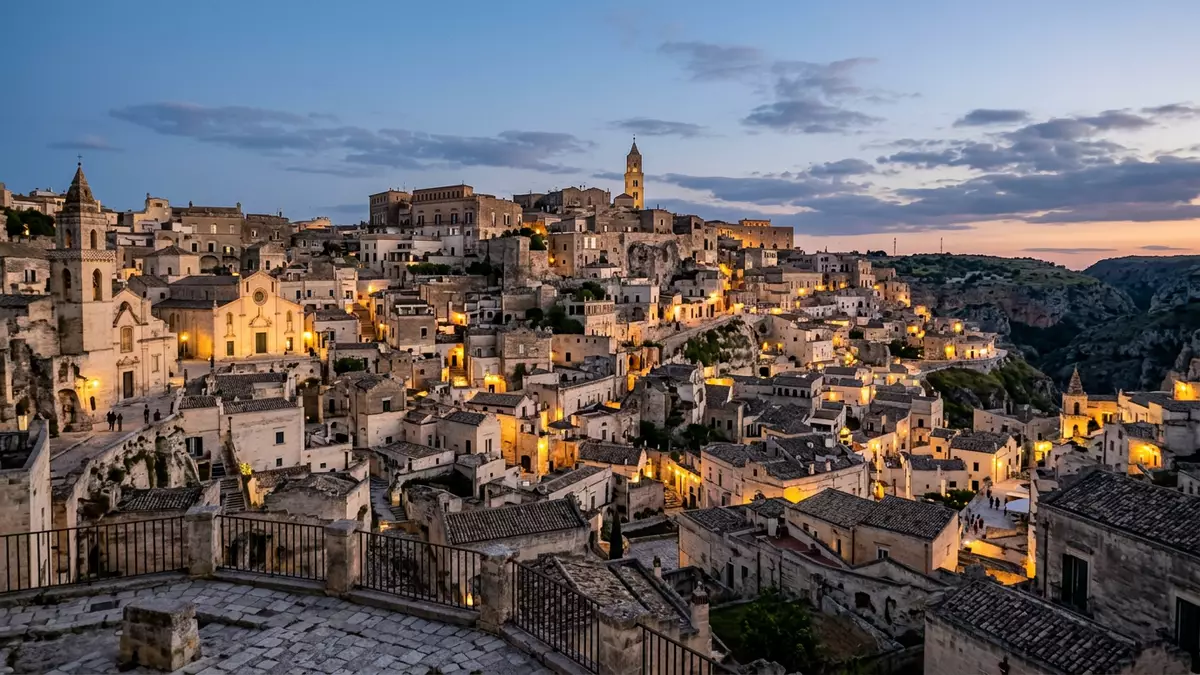
Sassi di Matera in Matera, Italy, forms a densely layered stone city climbing the sides of a deep ravine, where houses, lanes and churches are carved directly into the rock. The two historic districts, Sasso Caveoso and Sasso Barisano, preserve a long sequence of human settlement that reaches back to prehistoric times and continues into the twentieth century.
A rock-cut city above a ravine
The Sassi occupy the slopes of a limestone gorge cut by the Gravina di Matera, with dwellings stepping down towards the ravine on terraces and ledges. The cliffs are formed of soft calcarenitic rock, a variety of tufa that can be cut and shaped with hand tools yet still supports substantial structures, giving the urban fabric its distinctive pale colour and texture.calcarenitic rock From the upper edge of the plateau, the districts descend in a cascade of façades, stairways and rooftops, so that many houses sit partly under the rock and partly in front of it.
In Sasso Caveoso and Sasso Barisano, domestic rooms, cisterns, storage spaces and animal shelters have been excavated into the cliff, then fronted by masonry walls that extend the caves outward. The result is a hybrid between built and hollowed architecture, where interiors reach back into the hillside and exteriors stack one above another in compact clusters.ancient cave-dwelling districts Paths and staircases weave between these dwellings, forming a network of narrow lanes that often pass over the roofs of rooms below.
From prehistoric settlement to World Heritage landscape
The site of Matera shows evidence of human occupation from the Palaeolithic period, with use of natural caves continuing through the Neolithic and later eras.continuous human occupation The rock-cut districts known as the Sassi developed out of a prehistoric troglodyte settlement and are among the earliest settled urban areas in what is now Italy.prehistoric troglodyte settlement Over centuries, the simple caves were extended, regularised and combined, forming neighbourhoods with streets, courtyards and communal spaces.
In the Middle Ages, the Sassi acquired many rupestrian churches and monastic spaces cut into the rock, some of them decorated with frescoes showing Byzantine influence brought by monks active in the region.rock churches with sacred art The districts continued to be inhabited into the nineteenth and twentieth centuries, when overcrowding and poor sanitation turned the caves into a symbol of hardship. In 1952 a national law ordered the evacuation of the Sassi and the construction of new housing areas for the residents, leaving many of the rock-cut dwellings empty.1952 evacuation of the Sassi
Sasso Caveoso, Sasso Barisano and the rupestrian churches
The Sassi are divided into two principal districts, Sasso Caveoso and Sasso Barisano, which flank the Civita, the highest and oldest part of Matera. In Sasso Caveoso, many dwellings cling to the slope facing the Gravina, combining cave rooms with masonry additions that step down towards the ravine.Caveoso and Barisano around the Civita Sasso Barisano, on the opposite side, contains many façades that resemble conventional houses but conceal deep excavated interiors behind their street fronts.
Scattered among the dwellings are rupestrian churches cut into the rock, some with façades built onto the cliff and others accessed through simple entrances opening directly from lanes and terraces. Inside, rock-cut naves and side spaces are defined by carved columns and vaults, and fragments of painted decoration survive on some walls. Together with monasteries and hermitages in the surrounding landscape, these churches form part of a wider cultural landscape recognised on the World Heritage List as “The Sassi and the Park of the Rupestrian Churches of Matera”, inscribed in 1993.World Heritage inscription in 1993
Visiting Sassi di Matera: what travellers from Western Europe should know
- The Sassi lie on the slopes of a ravine on the eastern side of Matera in southern Italy, in the Basilicata region. Matera is inland, away from the coastal cities of southern Italy.
- Within the districts, movement is largely on foot along steep lanes and stairways, with many changes of level and uneven stone paving. Visitors encounter numerous steps and sloping passages between terraces.
- The rock-cut churches and dwellings sit close to the edge of the Gravina di Matera, with viewpoints looking across the gorge to the plateau of the Murgia and its scattered caves.
- The official language is Italian and the currency is the euro.
Searching for Sassi di Matera on social platforms
These links open searches for Sassi di Matera on each platform.
Frequently asked questions about Sassi di Matera
Where is Sassi di Matera located?
The Sassi form two historic districts of Matera in the Basilicata region of southern Italy, on the slopes of a ravine cut by the Gravina di Matera.
What should visitors expect in the Sassi?
Visitors encounter cave-based dwellings, stone façades and rupestrian churches arranged on steep terraces, with many stairways, narrow lanes and sudden views into the ravine.
What makes Sassi di Matera distinctive?
The districts combine prehistoric cave settlement, medieval rock churches and later masonry additions into a continuous rock-cut urban landscape recognised as a World Heritage cultural landscape.


