
Schloss Heidelberg and the romance of a ruined Renaissance residence
Published on 09/07/2026 at 20:16 | Editorial responsibility: Rafael Müller, Editor-in-Chief AD HOC NEWS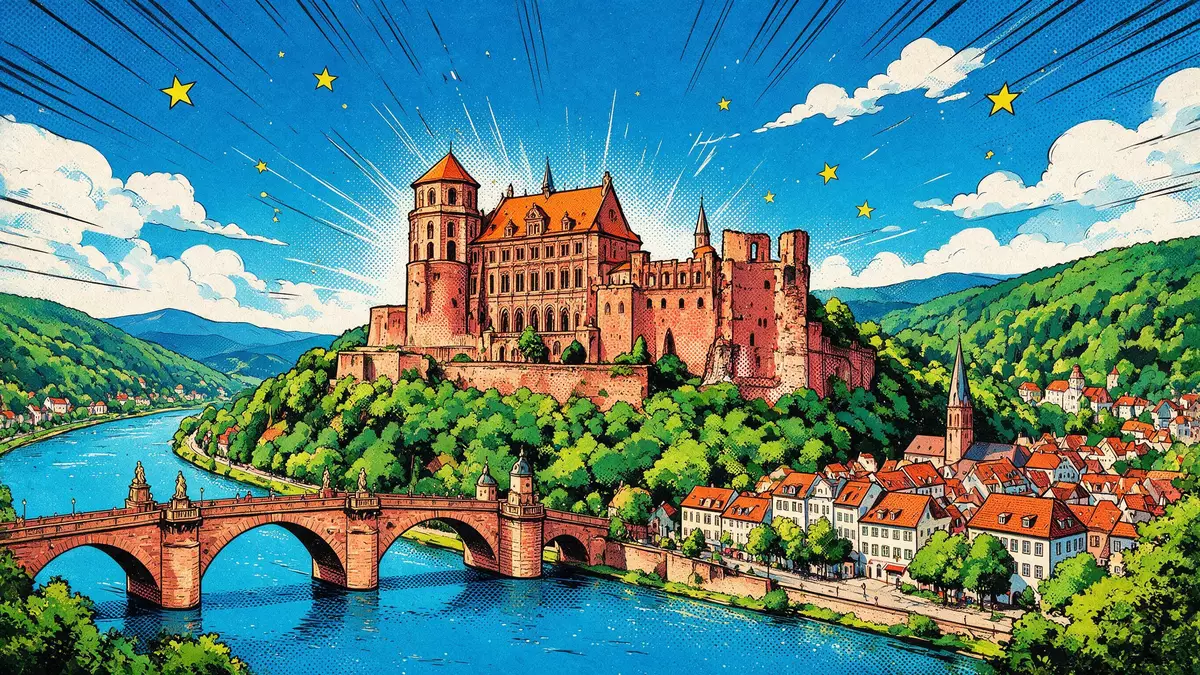
Schloss Heidelberg rises above the Neckar valley on a terrace of the Königstuhl hill, its red sandstone walls broken and open to the sky yet still forming one of Germany’s most evocative castle ruins. First mentioned as a fort in the early thirteenth century and later developed as the residence of the Palatine prince-electors, it combines medieval foundations with elaborate Renaissance façades that survived destruction in the seventeenth century and devastating lightning strikes in 1764.
A ruined residence above the Neckar
The castle stands on the Jettenbühl, a rocky spur below the Königstuhl, looking down over Heidelberg’s old town and the river Neckar. A fort in Heidelberg appears in documents in 1225, marking the beginning of a fortified presence on this terrace above the growing settlement in the valley.A fort first mentioned in 1225 Over the later Middle Ages, the complex expanded from a defensive stronghold into a castle with courtyards framed by residential wings.
From the fourteenth century into the seventeenth, Schloss Heidelberg served as the main residence of the counts palatine of the Rhine and, later, the prince-electors, anchoring their authority over the region.Heidelberg Castle as prince-electors’ residence The shift from simple fortifications to palace buildings is visible in the way the courtyard became lined with multi-storey façades, some decorated with sculpted figures and ordered window axes that contrast with the castle’s older towers and walls.
Renaissance façades and red sandstone
Much of the standing architecture around the main courtyard dates from the sixteenth and early seventeenth centuries, when medieval structures were rebuilt or replaced by Renaissance palace wings. The Ottheinrichsbau, started in the 1550s under Prince Elector Ottheinrich, presents a richly articulated façade often cited as one of the earliest major Renaissance palace fronts in German-speaking lands.Construction of the Ottheinrichsbau in 1556-59 Nearby, the Friedrichsbau, built in the early seventeenth century, extends this composition with niches containing statues of rulers arranged across several storeys.Friedrichsbau and other palace wings
These wings share a distinctive material: warm-hued sandstone quarried from the region. The colour gives Schloss Heidelberg its characteristic appearance, especially where sculpted decoration survives on cornices, window surrounds and statue bases. Around them stand other named buildings, including the Gläserner Saalbau and the Englischer Bau, which together formed an ensemble regarded as one of the grandest castle complexes in the Holy Roman Empire before its destruction in the late seventeenth century.
Destruction, Romanticism and the giant barrel
Schloss Heidelberg’s present ruined state traces back to repeated damage between the seventeenth and eighteenth centuries. During the Palatine War of Succession in 1689 and 1693, French troops attacked Heidelberg, blasting sections of the castle fortifications and leaving many buildings gutted.Destruction in the Palatine War of Succession Limited rebuilding followed in the eighteenth century, but in 1764 lightning strikes caused fires that destroyed further parts of the complex, after which its role as a residence came to an end.Lightning damage in 1764
By the early nineteenth century, the broken walls, roofless halls and overgrown terraces were seen less as damage to be repaired and more as a picturesque landscape in their own right. The ruins became closely associated with German Romanticism, inspiring painters, writers and early travellers who were drawn to the interplay of architecture and surrounding woodland.Ruins synonymous with Romanticism Within the complex, one surviving interior highlights the castle’s former wealth: the cellar housing the Großes Fass, a huge wine barrel installed in the eighteenth century with a capacity recorded at over 220,000 litres, standing inside a vaulted space beneath the courtyard.
Visiting Schloss Heidelberg: what travellers from Western Europe should know
- Schloss Heidelberg stands on a hillside terrace above Heidelberg’s Altstadt on the south bank of the Neckar, reached from the city by paths and roads climbing towards the Königstuhl.
- The approach from the old town involves an uphill walk and, within the complex, stairways and uneven stone surfaces around the courtyards and the gardens.
- Heidelberg lies in south-west Germany on the Neckar; the official language is German and the currency is the euro.
- Schloss Heidelberg is close to other landmarks including the Philosophenweg on the opposite side of the river and the Königstuhl summit further up the hill.
Searching for Schloss Heidelberg on social platforms
These links open searches for Schloss Heidelberg on each platform.Frequently asked questions about Schloss Heidelberg
Where is Schloss Heidelberg located?
Schloss Heidelberg stands on a hillside above the old town of Heidelberg in south-west Germany, on the south side of the river Neckar.
What can visitors expect when exploring the castle?
Visitors encounter roofless halls, intact palace wings and terraces, with red sandstone façades, stairways and garden remains forming a large ruined complex.
What makes Schloss Heidelberg distinctive among German castles?
Its combination of Renaissance palace architecture, red sandstone materials and long-standing ruined state has made it closely associated with German Romanticism.


