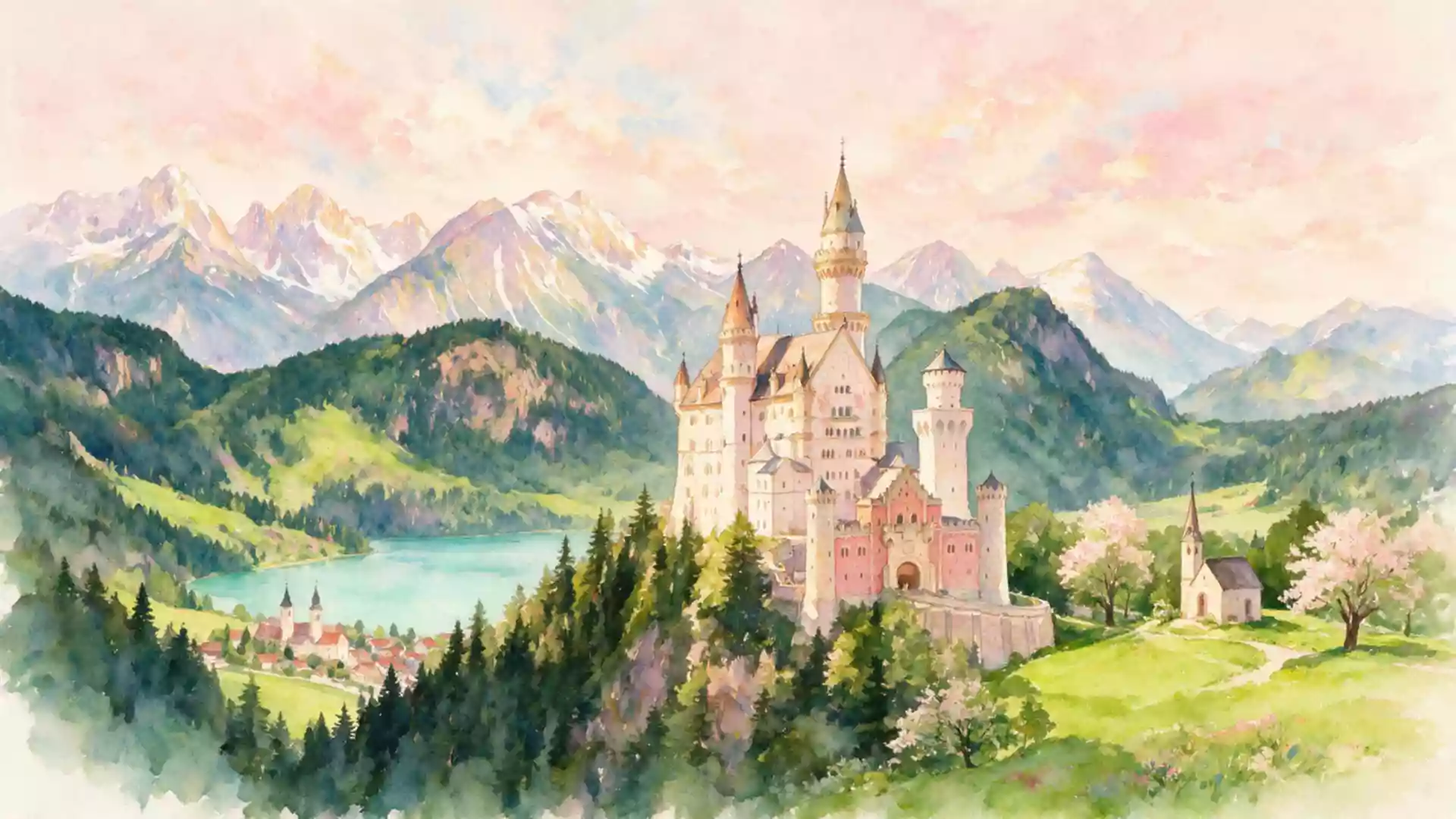
Schloss Neuschwanstein and its Romantic silhouette above Schwangau
Published on 09/07/2026 at 18:46 | Editorial responsibility: Rafael Müller, Editor-in-Chief AD HOC NEWS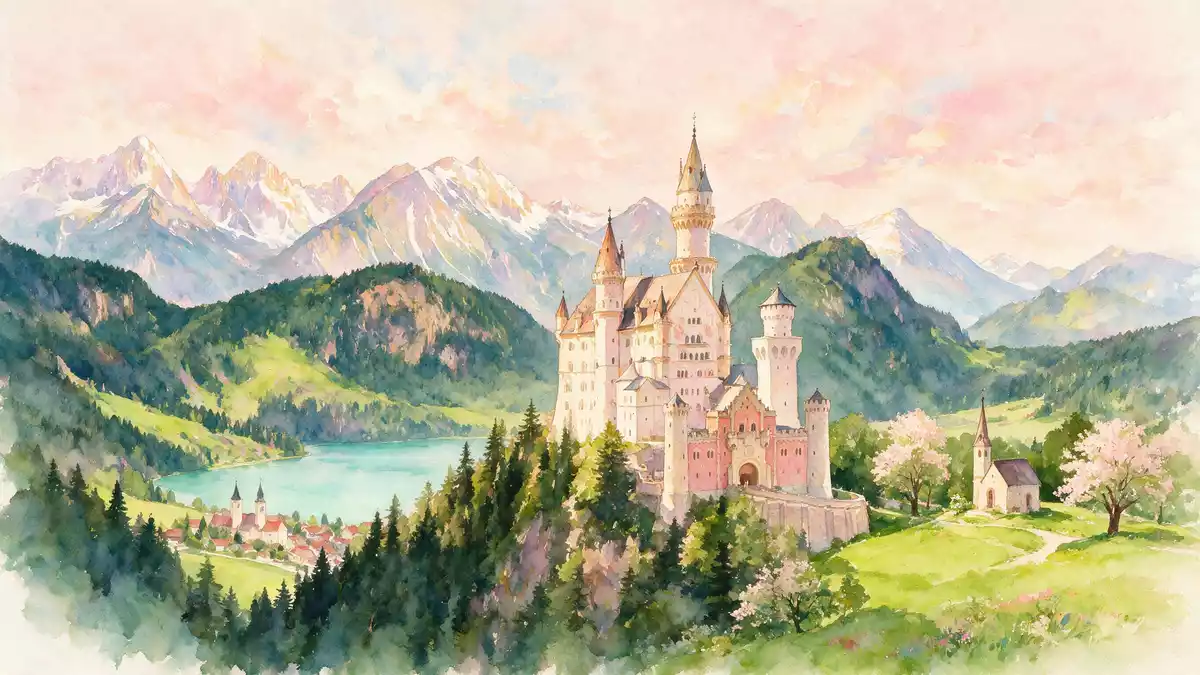
High above the village of Schwangau in southern Germany, Schloss Neuschwanstein presents a Romantic silhouette of towers and turrets set against the Bavarian Alps. Conceived by King Ludwig II of Bavaria in the late nineteenth century, this historicist palace turns a steep mountainside above the Pöllat Gorge into a theatrical vision of a medieval knight’s castle.
A nineteenth-century castle built as a fantasy retreat
Schloss Neuschwanstein stands on a rugged hill overlooking the valley around Schwangau and the nearby village of Hohenschwangau, close to Füssen in Bavaria. The site lies on a rock ledge above the Pöllat Gorge at the edge of the Alps, so the castle appears to rise directly from the mountain landscape.rock ledge over the Pöllat Gorge From the approach roads below, its pale walls and dark roofs form a striking outline against the surrounding peaks.
The building belongs to the nineteenth century and was commissioned by King Ludwig II of Bavaria, who reigned from 1864 until his death in 1886.King Ludwig II of Bavaria Construction began with the laying of the foundation stone on 5 September 1869, and the main phase of building continued into the 1880s.foundation stone was laid on 5 September 1869 The complex is often described as a palace rather than a fortress, reflecting its origin as a retreat rather than a defensive stronghold.
Historicist architecture above the Pöllat Gorge
Architecturally, Schloss Neuschwanstein belongs to the historicist movements of the nineteenth century and uses forms associated with Romanesque Revival and neo-Gothic design.dreiflügelige Anlage im Stil der Neuromanik The original designs were created by the stage painter Christian Jank and translated into architectural plans by Eduard Riedel, who served as the first chief architect.Christian Jank and Eduard Riedel Later, architects such as Georg von Dollmann and Julius Hofmann continued the work, but the building retains the character of a theatre set turned into a permanent structure.
The castle forms a three-winged complex that wraps around an inner courtyard, with towers, gables and projecting bays rising above substantial stone walls.three-winged complex Inside, the rooms were furnished in medievalising styles, with wall paintings and decorative schemes inspired by German legends and the operas of Richard Wagner. The Throne Hall, for example, occupies a large volume supported by an encased steel construction, a reminder that modern engineering underpins the historicist appearance.encased steel construction for the Throne Hall
Landscape views and the wider Schwangau setting
Schloss Neuschwanstein is part of a wider ensemble of castles and lakes around Schwangau. Below the hill, Hohenschwangau Castle occupies the site of the earlier Schwanstein castle, which Crown Prince Maximilian II had rebuilt in the Gothic style from 1832.Schwanstein rebuilt in the Gothic style from 1832 From the terraces and paths around Schloss Neuschwanstein, the view takes in nearby lakes and the foothills of the Alps, making the building part of a scenic route through southern Bavaria.
The castle lies near the southern end of the German Romantic Road, close to the town of Füssen and within sight of the Bavarian Alps.southern end of the Romantic Road Its address on Neuschwansteinstraße in Schwangau places it firmly within the Allgäu region, where steep forested slopes rise directly from the valley floor.situated near Schwangau and Füssen in the Allgäu For travellers, the contrast between the elaborate castle and the pastoral landscape is one of the enduring characteristics of a visit.
Visiting Schloss Neuschwanstein: what travellers from Western Europe should know
- Schloss Neuschwanstein stands near Schwangau and Füssen in southern Bavaria, reached by road connections such as the B17 towards Hohenschwangau and Neuschwansteinstraße.
- The terrain between Hohenschwangau and the castle involves a sustained uphill walk on paved paths, with a further climb from the ticket area to the castle itself.
- The surrounding landscape includes steep slopes and viewpoints above the Pöllat Gorge, so visitors encounter gradients and elevated paths as part of the experience.
- The official language is German and the currency is the euro.
Searching for Schloss Neuschwanstein on social platforms
These links open searches for Schloss Neuschwanstein on each platform.Frequently asked questions about Schloss Neuschwanstein
Where is Schloss Neuschwanstein located?
Schloss Neuschwanstein is located above Hohenschwangau near Schwangau and Füssen in southern Bavaria, Germany, close to the border with Austria in the foothills of the Alps.
What can visitors expect on a visit to Schloss Neuschwanstein?
Visitors encounter a steep ascent from the valley to a historicist castle with richly decorated interiors, courtyard views and panoramas over lakes, forests and the surrounding mountains.
What makes Schloss Neuschwanstein distinctive among European castles?
Its late nineteenth-century origin, historicist architecture and dramatic mountainside position above the Pöllat Gorge give Schloss Neuschwanstein a distinctive character compared with earlier defensive castles.