
Schloss Sanssouci, Frederick the Great’s Rococo terrace palace
Published on 08/21/2026 at 17:49 | Editorial responsibility: Rafael Müller, Editor-in-Chief AD HOC NEWS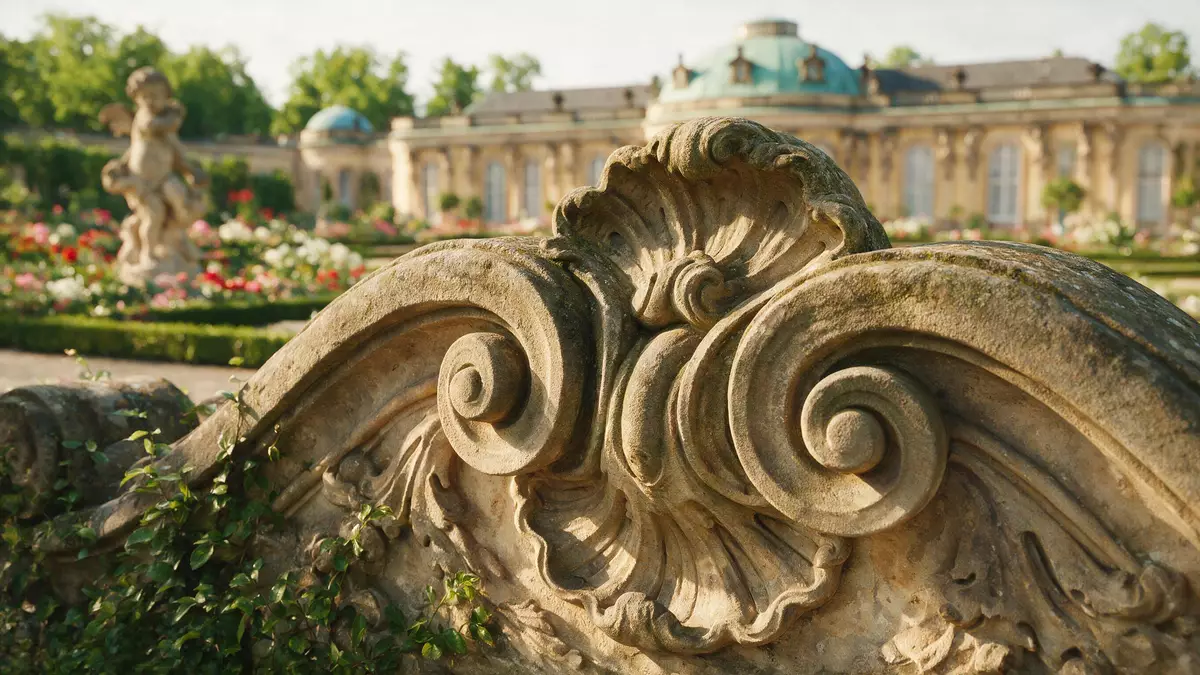
Schloss Sanssouci in Potsdam is a compact Rococo summer palace created for Frederick II of Prussia on a slope of vineyard terraces, where architecture, gardens and hillside terrain form a single composition. Built in the mid?eighteenth century as a personal retreat, it stretches along the crest of the slope so that the façades, steps and vines read almost as one continuous stage.
A Rococo palace shaped by a hillside of vines
The palace stands in Sanssouci Park on a rise south-west of central Potsdam, its main garden front looking down across a cascade of formal terraces planted with vines and fig trees. Frederick II, later known as Frederick the Great, had vines laid out on this gentle slope in the 1740s and then decided to place his residence directly above them, so the palace and the planted terraces became inseparable parts of one design.vines laid out on this gentle slope The name “Sanssouci”, adapted from French for “without worry”, reflects the idea of an unhurried summer residence where court formality receded behind conversation, writing and music in a setting of cultivated nature.French for “without worry”
Construction of Schloss Sanssouci began in 1745 and was completed in 1747, with the Prussian court architect Georg Wenzeslaus von Knobelsdorff turning Frederick’s sketches into a built design.construction began in 1745 and was completed in 1747 The result is a single-storey palace, gently curved along the line of the hilltop, whose garden front is articulated by tall French windows between sculpted pilasters and playful Rococo ornament. From the foot of the terraces, the palace appears almost to grow out of the hillside, its yellow façades and green dome drawing the eye up along the central flight of steps.
Frederick the Great’s most personal residence
Schloss Sanssouci was conceived as a pleasure palace rather than an official seat of power, and it became the residence Frederick II used for the part of the year when he withdrew from the ceremonial routines of Berlin. Inside, the enfilade of rooms mirrors that personal focus: the king’s study, his bedroom, a music room and the small library run along one side, while guest rooms and reception spaces occupy the other, all looking out across the terraces and park. The palace’s compact scale and limited storeys underline that it was intended as an intimate dwelling for a small circle rather than an arena for grand processions.pleasure palace rather than an official seat
Frederick invited distinguished visitors to Sanssouci, among them the French writer Voltaire, who stayed at the palace in the early 1750s as a guest at the Prussian court.Voltaire, who stayed at the palace In later reigns, Prussian kings added to the complex, extending wings and adapting parts of the interior, yet the core of Schloss Sanssouci remains the mid?eighteenth?century Rococo residence that Frederick shaped as his favourite place in Potsdam. In the nineteenth century it was opened as a museum, making public a residence that had begun life as a highly private space.
Interiors, park landscape and World Heritage status
Inside Schloss Sanssouci, Rococo decoration appears in gilded stucco, carved panelling and ceiling paintings that bind the walls and vaults into intricate compositions. The Marble Hall, positioned near the centre of the palace, takes the form of a domed reception space with rich stone surfaces and elaborate ornament that contrast with the lighter treatment of the smaller adjoining rooms.Marble Hall, positioned near the centre Elsewhere, details such as the Round Table dining room and the king’s library illustrate how decoration and use were closely intertwined, with book-lined walls and panelled ceilings supporting the intellectual and artistic life that unfolded here.
Beyond the palace, Sanssouci Park stretches out as a landscape of formal avenues, clipped hedges, freestanding temples and later palaces, all woven into views that frame Schloss Sanssouci on its vineyard hill. The ensemble of palaces and parks in Potsdam and neighbouring parts of Berlin, including Sanssouci, is inscribed on the UNESCO World Heritage List as an outstanding example of eighteenth- and nineteenth?century architecture and landscape design.inscribed on the UNESCO World Heritage List Walking through the park reveals how later pavilions, galleries and sightlines were aligned so that the low profile of Schloss Sanssouci stays visible as a focal point above its terraces.
Visiting Schloss Sanssouci: what travellers from Western Europe should know
- The palace stands within Sanssouci Park on Maulbeerallee in Potsdam, west-south-west of central Berlin, and is reached by regional trains to Potsdam followed by local transport or a walk through the park.
- The approach from the main park axis leads past the vineyard terraces and up a long exterior staircase, and the palace interior includes historic rooms connected by corridors, with some areas reached via further staircases.
- The wider park contains lawns, formal gardens, woodland paths and other palaces, so a visit that extends beyond Schloss Sanssouci itself involves covering appreciable distances on foot across varied but generally gentle terrain.
- Germany’s official language is German and the currency is the euro.
Searching for Schloss Sanssouci on social platforms
These links open searches for Schloss Sanssouci on each platform.
Frequently asked questions about Schloss Sanssouci
Where is Schloss Sanssouci located?
Schloss Sanssouci stands in Sanssouci Park in Potsdam in Germany, on Maulbeerallee west-south-west of Berlin.
What can visitors expect at Schloss Sanssouci?
Visitors encounter a Rococo summer palace set above vineyard terraces, with richly decorated interiors and a surrounding park landscape of avenues, gardens and further palaces.
What makes Schloss Sanssouci distinctive among European palaces?
The palace’s low, elongated form atop terraced vineyards, its close link to Frederick the Great’s personal life and its integration into a UNESCO-listed ensemble of palaces and parks give it a particular character.


