
Shwedagon Pagoda and the golden hill above Yangon
Published on 08/16/2026 at 13:03 | Editorial responsibility: Rafael Müller, Editor-in-Chief AD HOC NEWS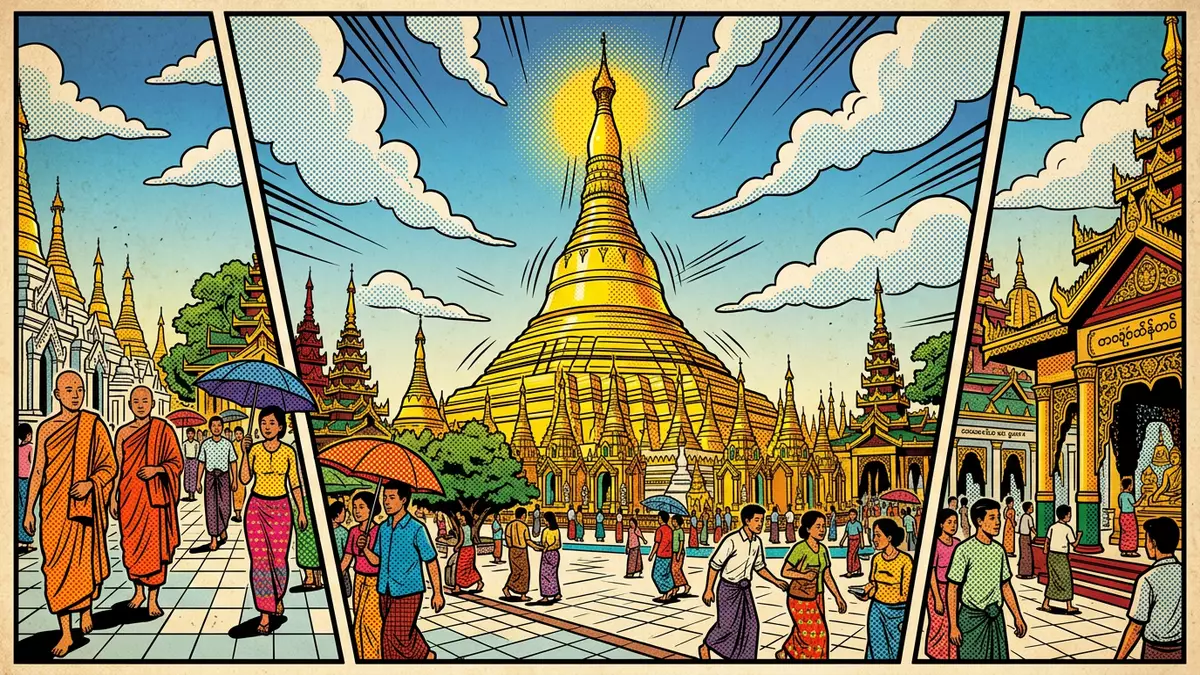
Shwedagon Pagoda is the great gilded stupa on Singuttara Hill that dominates the skyline of Yangon, Myanmar, its bright surface marking one of the most revered Buddhist sites in the country.Singuttara Hill in Yangon The complex gathers shrines, stupas and halls around a central tower whose form and golden cladding have been shaped across many centuries.
A golden stupa raised over sacred relics
The heart of Shwedagon Pagoda is a solid stupa, an unenterable reliquary that rises above a series of terraces on the summit of Singuttara Hill.Buddhist stupa type Its role is to enshrine relics associated with four Buddhas of the present world age, a core reason for the site’s religious standing.relics of four Buddhas Traditions speak of eight strands of hair from Gautama Buddha, together with a staff, a water filter and a robe linked to earlier Buddhas, sealed inside the structure as part of a layered reliquary arrangement.staff, water filter and robe
Legend dates the foundation of Shwedagon Pagoda more than 2,500 years ago, during the lifetime of Gautama Buddha, while archaeological research places the first substantial stupa on the hill between the sixth and tenth centuries AD.between the sixth and tenth centuries Later royal chronicles and inscriptions record how successive rulers of the Mon and Burmese kingdoms enlarged and repaired the tower, linking the monument with a long sequence of patrons rather than a single founding figure.royal attention over centuries
Queen Shin Saw Pu, King Hsinbyushin and a changing silhouette
The visible form of Shwedagon Pagoda owes much to late medieval and early modern rulers, whose interventions increased its height and changed the hill into a layered platform of religious architecture. In the fifteenth century, Queen Shin Saw Pu of the Hanthawaddy kingdom raised the stupa to a recorded height of 302 ft, an enlargement that strengthened its visual presence over Yangon and established a precedent for gilding the structure.302 ft under Queen Shin Saw Pu She is associated with contributions of gold to cover the tower, tying the building’s bright surface directly to royal patronage.gold offered by Queen Shin Saw Pu
In 1774, after earthquake damage in the eighteenth century, King Hsinbyushin of the Konbaung dynasty had the pagoda raised again to a height recorded as about 99 m (326 ft), a figure that defines the present stupa.current height of 326 ft From the hilltop, the gilded tower rises above a base ringed with smaller pagodas, prayer halls and pavilions that frame views of the main stupa from different angles. This layered composition of one dominant tower and multiple subsidiary structures gives the complex its distinctive profile when seen against the urban plain below.hundreds of temples and stupas
A religious and civic landmark for Yangon
Shwedagon Pagoda stands on Singuttara Hill west of Kandawgyi Lake, rising above central Yangon and acting as both a religious focal point and a landmark visible from many parts of the city.location west of Royal Lake The hilltop is approached by covered stairways and access routes from several sides, each bringing visitors up through lines of smaller shrines towards the main platform.
Beyond its role in Buddhist worship, the site has also served as a stage for political and civic events. During the nineteenth century, British colonial forces occupied the hilltop complex for extended periods, using the raised platform and its structures as a fortified position.British occupation of the hilltop In the twentieth century, gatherings related to the independence movement and later political life took place around the pagoda, embedding national memory in a space that is otherwise oriented towards religious ritual.civic role in the twentieth century
Visiting Shwedagon Pagoda: what travellers from Western Europe should know
- Shwedagon Pagoda stands on Singuttara Hill to the west of Kandawgyi Lake in central Yangon, reached by road and by covered stairways rising from surrounding streets.
- The main platforms lie on a raised hilltop; approaches involve significant climbs on stairways, and movement around the complex includes steps between terraces and shrine clusters.
- English is used alongside Burmese in many information panels, but the official language is Burmese and the currency is the Myanmar kyat.
- Yangon’s humid tropical climate means that exposed surfaces around the hilltop can feel hot during the day, while the covered stairways provide shade along the ascents.
- Entry requirements depend on your nationality; UK travellers can check the FCDO travel advice at gov.uk/foreign-travel-advice, Irish travellers the Department of Foreign Affairs at ireland.ie.
Searching for Shwedagon Pagoda on social platforms
These links open searches for Shwedagon Pagoda on each platform.
Frequently asked questions about Shwedagon Pagoda
Where is Shwedagon Pagoda located?
Shwedagon Pagoda stands on Singuttara Hill in central Yangon, Myanmar, to the west of Kandawgyi Lake and above surrounding urban districts.
What should visitors expect on a visit?
Visitors encounter a large hilltop platform with the central gilded stupa surrounded by numerous shrines, pagodas and prayer halls, reached by stairways from several sides.
What makes Shwedagon Pagoda distinctive among Buddhist sites?
Its prominence over Yangon, the height of its gilded stupa and the traditional association with relics from four Buddhas together give the pagoda a distinctive character.


