
Sirmione and the castle standing in Lake Garda
Published on 09/23/2026 at 02:37 | Editorial responsibility: Rafael Müller, Editor-in-Chief AD HOC NEWS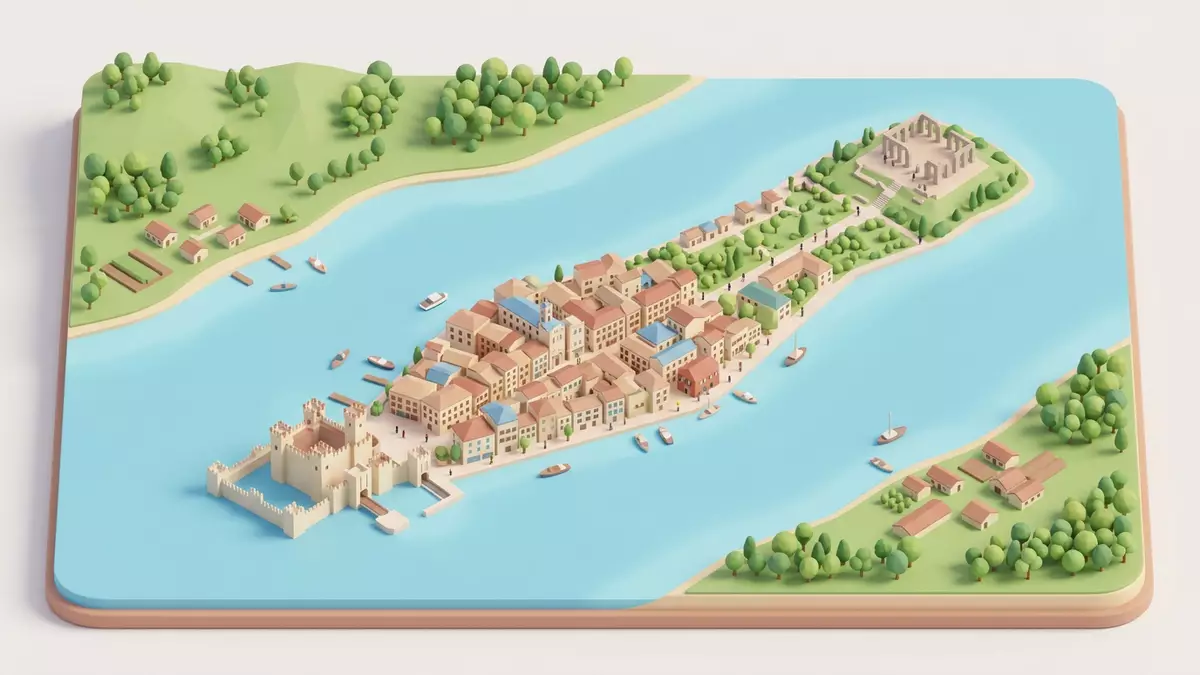
Sirmione extends into the southern part of Lake Garda as a narrow peninsula of water, stone and layered history. At its entrance, the medieval Scaliger Castle rises beside the lake, while the Roman remains of the Grotte di Catullo occupy the peninsula’s northern end.
Sirmione’s water-bound Scaliger Castle
The Rocca Scaligera is a lakeside fortress associated with the Della Scala family, the rulers of Verona from 1259 to 1387. Its construction belongs to the second half of the fourteenth century, during the period of Cansignorio and Antonio II della Scala.
Its walls, towers, drawbridge and enclosed dock form a compact fortified complex beside the historic centre. The dock remains part of the castle’s design, with water enclosing the small harbour within the defensive structure. A lakeside Scaliger fortress therefore introduces Sirmione through both medieval architecture and the surface of Lake Garda.
From Roman villa to peninsula landscape
At the far end of Sirmione, the Grotte di Catullo preserve the remains of a large Roman villa dating from the first century AD. The name connects the site with the poet Gaius Valerius Catullus, whose family had links with the area.
The surviving complex includes terraces, walls, columns and fragments of decorative work spread across a broad archaeological landscape. The term “grotte” refers to the appearance of the ruined structures, whose vaulted remains resemble natural caves. An archaeological site at the peninsula’s tip places Roman domestic architecture beside the lake’s open horizon.
Streets, water and thermal history
The historic centre gathers around narrow streets, small squares and buildings close to the shoreline. The castle marks the approach to the old town, while the peninsula continues towards olive trees, cypresses and the Roman ruins.
Sirmione also has a long association with thermal water. Springs beneath Lake Garda are connected with the town’s spa tradition, and the peninsula’s identity combines Roman leisure, medieval fortification and lakeside settlement.
The town’s historical layers are unusually close together. A Roman villa, a medieval fortress, parish churches and thermal facilities belong to the same compact peninsula. The result is a place read through materials and structures rather than through a single period.
Visiting Sirmione: what travellers from Western Europe should know
- Sirmione lies in the southern Garda Lake area, in Lombardy’s province of Brescia. The nearest railway stations are Desenzano del Garda and Peschiera del Garda, with bus and taxi connections to the town.
- The historic centre begins beside the castle and continues along a narrow peninsula. The walk towards the Grotte di Catullo includes paved streets, uneven surfaces and archaeological paths.
- Lake Garda surrounds the peninsula on several sides. Ferries and boats connect Sirmione with other lakeside settlements, while road access reaches the town from the southern shore.
- The official language is Italian and the currency is the euro.
Searching for Sirmione on social platforms
These links open searches for Sirmione on each platform.
Frequently asked questions about Sirmione
Where is Sirmione?
Sirmione is in northern Italy, on a peninsula projecting into the southern part of Lake Garda. It belongs to Lombardy’s province of Brescia.
What can visitors see in Sirmione?
The main historic sights are the Scaliger Castle at the entrance to the old town and the Roman villa remains known as the Grotte di Catullo.
What makes Sirmione distinctive?
Sirmione brings together a medieval fortress with an enclosed lakeside dock, Roman villa ruins, thermal water and a narrow peninsula landscape.


