
Souq Waqif keeps Doha’s market lanes in traditional form
Published on 09/22/2026 at 11:16 | Editorial responsibility: Rafael Müller, Editor-in-Chief AD HOC NEWS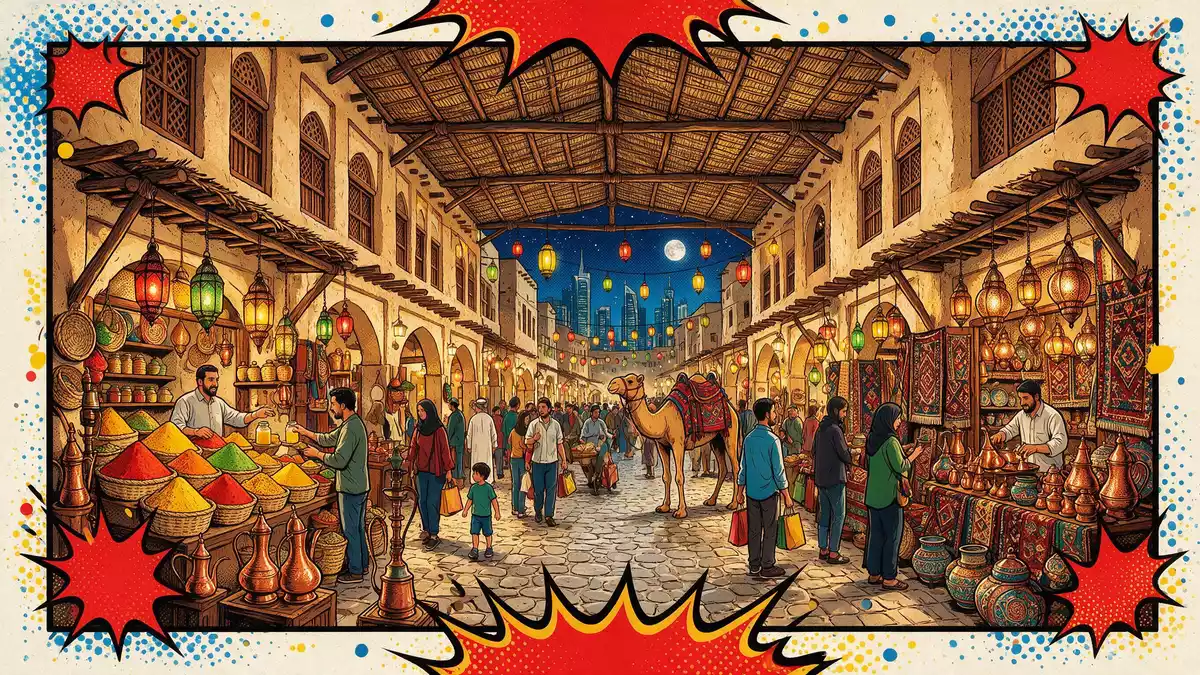
Souq Waqif is a market district in central Doha where narrow lanes run between low-rise buildings of mud-rendered walls, timber beams and covered passageways. Its visible character comes from the contrast between traditional Qatari construction and the towers of the surrounding city.
The market occupies a historic trading site beside Wadi Musheireb. Its present form connects a late nineteenth- and early twentieth-century marketplace with a restored urban quarter of shops, workshops, cafés and restaurants.
Souq Waqif’s lanes and traditional materials
The buildings remain close to the ground, with façades finished in earth-coloured plaster and passages arranged around courtyards and small open spaces. Timber projects from walls and roofs, while woven materials, clay and straw appear in the construction language.
The roofscape is part of the market’s identity. Mangrove or dangeal wood, bamboo and layers of clay and straw recall building methods associated with the Gulf. The materials give the lanes a textured appearance that differs from Doha’s glass-and-steel skyline.
Shops occupy the passageways rather than a single enclosed hall. The district includes stalls for spices, textiles, perfumes, jewellery and handicrafts, alongside food outlets and workshops. The arrangement keeps trading, eating and browsing within the same network of lanes.
From a trading site to a restored urban quarter
The market was active by the late nineteenth and early twentieth centuries, when Bedouin traders and Doha residents exchanged livestock, wool, fish, pearls, spices and everyday provisions. The Arabic word waqif means “standing”, linking the name with merchants who conducted business on their feet near the wadi.
Souq Waqif changed substantially during Doha’s rapid economic growth. Much of the older market was destroyed by fire in 2003, and a restoration programme began in 2006. The rebuilt complex retained a traditional street pattern and materials associated with Qatari architecture.
The major restoration was completed in 2008. Its buildings combine commercial uses with a setting that recalls the scale and appearance of an older souq, while galleries, cultural venues and restaurants extend the district beyond retail.
The market’s history is tied to Doha’s position between the coast and the desert. Goods associated with maritime trade stood alongside products brought by travelling communities. Souq Waqif’s earlier trading role remains visible in the range of goods and specialist shops found within the lanes.
What the market contains today
Souq Waqif is organised as a collection of specialised areas rather than a single uniform marketplace. Textile shops display fabrics and garments, spice merchants sell coloured powders and dried ingredients, and perfume shops offer oils and incense. Craft workshops add metalwork, woodwork and other handmade objects to the commercial mix.
Food is another major part of the district. Restaurants and cafés occupy courtyards, arcades and side streets, with menus reflecting Qatari, Gulf, Middle Eastern and wider regional traditions. The market also contains spaces associated with music, art and cultural programming.
Animal-related trading has a long connection with the site, and the district includes areas associated with falcons and horses. These spaces provide a direct link to practices that formed part of life in Qatar before Doha developed into a high-rise capital.
The market sits close to the Corniche and Doha’s central districts. The market’s central setting places traditional lanes near the waterfront and the city’s contemporary commercial areas.
The restored buildings are not isolated monuments. They form an active district with shops at street level, shaded routes, courtyards, dining spaces and cultural venues. The result is a market whose architecture and daily uses remain closely connected.
Souq Waqif’s materials also make its identity easy to read. Mud-rendered walls, exposed timber and low roofs create a continuous visual language across the district. Traditional construction materials were central to the restoration of the market’s historic appearance.
Visiting Souq Waqif: what travellers from Western Europe should know
- Souq Waqif lies in central Doha near the Corniche, Wadi Musheireb and Al Jasra. Doha Metro’s Gold Line serves Souq Waqif station.
- The district consists of narrow lanes, covered passages and courtyards. Comfortable walking shoes are useful because the market is explored on foot across uneven paving.
- The official language is Arabic and the currency is the Qatari riyal.
- Souq Waqif is close to the Museum of Islamic Art, the National Museum of Qatar and Doha’s waterfront districts.
Searching for Souq Waqif on social platforms
These links open searches for Souq Waqif on each platform.
Frequently asked questions about Souq Waqif
Where is Souq Waqif?
Souq Waqif is in central Doha near the Corniche, Wadi Musheireb and Al Jasra. The district is also close to Doha’s waterfront museums and central urban quarters.
What can visitors expect at the market?
Visitors find narrow lanes, low-rise buildings, specialist shops, workshops, restaurants and cafés. Spices, textiles, perfumes, handicrafts, falcons and regional food are among the market’s established features.
What makes Souq Waqif distinctive?
Its distinctive character comes from traditional Qatari materials and a restored market layout. Mud-rendered walls, timber roofs and covered lanes place Doha’s trading history within a contemporary capital.


