
Sri Dalada Maligawa and the layered courtyards of Kandy’s Tooth Temple
Published on 08/12/2026 at 13:52 | Editorial responsibility: Rafael Müller, Editor-in-Chief AD HOC NEWS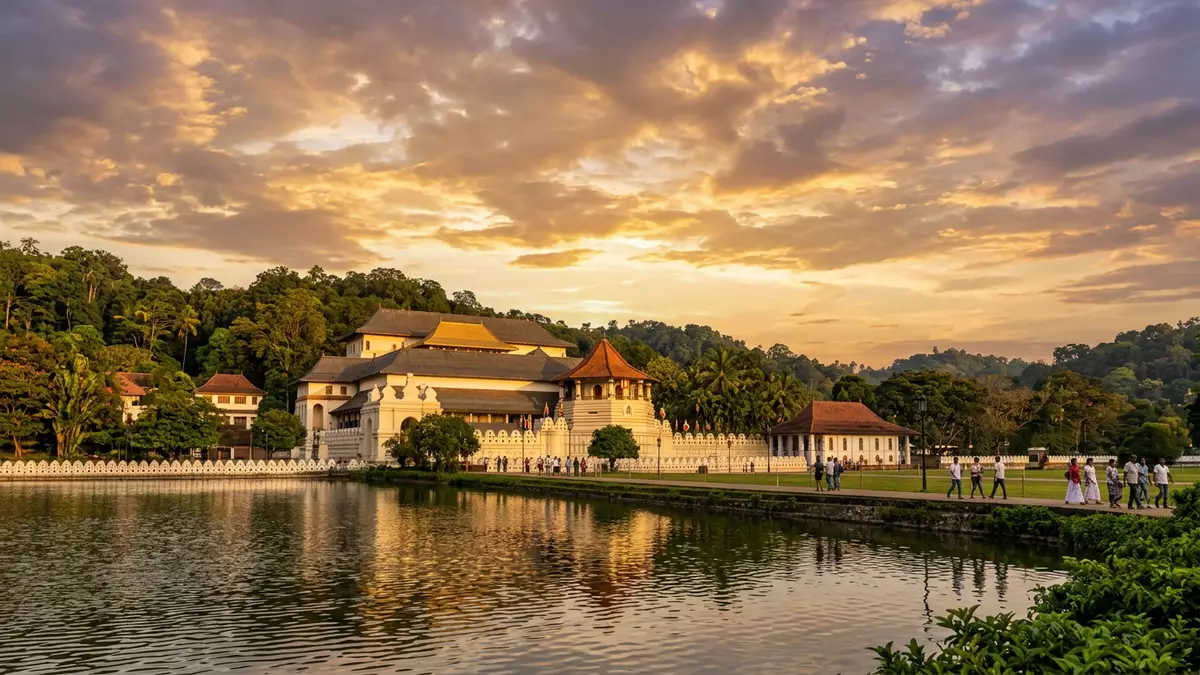
Sri Dalada Maligawa, known in English as the Temple of the Sacred Tooth Relic, is the Buddhist shrine at the heart of Kandy where a tooth of the Buddha is enshrined. Set within the old royal palace complex of the former Kingdom of Kandy and recognised as part of the Sacred City of Kandy UNESCO World Heritage Site, it combines royal architecture, ritual spaces and layered courtyards in a single compact ensemble.
Royal palace setting and sacred status
The core of Sri Dalada Maligawa stands in the palace precinct of Kandy, the last royal capital of the Sinhala kings before British rule in the nineteenth century.Royal palace complex in Kandy The main shrine rises close to Kandy Lake, with the former royal residence to one side and the Udawatta Kele forest reserve on the slope behind.Situated near Kandy Lake and Udawatta Kele
The temple forms the spiritual focus of the Sacred City of Kandy, which was inscribed as a UNESCO World Heritage Site in 1988 for its combination of palace, monastic buildings and the shrine housing the Sacred Tooth Relic.Sacred City of Kandy UNESCO inscription Within this complex, Sri Dalada Maligawa has long been associated with royal authority, because possession of the relic was linked to the legitimacy of the island’s rulers during the Kandyan kingdom.
The Sacred Tooth Relic and its layered shrines
The focal point of the entire complex is the Sacred Tooth Relic of Gautama Buddha, traditionally described as a left canine, which is kept sealed within nested reliquaries inside the main shrine.Relic of the Buddha’s tooth Visitors move through halls and corridors towards the inner sanctum, but the relic itself is not directly visible, remaining enclosed within its caskets.
The shrine that houses the relic is known as the Vedahitina Maligava and stands at the centre of the complex as a multi-storey structure surrounded by verandas and supporting halls.Vedahitina Maligava central shrine Around it, other buildings such as the Pattirippuwa, or Octagon, and the Aluth Maligawa form additional layers of worship and reception spaces that wrap the core shrine in further architectural shells.
Kandyan architecture in wood, stone and plaster
Sri Dalada Maligawa is a showcase of Kandyan-period architecture, combining timber columns, whitewashed walls and tiled roofs across its halls and courtyards.Kandyan-period temple architecture The Magul Maduwa, or Audience Hall, nearby is lined with carved wooden pillars that demonstrate the detailed woodcarving associated with the Kandyan royal court.Magul Maduwa wooden pillars
The Pattirippuwa projects from the temple complex as an octagonal pavilion attached to the palace side, which gained its current form under King Sri Wickrama Rajasingha in the early nineteenth century.Pattirippuwa octagonal pavilion The blend of enclosed rooms, pillared halls and balconies creates a sequence of sheltered spaces that frame views over Kandy Lake and the temple forecourts.
Ritual rhythms and daily life around the courtyards
The layered courtyards of Sri Dalada Maligawa are structured around daily rituals, with devotees bringing flowers and offerings into the inner halls while others circulate through outer terraces and cloisters. The approach leads across gateways and stepped platforms towards the main shrine, where lines form in front of doors that are opened at set times for the casket containing the relic to be displayed.
Beyond the central shrine, the wider complex includes museums and subsidiary shrines that reflect the role of the Tooth Relic in Sri Lankan Buddhist history. Kandy itself spreads out around the lake below, so that from the temple’s upper levels the city, the water and the wooded hillsides form a continuous backdrop to the courtyards and tiled roofs.
Visiting Sri Dalada Maligawa: what travellers from Western Europe should know
- Sri Dalada Maligawa stands in central Kandy on the shore of Kandy Lake, within the historic royal palace complex that forms part of the Sacred City of Kandy.
- The main approach from the city side leads through gateways and across stone platforms, followed by stairways and interior steps between halls and upper levels.
- The temple complex sits at modest elevation above the lake, with some passages under cover and others in open courtyards that are exposed to the tropical climate.
- Kandy lies in the Central Province of Sri Lanka, and the city is linked to Colombo and other regions by road and rail connections that converge near the lake.
- The official languages of Sri Lanka are Sinhala and Tamil, and the currency is the Sri Lankan rupee.
Searching for Sri Dalada Maligawa on social platforms
These links open searches for Sri Dalada Maligawa on each platform.
Frequently asked questions about Sri Dalada Maligawa
Where is Sri Dalada Maligawa located?
Sri Dalada Maligawa stands within the former royal palace complex in central Kandy, on the shore of Kandy Lake in Sri Lanka’s Central Province.
What should visitors expect inside the temple complex?
Visitors pass through gateways, courtyards and pillared halls towards the multi-storey shrine containing the Sacred Tooth Relic, with additional museums and subsidiary shrines around it.
What makes Sri Dalada Maligawa distinctive among Buddhist temples?
It houses the Sacred Tooth Relic of the Buddha within a royal palace setting, combining Kandyan court architecture with one of Sri Lankan Buddhism’s most revered pilgrimage shrines.


