
Stone Town’s coral streets and layered façades
Published on 08/20/2026 at 13:41 | Editorial responsibility: Rafael Müller, Editor-in-Chief AD HOC NEWS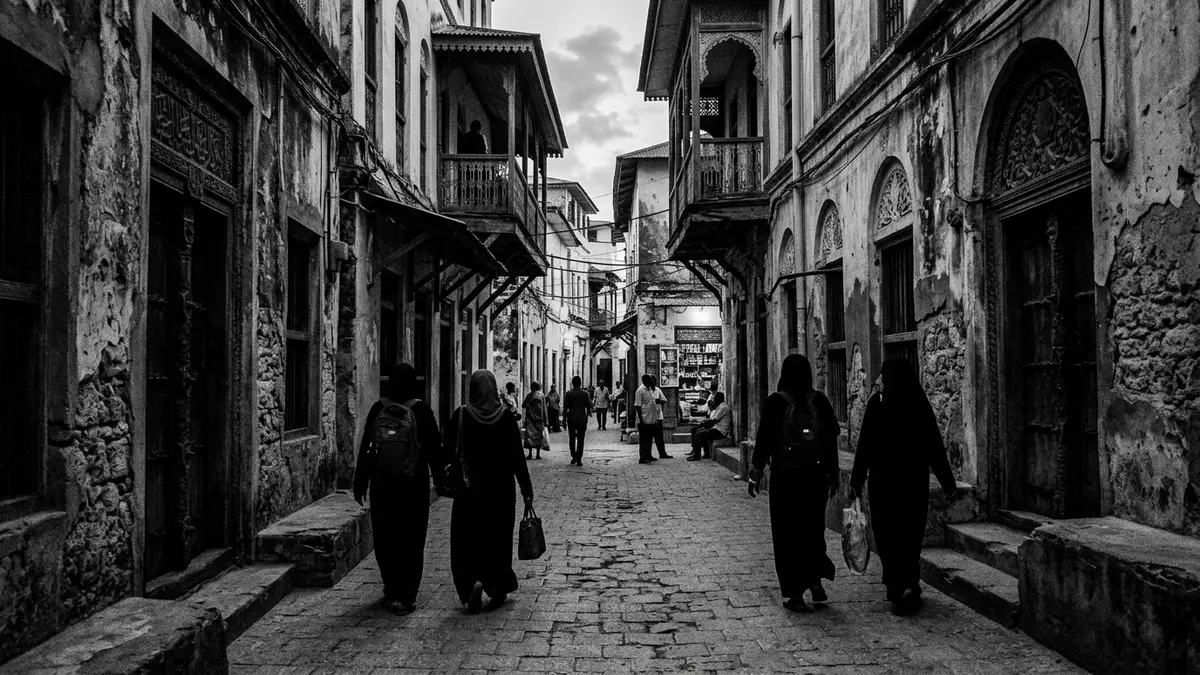
Stone Town in Sansibar is the historic quarter of Zanzibar City, and its streets are lined with coral-stone buildings, carved doors and seafront houses. The town was inscribed as a UNESCO World Heritage Site in 2000, and Sultan Barghash’s House of Wonders remains one of its best-known landmarks.
Coral stone, carved timber and tight streets
The urban fabric is compact and varied. Swahili courtyard houses stand beside narrow Indian shopfronts, while larger mansions face the sea and fit into a townscape that has stayed largely intact.
The common building palette includes coral rag masonry, lime mortar, plaster and lime wash, with mangrove timber used in many structures. Carved wooden doors, verandahs and flat terrace roofs give the quarter much of its visual character.
Omani rule and a nineteenth-century townscape
Stone Town took on its clearly urban form under Omani rule. Archnet describes a steady expansion from 1830, when stone buildings began to appear in significant numbers, and the same period brought palaces, residences, bazaars and warehouses.
Several named monuments belong to that era or the one before it. The Old Fort began under Portuguese control and later took its present form under the Sultanate of Oman, while the House of Wonders was built for Sultan Barghash in 1883 and the Old Dispensary dates from 1887.
The town also carries the memory of slavery and abolition. Christ Church Anglican Cathedral stands on the site of the last slave market, and the urban setting keeps that history visible beside mosques, palaces and merchant houses.
A Swahili port with many cultural layers
UNESCO characterises Stone Town as a fine example of the Swahili coastal trading towns of East Africa. Its buildings and street pattern reflect a long exchange between Africa, the Arab region, India and Europe over more than a millennium.
That mix appears in the town’s ordinary architecture as much as in its monuments. The two-storey courtyard houses, the bazaar streets and the seafront mansions belong to a port city shaped by commerce, migration and adaptation across generations.
The result is a place where the street plan, the masonry and the decorative details all carry the same story. Stone Town reads as an urban ensemble rather than a single monument, and that is what makes the quarter compelling to walk through.
Visiting Stone Town: what travellers from Western Europe should know
- Stone Town lies on the western side of Zanzibar Island, within Zanzibar City in Tansania. It is reached through Zanzibar’s transport network and the streets of the old quarter on foot.
- The historic core is compact, with narrow streets and many close-set façades. Coral masonry, uneven paving and steps appear frequently in the old lanes.
- The quarter sits on a coral peninsula beside the sea. The seafront, courtyards and bazaar streets form the main parts of the historic fabric.
- The official language is Swahili and the currency is the Tanzanian shilling.
- Entry requirements depend on your nationality; UK travellers can check the FCDO travel advice at gov.uk/foreign-travel-advice, Irish travellers the Department of Foreign Affairs at ireland.ie.
Searching for Stone Town on social platforms
These links open searches for Stone Town on each platform.
Frequently asked questions about Stone Town
Where is Stone Town?
Stone Town is the historic centre of Zanzibar City on Zanzibar Island in Sansibar, part of Tansania. It occupies the old seafront quarter on a coral peninsula.
What does a visit involve?
The place is a dense old town of lanes, courtyards and seafront buildings. Coral masonry, carved timber and mixed religious and commercial buildings give it a layered urban character.
What makes Stone Town distinctive?
Its distinction lies in the survival of a Swahili trading town with Arab, Indian and European influences. UNESCO lists it as a World Heritage Site for that urban and cultural ensemble.


