
Stone Town’s coral streets and Swahili heritage in Sansibar
Published on 09/22/2026 at 04:27 | Editorial responsibility: Rafael Müller, Editor-in-Chief AD HOC NEWS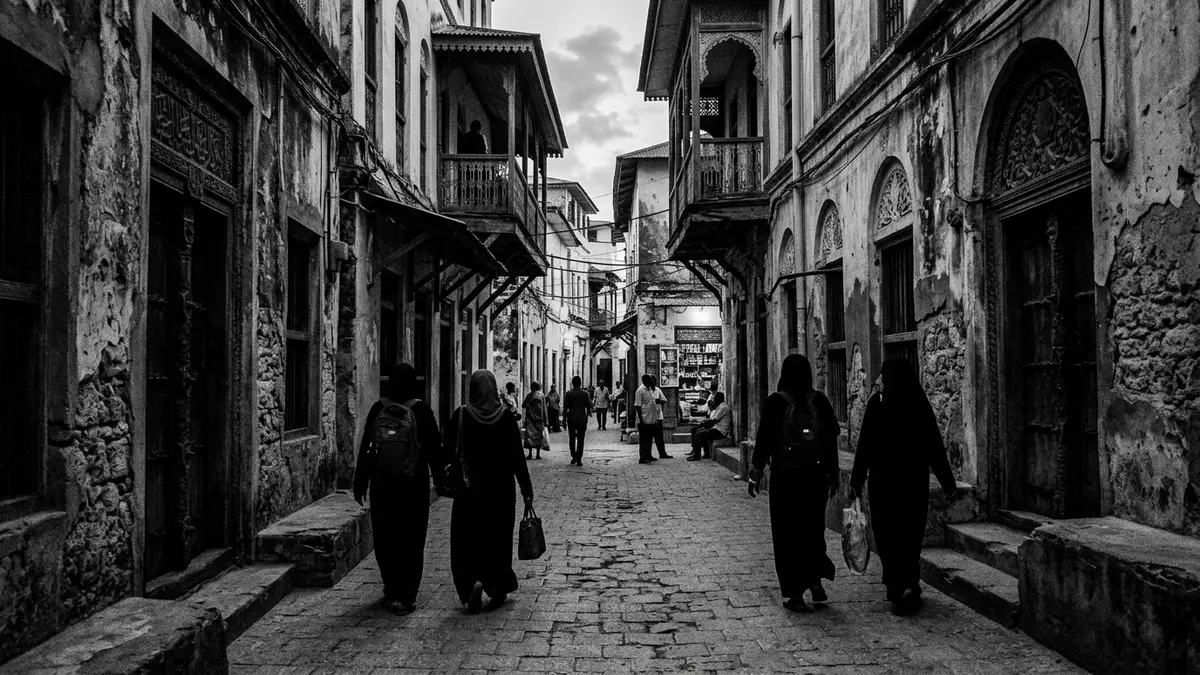
Stone Town on the island of Zanzibar in Tanzania is the historic core of Zanzibar City, a dense Swahili coastal town built in coral stone and known for its carved wooden doors and winding alleys. Its present urban form largely dates to the eighteenth and nineteenth centuries, when it served as the capital of the Sultanate of Zanzibar and a centre of Indian Ocean trade.
Coral stone fabric and Swahili townscape
Stone Town occupies a low coral peninsula on the western side of Unguja, the main island of Zanzibar, facing the channel towards mainland East Africa. The historic streets are lined with houses and public buildings constructed mainly from coralline ragstone and mangrove timber, set in lime mortar and finished with lime plaster, giving many facades a pale, weathered surface against which doorways and balconies stand out.coralline ragstone and mangrove timber
The core street pattern grew as an intertwined network of narrow lanes and small squares, with the seafront forming one edge and the line of the former creek marking another. In the nineteenth century stone buildings expanded from the northern tip at Shangani across areas such as Kiponda and Malindi, creating a continuous urban fabric in which houses, mosques, warehouses and civic buildings stand side by side.expanded across Shangani and Kiponda Many houses rise several storeys, with projecting verandas and enclosed upper rooms overlooking the lanes, giving the town a vertical profile above its ground-level shops and passageways.
Layers of trade, religion and architecture
Settlement on the peninsula is attested from the eleventh century, linked to Swahili communities trading along the East African coast, but the stone urban character developed markedly from the early nineteenth century.Swahili people have lived along the peninsula since at least the 11th century In the early sixteenth century the Portuguese Empire established fortifications at the harbour, and the foundations of the Old Fort, also known as Ngome Kongwe, date to that period.Old Fort During the seventeenth century political authority shifted to the Sultanate of Oman, whose rulers later moved their seat to Zanzibar and made Stone Town their capital in the nineteenth century.former capital of the Sultanate of Zanzibar
This history appears directly in the town’s built fabric. Along the waterfront stand palaces and ceremonial buildings, including the House of Wonders, a grand palace commissioned by Sultan Barghash in the nineteenth century, and nearby the Old Dispensary with its richly decorated facade.House of Wonders and Old Dispensary Churches such as St Joseph’s Roman Catholic Cathedral and Christ Church Anglican Cathedral mark the presence of European missions and communities, while mosques including Malindi Mosque and the Jamat Khan reflect long-standing Islamic traditions and Indian influences in religious architecture.Malindi Mosque and Christ Church Cathedral
UNESCO recognition and carved doors
Stone Town of Zanzibar was inscribed as a UNESCO World Heritage Site in 2000 for its outstanding universal value as a Swahili coastal trading town that fuses African, Arab, Indian and European cultural influences over more than a millennium.inscribed as a UNESCO World Heritage Site in 2000 Its urban fabric remains largely intact, with hundreds of historic buildings still occupied and used as homes, shops, religious spaces and public institutions.
One of the most recognisable features of Stone Town is its carved wooden doors. These large hardwood doors, often framed by heavy lintels and decorated with intricate patterns and inscriptions, front many houses and merchant residences, and stand as distinctive examples of Swahili craftsmanship drawing on Indian and Arab decorative traditions.large and ornately carved wooden doors Behind them, interior layouts with central courtyards, galleries and rooftop terraces show how imported ideas and local building techniques were combined to suit the coastal climate and the social life of the town.
Visiting Stone Town: what travellers from Western Europe should know
- Stone Town forms the historic centre of Zanzibar City on Unguja, reached by air to Zanzibar’s main airport near the town and by ferries across the channel from Dar es Salaam.
- The streets within the old town are narrow, irregular and paved, with numerous steps and passageways; exploring the area involves walking between closely spaced buildings and through covered alleys.
- The seafront is bordered by open spaces such as Forodhani Gardens and the harbour area, while inland markets and religious buildings stand within the dense urban blocks.
- The official language is Swahili and the currency is the Tanzanian shilling.
- Entry requirements depend on your nationality; UK travellers can check the FCDO travel advice at gov.uk/foreign-travel-advice, Irish travellers the Department of Foreign Affairs at ireland.ie.
Searching for Stone Town on social platforms
These links open searches for Stone Town on each platform.
Frequently asked questions about Stone Town
Where is Stone Town and what kind of place is it?
Stone Town is the historic centre of Zanzibar City on Unguja island in Tanzania, a coastal Swahili town built on a coral peninsula.
What can visitors expect when walking through Stone Town?
Visitors encounter narrow lanes lined with coral stone houses, carved hardwood doors, mosques, churches and former palaces, with seafront gardens and a busy harbour nearby.
What makes Stone Town distinctive among East African coastal towns?
Stone Town is recognised as a UNESCO World Heritage Site for its intact urban fabric and its fusion of African, Arab, Indian and European influences expressed in architecture and town planning.


