
Su Nuraxi and the stone towers of Barumini
Published on 08/22/2026 at 19:50 | Editorial responsibility: Rafael Müller, Editor-in-Chief AD HOC NEWS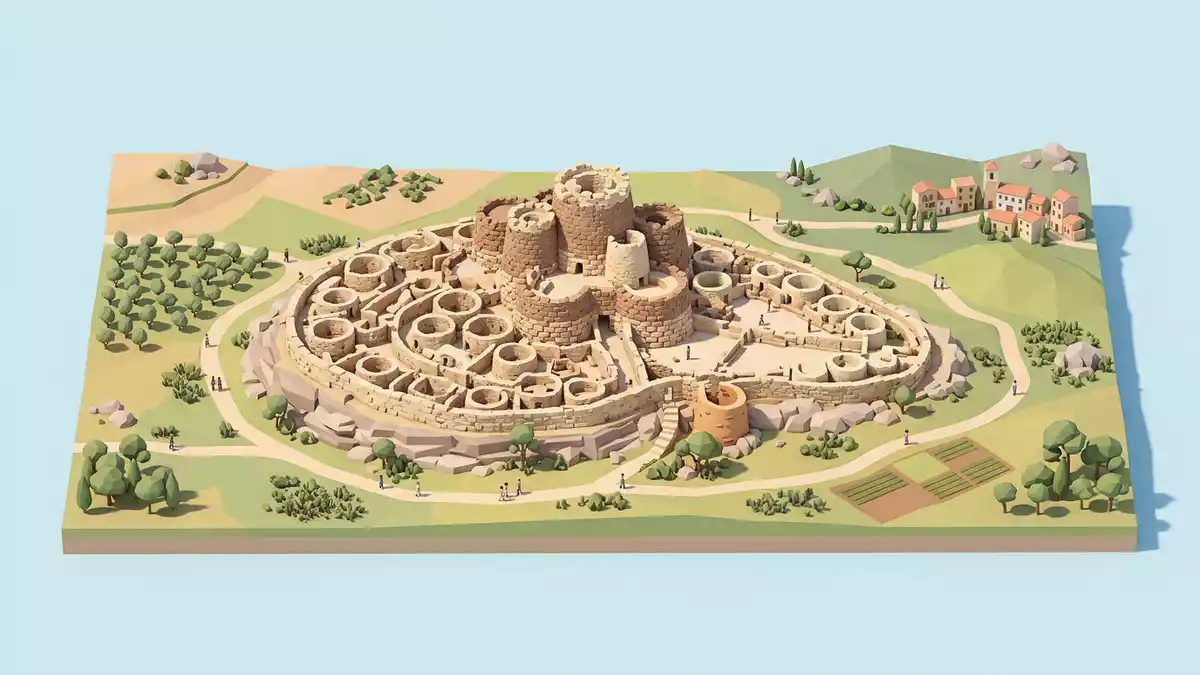
Su Nuraxi in Barumini is a Nuragic complex built from dressed stone, with a central tower, defensive towers and a surrounding village. Its UNESCO inscription in 1997 places it among Sardinia’s key archaeological sites.
Stone towers in the Nuragic landscape
The site’s core form is a megalithic tower complex, with circular towers and corbel-vaulted chambers. The structures belong to the Nuragic civilisation, a Bronze Age culture that left its strongest trace in Sardinia.
Su Nuraxi di Barumini has long been treated as the most complete surviving example of this architectural type. The UNESCO listing identifies it as a major example of nuraghi and dates the World Heritage inscription to 1997.
The complex sits in the Marmilla area of Sardinia, close to Barumini, and forms part of a wider archaeological and cultural landscape. Its stone construction, massing and surviving village remains give the place a dense, layered presence even without any modern embellishment.
Bronze Age masonry and village remains
The main tower, or mastio, belongs to the Middle Bronze Age, around the second millennium BC. Later phases added stronger walls and side towers, while the village expanded around the core structure.
The surviving remains show a settlement that developed over centuries rather than a single isolated monument. Huts, walls and passages create a compact archaeological field where domestic and defensive elements stand side by side.
Barumini’s Su Nuraxi links the fortified centre with the village fabric in a way that is easy to read on site. The place is defined by stone, enclosure and accumulation, not by decoration or monumental scale alone.
Su Nuraxi as a World Heritage site
The UNESCO World Heritage Centre describes the complex as a fine and complete example of prehistoric defensive architecture. The designation also recognises the site’s role as evidence of Nuragic society on the island.
That combination of tower, village and later reinforcement makes Su Nuraxi more than a single ruin. It is an archaeological ensemble in which different building phases remain visible in the fabric of the place.
For travellers interested in early Mediterranean societies, the appeal lies in that clarity of form. The site offers a direct view of Bronze Age Sardinia through masonry, enclosure and settlement remains.
Visiting Su Nuraxi: what travellers from Western Europe should know
- The site lies in Barumini, in central Sardinia, within reach of Cagliari and the Marmilla landscape. Su Nuraxi is the name used for the archaeological complex.
- The ground is uneven and the remains are stone-built, with narrow passages and raised sections in the core area. The old masonry calls for careful footing.
- The official language is Italian and the currency is the euro.
- Su Nuraxi belongs to a wider heritage area that includes other cultural sites in Barumini. The archaeological complex is the main reason for a visit.
Searching for Su Nuraxi on social platforms
These links open searches for Su Nuraxi on each platform.
Frequently asked questions about Su Nuraxi
Where is Su Nuraxi?
It is in Barumini, in Sardinia, in the centre of the island. The archaeological complex forms part of the Nuragic landscape of central Sardinia.
What does a visit involve?
The place consists of stone ruins, towers and the remains of an ancient village. Visitors encounter an archaeological site rather than a polished monument.
What makes Su Nuraxi distinctive?
The central tower, surrounding fortifications and village remains survive together in one complex. The UNESCO listing highlights it as a major example of Nuragic defensive architecture.


