Su Nuraxi, the stone heart of Bronze Age Barumini
Published on 08/06/2026 at 20:14 | Editorial responsibility: Rafael Müller, Editor-in-Chief AD HOC NEWS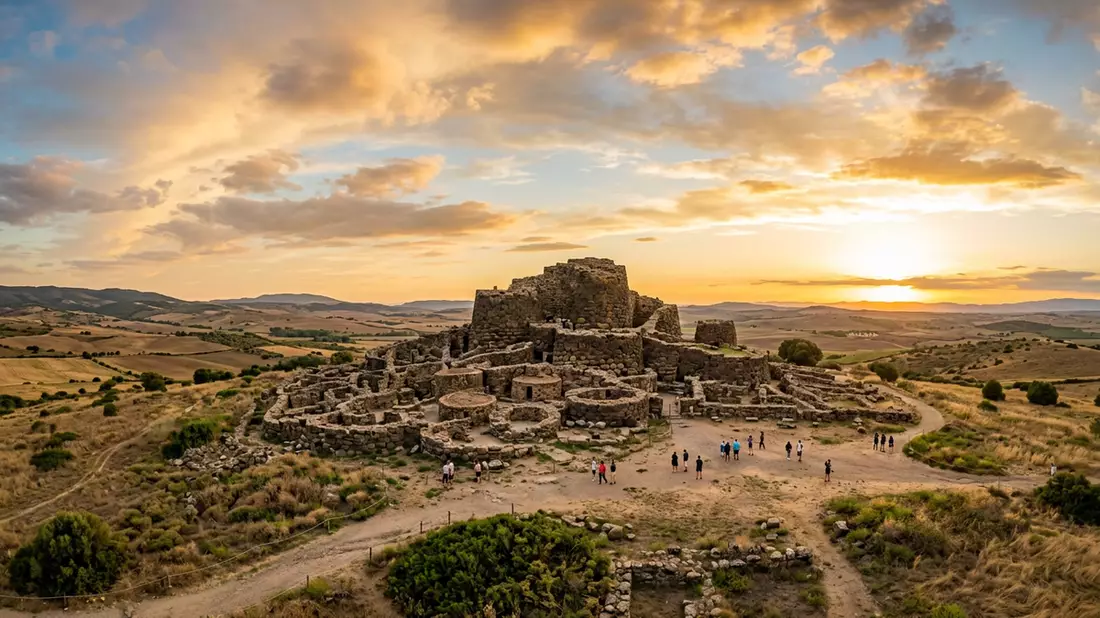
Su Nuraxi near Barumini in Italy is one of the clearest windows onto the Bronze Age civilisation of Sardinia, centred on its massive stone tower and surrounding village. Built in the second millennium BC in the Nuragic period, this fortified complex of dry?stone structures turns a low hill into a dense landscape of towers, walls and dwellings that a visitor can walk through and read in the rock. Recognised as a UNESCO World Heritage Site since 1997, it has become the best?known Nuragic monument on the island and a key reference point for understanding this distinctive prehistoric culture.
The Nuragic core tower and its defensive rings
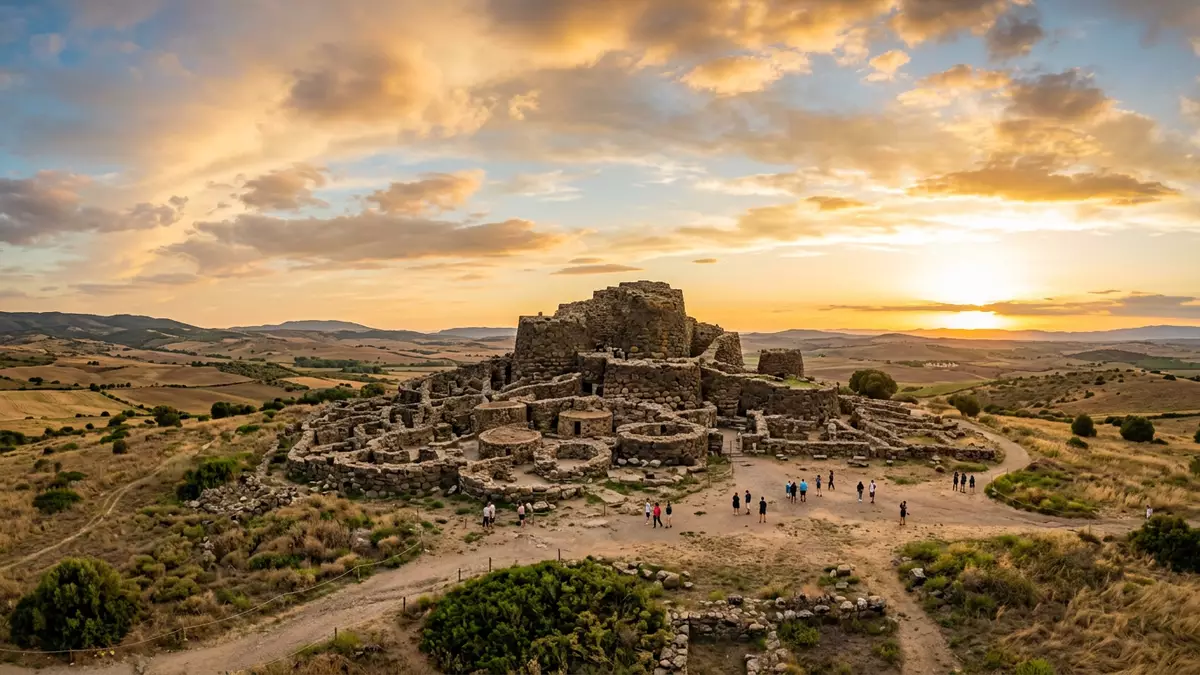
At the heart of Su Nuraxi stands its main nuraghe, a central tower built from large blocks of local basalt carefully stacked without mortar, forming thick walls and a tight internal space. The tower rises from a roughly circular base, giving it a strong vertical emphasis that contrasts with the low agricultural landscape around Barumini. Inside, narrow passages and internal chambers are linked by steep stone steps set within the thickness of the wall, creating a compact maze that rewards close inspection. The masonry shows the characteristic Nuragic technique: carefully shaped outer faces with a more irregular core, producing a rugged texture that catches the light.
Around this main tower, Su Nuraxi is encircled by added bastions and a curtain of defensive walls that turn the core into a compact fortress. The outer defences include subsidiary towers connected by thick walls, together forming a sort of stone crown around the centre. Between these towers and walls, small courtyards and enclosed spaces open up, with traces of hearths and storage areas that hint at the daily use of the stronghold. The overall effect is of a multi?layered defensive system built up over time in the Bronze and early Iron Ages, each phase adding new rings of stone and complexity to the initial core.
The village clustered around the fortress
Beyond the central nuraghe and its immediate defences, Su Nuraxi expands into a surrounding village of stone huts, laid out in close clusters that follow the slope of the hill. These huts are defined by thick dry?stone walls and low doorways, their plans generally rounded or gently polygonal, often organised around a central courtyard or open space. Many of them contain stone benches, niches and the remains of domestic installations such as hearths and basins, giving a tangible sense of how the settlement functioned as a lived?in community around the fortress. The density of structures makes the hilltop feel like a single integrated organism, with domestic life and defence tightly interwoven.
Archaeological investigation in the twentieth century, especially the work led by the Sardinian archaeologist Giovanni Lilliu, revealed multiple phases of construction and occupation at Su Nuraxi, from its Bronze Age origins through later reuse in the Punic and Roman periods. Excavation exposed layers of collapsed masonry, floor surfaces and pottery deposits, allowing the site's history to be read in detail. It is in its present form the result of careful excavation and partial restoration, with some walls consolidated to convey the original volumes without inventing missing elements. Walking through the village, a visitor passes from domestic spaces to communal areas and back again, tracing the rhythm of life on this fortified hill.
Su Nuraxi in the Sardinian landscape
Su Nuraxi occupies a rise in the rolling inland landscape of central Sardinia, near the modern town of Barumini, with views out over agricultural fields and low hills. The choice of a slightly elevated site gives the main tower a clear silhouette against the sky and offers strategic sightlines across the surrounding territory. Approaching the complex, the mass of dark basalt stands out against the lighter soils and vegetation, and the stonework appears almost organic, as if it had grown from the hill itself. The position between different micro?regions of Sardinia underlines its role as a nodal point in past networks of movement and exchange.
Today Su Nuraxi is reached from Barumini by road, and the site is well integrated into regional itineraries that also include the Giara plateau and other Nuragic remains. The surroundings are relatively open, with paths that lead visitors around the outer village and up towards the central tower, giving multiple vantage points on the architecture. Because the complex stands slightly apart from dense modern development, its Bronze Age horizon remains legible: fields, low ridges and occasional farm buildings frame the view rather than urban construction. This setting makes it easier to imagine the site as a focal point within a wider prehistoric landscape of farms, tracks and grazing land.
Visiting Su Nuraxi: what travellers from Western Europe should know
- Su Nuraxi lies near Barumini in central Sardinia, reached from the island's main cities by road; many travellers include it in a wider tour of the region.
- Admission arrangements and opening hours are set by the site's operator and change with the season; the official website is the only binding source.
- The exposed hilltop location and outdoor nature of the ruins mean visits feel different in cooler and warmer months, and daylight is important for appreciating the stonework.
- The site involves walking on uneven stone surfaces, climbing steep steps and negotiating narrow passages inside the tower, so sturdy footwear is advisable.
- On the ground, Italian and Sardinian are widely spoken, with basic English available; card payments are often accepted, and local customs around queuing and greetings follow Italian norms.
- Entry requirements depend on your nationality. UK travellers should check the FCDO travel advice at gov.uk/foreign-travel-advice; Irish travellers the Department of Foreign Affairs at ireland.ie; EU and EEA citizens their own national foreign ministry.
Searching for Su Nuraxi on social platforms
These links open searches for Su Nuraxi on each platform.
Frequently asked questions about Su Nuraxi
Where is Su Nuraxi and how do I get there?
Su Nuraxi is on a hill near Barumini in central Sardinia, Italy, and is reached from Sardinian towns and airports by road with local access routes.
What should I expect when visiting Su Nuraxi?
Expect an extensive archaeological site with a central stone tower, surrounding fortifications and a village of excavated huts, all set on uneven terrain with steep steps.
What makes Su Nuraxi distinctive among Nuragic sites?
Su Nuraxi is distinctive for its combination of a well?preserved central nuraghe, multiple defensive rings, a large surrounding village and its recognised UNESCO World Heritage status.