
Suchitoto: cobblestones, lake light and colonial silhouettes
Published on 08/23/2026 at 13:00 | Editorial responsibility: Rafael Müller, Editor-in-Chief AD HOC NEWS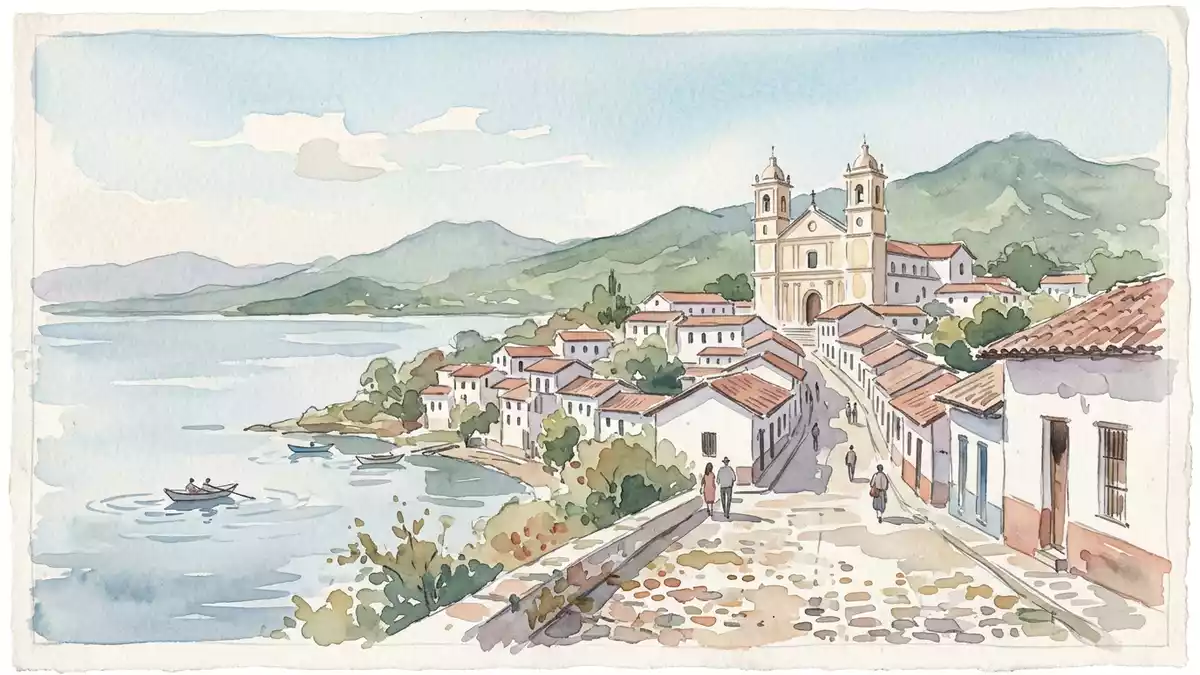
Suchitoto in central El Salvador is a small highland town where cobblestone streets, whitewashed houses and a bright church front gather above the wide surface of Lake Suchitlán. Set within the Cuscatlán Department and linked to the early Spanish foundation of San Salvador in 1528, it offers a compact colonial centre with constant views towards water and distant volcanic ridges.
Cobblestones, white walls and a nineteenth-century church
The heart of Suchitoto is laid out on a regular grid of cobblestone streets bordered by single and two-storey houses with thick walls and clay-tiled roofs. This layout follows the “damero” pattern used by Spanish planners across the region, with straight streets meeting at right angles and a central square in front of the main church.The grid plan with cobbled streets gives the historic centre a clear shape that is easy to trace on foot.
On the main plaza, the Church of Santa Lucía dominates one side with its white facade facing a simple square. The current building was begun in 1853 under the direction of Pío José Araujo and inaugurated in 1857 during the early republican period, replacing earlier structures lost to fire.Its nineteenth-century church shows baroque and rococo influences in its ornamented front, which stands out clearly against the simpler lines of the surrounding homes.
A lakeside town shaped by a reservoir
From the upper streets of Suchitoto the land falls away towards Lake Suchitlán, an artificial lake formed in the 1970s when the Cerrón Grande hydroelectric dam closed on the Lempa River.The town stands on the northern shore of the reservoir, so that many viewpoints look across a broad expanse of water framed by hills. The reservoir has become the largest body of freshwater in El Salvador, and its inlets and islets are a setting for boat trips and birdwatching rather than heavy industry.Lake Suchitlán, also known as the Cerrón Grande Reservoir, links the departments of Chalatenango, Cuscatlán and Cabañas.
The name Suchitlán was coined in the twentieth century by Salvadoran filmmaker and cultural figure Alejandro Cotto by combining elements of “Suchitoto” and “Cuscatlán”, reflecting its roots in the Nahuatl language.The composite name refers to a “place of flowers” and is echoed in translations of Suchitoto itself as “place of flowers and birds”. The result is a town where water, language and settlement history are closely intertwined in the landscape visible from almost every higher corner.
Layers of Nahua, Spanish and contemporary culture
Long before the Spanish arrived, the Suchitoto area formed part of a Nahua-speaking region whose communities left traces in both place names and local traditions.Continuous habitation in the district predates Spanish colonisation, and the early colonial town of San Salvador was briefly founded within this municipal territory in 1528 before the capital shifted elsewhere. Later centuries layered Spanish urban forms and Catholic institutions onto that older landscape, creating the mix of grid streets and indigenous names that defines Suchitoto today.
Since the end of the Salvadoran civil war in the late twentieth century, Suchitoto has developed a reputation as a cultural centre with galleries, small theatres and workshops occupying restored colonial houses.Indigo dyeing, visual arts and film-related events are closely associated with the town, reinforcing its image as a place where historic architecture forms the backdrop to contemporary creativity. Together with the views towards Lake Suchitlán, these cultural spaces give Suchitoto a character distinct from larger Central American cities built in flatter terrain or without a large body of water at their feet.
Visiting Suchitoto: what travellers from Western Europe should know
- Suchitoto lies in the Cuscatlán Department of central El Salvador, north-east of San Salvador, and is reached by road from the capital via routes serving the town.
- The historic centre stands on a hillside above Lake Suchitlán, and walking between the upper streets and lake viewpoints involves noticeable slopes and cobblestone surfaces.
- The town is within a tropical climate zone where the landscape around the lake changes between greener and drier appearances across the year.
- Spanish is the official language and the currency is the United States dollar.
- Entry requirements depend on your nationality; UK travellers can check the FCDO travel advice at gov.uk/foreign-travel-advice, Irish travellers the Department of Foreign Affairs at ireland.ie.
Searching for Suchitoto on social platforms
These links open searches for Suchitoto on each platform.
Frequently asked questions about Suchitoto
Where is Suchitoto in El Salvador?
Suchitoto is a small town in the Cuscatlán Department of central El Salvador, north-east of San Salvador and set on high ground above Lake Suchitlán.
What should visitors expect in Suchitoto?
Visitors encounter cobblestone streets, colonial-era houses, the nineteenth-century Church of Santa Lucía and wide views over a large reservoir with wooded shores.
What makes Suchitoto distinctive among Central American towns?
Suchitoto combines a well-preserved Spanish colonial street grid, an arts-oriented atmosphere and an elevated position overlooking El Salvador’s largest artificial lake.


