
Sukhothai Historical Park and the lotus-bud chedis of Thailand
Published on 09/23/2026 at 09:55 | Editorial responsibility: Rafael Müller, Editor-in-Chief AD HOC NEWS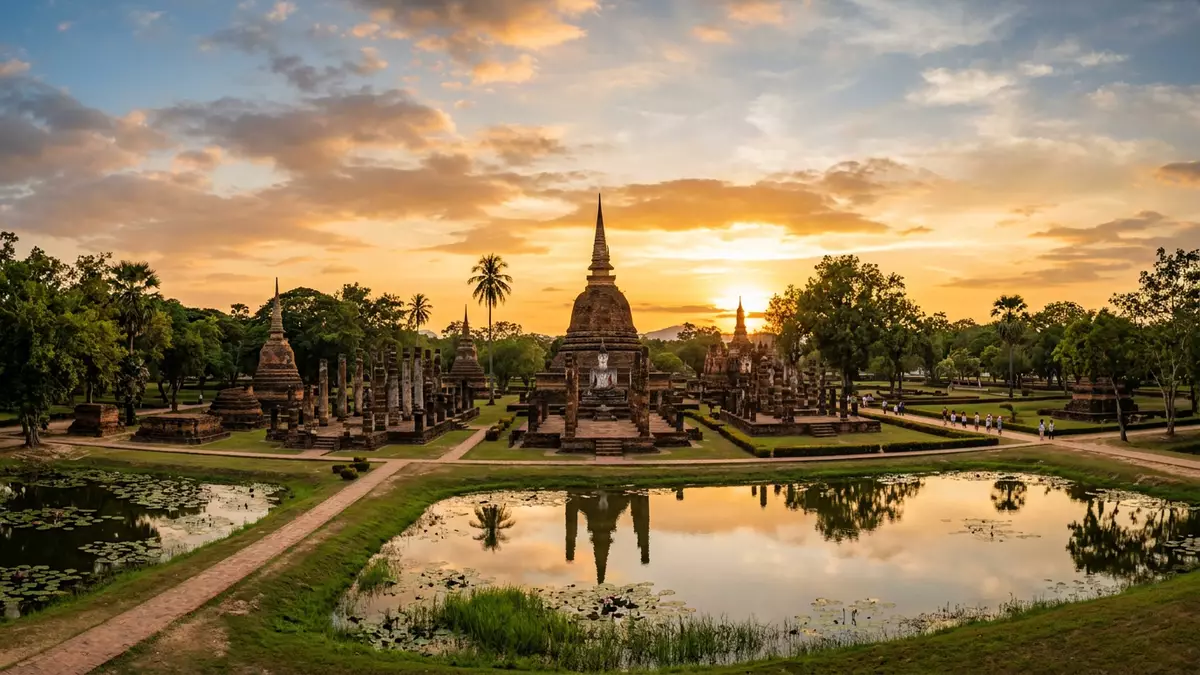
Sukhothai Historical Park spreads across the remains of a walled royal city in northern Thailand. Brick temples, earthen walls, reservoirs and lotus-bud chedis form a landscape shaped by the Sukhothai Kingdom between the thirteenth and fifteenth centuries.
Sukhothai Historical Park inside the old city walls
The central ruins occupy the former urban core of Sukhothai, with temples, ponds, gates and sections of the city wall arranged across a broad archaeological landscape. The historic town was inscribed on the World Heritage List in December 1991 as part of the Historic Town of Sukhothai and Associated Historic Towns. The inscription also includes Si Satchanalai and Kamphaeng Phet, but Sukhothai Historical Park remains the best-known expression of the kingdom’s architectural style.
The inner city has a roughly rectangular plan, with earthen and laterite walls, moats and water reservoirs. The remains of the royal palace and major Buddhist sanctuaries occupy the central area, while additional monuments extend beyond the walls. The layout preserves the relationship between political power, religious buildings and managed water within the medieval city.
Wat Mahathat and Sukhothai’s Buddhist architecture
Wat Mahathat forms the central temple complex, with brick structures, stucco details, ponds and Buddha images spread across its enclosure. Its surviving chedis and columns show the variety of forms used in Sukhothai religious architecture. The lotus-bud chedi, known in Thai as Poom Khao Bin, is among the clearest visual signs of the Sukhothai style.
Sukhothai architecture combines Khmer and Sri Lankan influences with forms that developed within the kingdom. Bell-shaped chedis, seated Buddha images and walking Buddha figures appear alongside earlier architectural elements. The park’s Buddha images are recognised by gently modelled bodies, flowing robes and distinctive gestures. Their placement among brick ruins connects sculpture, ritual space and the open landscape.
From royal capital to protected archaeological landscape
Sukhothai became the centre of a Thai kingdom in the thirteenth century. King Si Inthrathit is associated with the early dynasty, while King Ramkhamhaeng is associated with the kingdom’s expansion and the development of Thai cultural traditions. The period is also linked with the early use of written Thai and with distinctive forms of religious art.
The city’s remains record more than temples. Reservoirs, ponds, canals, dikes and glazed water pipes reveal an urban system connected with water management. Kilns outside the city produced ceramics known as Sangkalok wares, which circulated beyond the kingdom. The Fine Arts Department established the historical park project in the twentieth century, preserving the monuments as an archaeological and cultural landscape.
Visiting Sukhothai Historical Park: what travellers from Western Europe should know
- Sukhothai Historical Park is in Mueang Kao, about 12 km (7.5 miles) west of modern Sukhothai on Highway 12. Local buses, songthaews, tuk-tuks and bicycles connect the modern town with the park.
- The ruins occupy a wide area with walls, ponds, grassy ground and separate temple compounds. Exploring the monuments involves walking outdoors between archaeological sites.
- The central monuments include Wat Mahathat, Wat Si Sawai and Wat Sa Si. Wat Si Sawai retains prang towers linked with Khmer architectural traditions.
- The official language is Thai and the currency is the Thai baht.
- Entry requirements depend on your nationality; UK travellers can check the FCDO travel advice at gov.uk/foreign-travel-advice, Irish travellers the Department of Foreign Affairs at ireland.ie.
Searching for Sukhothai Historical Park on social platforms
These links open searches for Sukhothai Historical Park on each platform.Frequently asked questions about Sukhothai Historical Park
Where is Sukhothai Historical Park?
Sukhothai Historical Park is in Mueang Kao, west of modern Sukhothai in northern Thailand. Highway 12 links the park with Sukhothai and the surrounding province.
What can visitors see there?
The park contains temple ruins, Buddha images, chedis, ponds, moats, city walls and traces of the former royal city. Wat Mahathat, Wat Si Sawai and Wat Sa Si are among its named monuments.
What distinguishes Sukhothai Historical Park?
Its lotus-bud chedis and walking Buddha images belong to the distinctive Sukhothai style. The monuments remain within a planned landscape of walls, waterworks and open archaeological ground.


