
Sukhothai Historical Park and the ruins of royal Sukhothai
Published on 09/09/2026 at 06:06 | Editorial responsibility: Rafael Müller, Editor-in-Chief AD HOC NEWS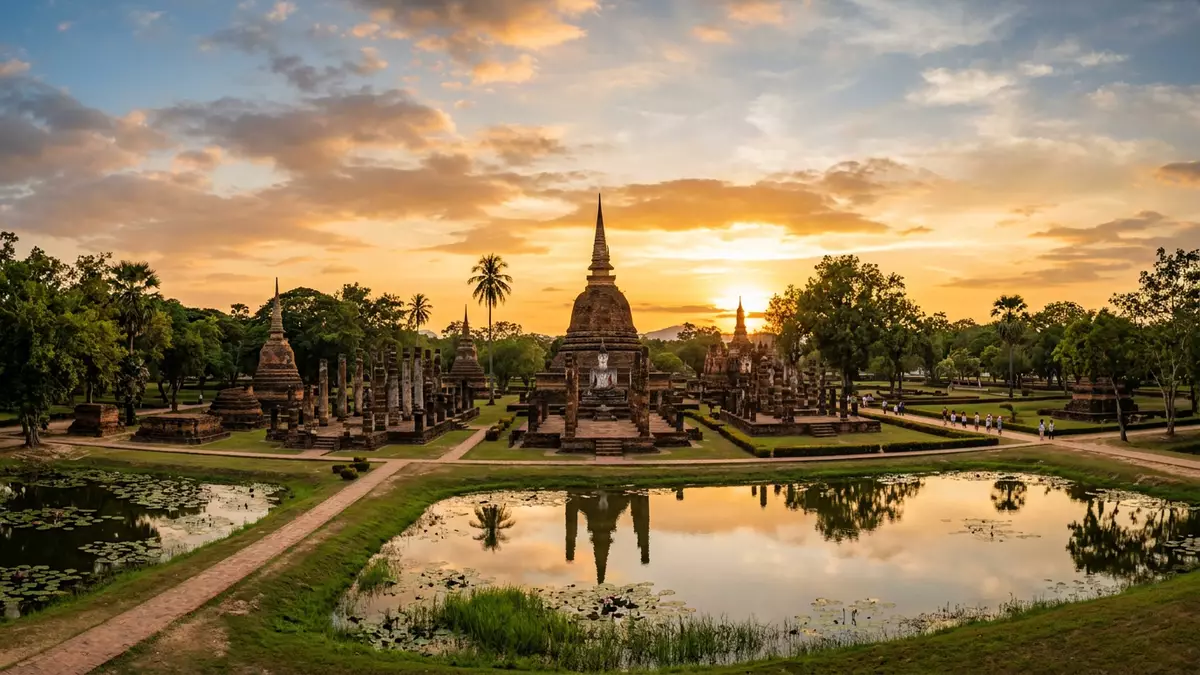
Sukhothai Historical Park spreads across the ruins of the old capital in Sukhothai, in north-central Thailand. Brick temples, lotus ponds and low masonry walls give the site a clear historical outline, with the name Sukhothai tied to the Sukhothai Kingdom and a UNESCO World Heritage designation.
Brick towers and temple compounds
The park’s best-known monuments belong to the city that flourished under Ramkhamhaeng and his successors in the thirteenth and fourteenth centuries. Wat Mahathat, Wat Si Sawai and Wat Sa Si are among the named temple sites that shape the central zone, each marked by brick prangs, chedis and traces of enclosed courtyards.
The material palette is part of the appeal: baked brick, stucco remnants and reflecting water sit together in a broad, low landscape. A second source profile places the park among the remains of the Sukhothai Kingdom, while the same account identifies the area as a major historic town in Thailand.
The Sukhothai Kingdom in stone and water
The park belongs to the Historic Town of Sukhothai and Associated Historic Towns, a serial World Heritage property inscribed in 1991. That listing links Sukhothai with Si Satchanalai and Kamphaeng Phet, and it gives the site a wider regional frame than the park alone.
The visible remains belong to a courtly and religious cityscape rather than a single monument. Visitors encounter temple mounds, standing Buddha images, fragmented walls and the regular lines of ponds and moats that still structure the grounds.
A third World Heritage map identifies the park as a 7,000-hectare component of the listed property, and the park lies in Mueang Sukhothai District.
What survives across the park
The site is best read as a spread-out archaeological landscape. Some monuments stand alone, while others sit inside rectangular enclosures or beside water channels, so the visitor sees both individual shrines and the larger planning of the old city.
Ramkhamhaeng, the king linked with Sukhothai’s political rise, remains one of the strongest names attached to the place. The historical association matters because the park preserves the setting of that early Thai kingdom rather than a single dynastic tomb or palace.
Visiting Sukhothai Historical Park: what travellers from Western Europe should know
- The park lies in Sukhothai, in north-central Thailand. The area is reached through Sukhothai town and the district roads around the historic core.
- The terrain is flat, with long walking stretches between monuments. Brick surfaces, pond edges and open ground are part of the route through the site.
- The official language is Thai and the currency is the Thai baht.
- Entry requirements depend on your nationality; UK travellers can check the FCDO travel advice at gov.uk/foreign-travel-advice, Irish travellers the Department of Foreign Affairs at ireland.ie.
- The World Heritage property includes Sukhothai, Si Satchanalai and Kamphaeng Phet, so the park sits within a wider historic landscape rather than a single enclosed ruin field.
Searching for Sukhothai Historical Park on social platforms
These links open searches for Sukhothai Historical Park on each platform.
Frequently asked questions about Sukhothai Historical Park
Where is Sukhothai Historical Park?
It lies in Sukhothai, in north-central Thailand, and forms part of the Historic Town of Sukhothai and Associated Historic Towns. The park is tied to the ruins of the old capital of the Sukhothai Kingdom.
What does a visit involve?
The site is spread across a broad archaeological landscape of temples, ponds and low walls. Expect ruins arranged across open ground rather than a single compact monument.
What makes it distinctive?
The combination of brick temple remains, water features and the historical frame of the Sukhothai Kingdom defines the park. Its World Heritage status links it with Si Satchanalai and Kamphaeng Phet.


