Sukhothai Historical Park and the stone city of early Siam
Published on 08/18/2026 at 13:16 | Editorial responsibility: Rafael Müller, Editor-in-Chief AD HOC NEWS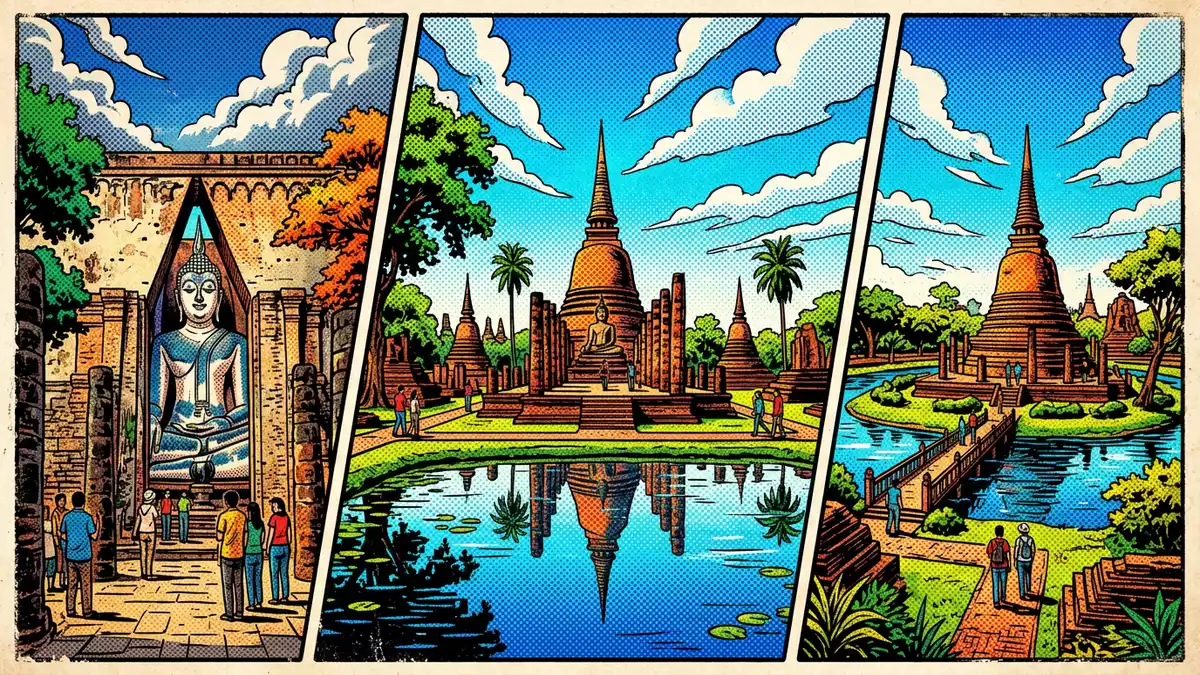
Sukhothai Historical Park in northern Thailand preserves the ruins of Sukhothai, a former capital of an early Thai kingdom in the thirteenth and fourteenth centuries. Within low laterite walls and moats, travellers encounter stone temples, palace platforms and reservoirs that outline a planned city laid out under the Sukhothai kings.
The former capital of the Sukhothai Kingdom
Sukhothai rose as the centre of the Sukhothai Kingdom in the thirteenth century, a formative period for Thai language, religion and political power that many histories describe as an early phase of Siam. The park covers the core of that city, including palace foundations, major Buddhist sanctuaries and the remains of fortifications that once defined the royal centre.covers the ruins of Sukhothai The wider “Historic Town of Sukhothai and Associated Historic Towns” ensemble, which also includes Si Satchanalai and Kamphaeng Phet, is recognised as a World Heritage property, with Sukhothai Historical Park forming one of its three historical parks under the Thai Fine Arts Department.Historic Town of Sukhothai and Associated Historic Towns
Within the old city, the ground plan follows a rectangular grid aligned roughly east?west, enclosed by earthen ramparts faced in laterite and a system of moats. Inside, lines of ponds and reservoirs form a pattern of water management that supported the town and its religious complexes.a rectangle about 2 km east-west by 1.6 km north-south The archaeological area contains a large number of individual ruins spread across tens of square kilometres, extending beyond the inner city to outlying temple sites on surrounding hills.
Stone temples, palace platforms and Buddha images
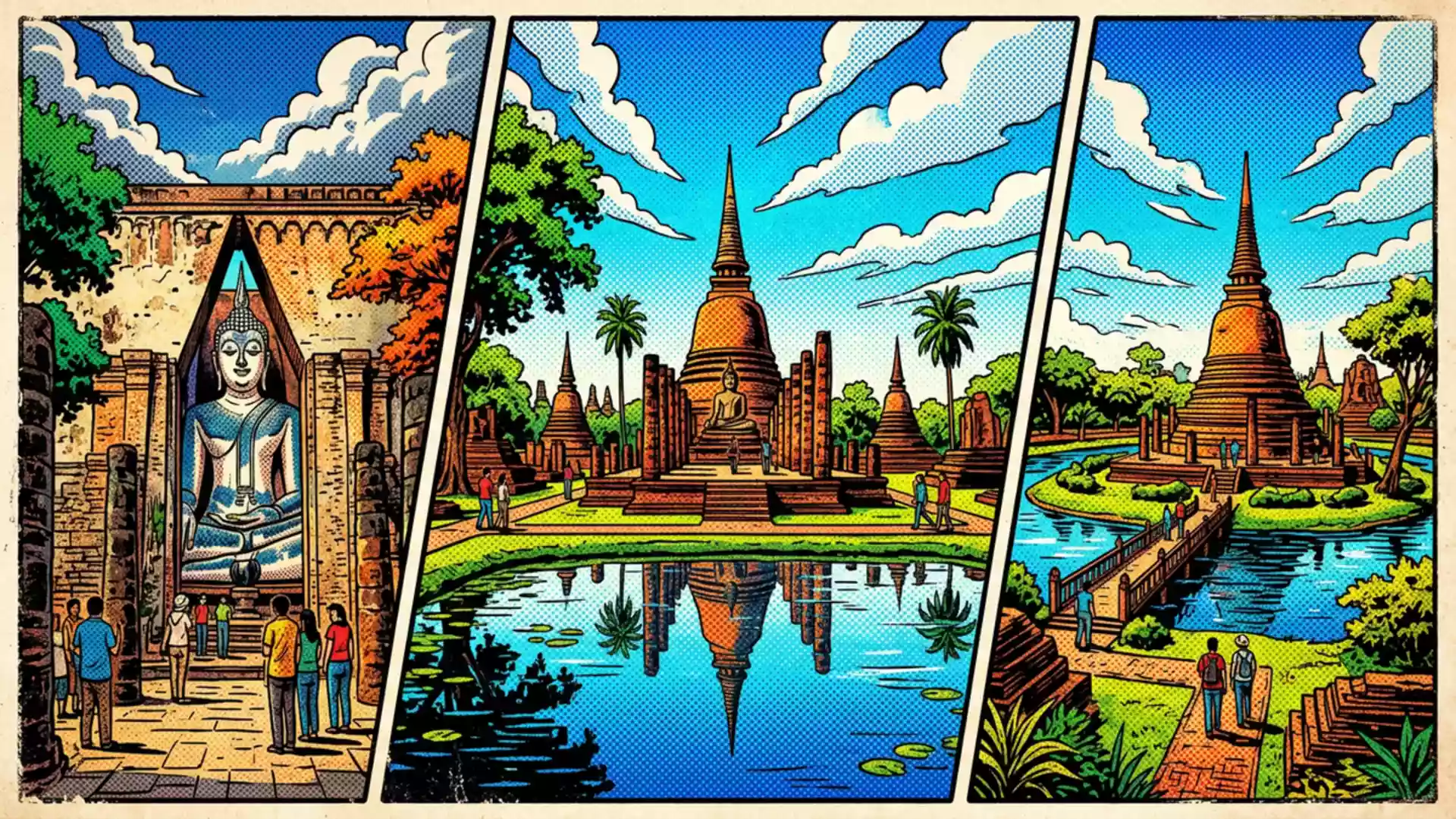
The most prominent monument in Sukhothai Historical Park is Wat Mahathat, the principal royal temple of the city. Its central sanctuary stands on a broad laterite platform, ringed by tall moulded stupas and smaller shrines that outline a ceremonial core for the old capital.Wat Mahathat Nearby Wat Sa Si rises from an island platform within a reservoir, linked to the shore by a causeway, while Wat Si Sawai combines Khmer?style sanctuary towers with later modifications that reflect shifts in religious practice.the remains of 21 historical sites
North of the central zone, at Wat Si Chum, a massive seated Buddha image fills an open chamber above a high laterite base, framed by tall masonry walls that rise close to the statue. West of the inner city, at sites such as Wat Saphan Hin, temple platforms occupy higher ground beyond the old walls, marking the spread of religious structures into the wider landscape. Across central, northern and western zones, ruined palaces, city gates, boundary walls and the remains of water?control works combine with religious complexes to give an unusually complete picture of a royal urban centre in pre?modern Thailand.royal palaces, Buddhist temples, the city gates, walls, moats and the water dyke control system
A planned landscape of water, walls and laterite
One way to understand Sukhothai Historical Park is to trace how water, masonry and open ground organise the space. Long rectangular reservoirs sit both inside and outside the old city walls, many originally linked by channels to form a controlled system that fed the town and its ritual structures.Master Plan of Ancient Sukhothai’s Development To Be A Historic Park Within the walls, formal ponds punctuate the precincts of major temples, reflecting the stone structures around them and marking axial approaches to central sanctuaries.
Laterite, a reddish iron?rich stone, and brick are the dominant construction materials. At Wat Mahathat and other major sites, moulded stucco once covered many surfaces, traces of which survive on base mouldings and decorative elements. The central zone holds a concentration of monuments within the old square of walls and moats, while additional archaeological sites lie scattered within a radius of several kilometres around it, extending the historic landscape into surrounding fields and low hills.an additional 70 sites within a 5km radius Together these elements make Sukhothai Historical Park a particularly readable example of a planned early Thai capital.
Visiting Sukhothai Historical Park: what travellers from Western Europe should know
- Sukhothai Historical Park lies near the modern town of Sukhothai in northern Thailand, with the historic area reached from the nearby district of Mueang Kao along local roads.liegt an der Thailand Route 12 etwa 13 Kilometer westlich des Zentrums der modernen Stadt Sukhothai
- The terrain inside the park is mostly level, with long stretches between temple groups and some monuments set on raised platforms or hill slopes that require walking on uneven stone and earth surfaces.Sukhothai Historical Park forms a rectangle
- Beyond the main archaeological zone, other parts of the World Heritage ensemble such as Si Satchanalai and Kamphaeng Phet lie in the same region and can be combined with Sukhothai for a wider view of the historic towns of the Sukhothai Kingdom.managed as three independent historical parks
- The official language is Thai and the currency is the Thai baht.
- Entry requirements depend on your nationality; UK travellers can check the FCDO travel advice at gov.uk/foreign-travel-advice, Irish travellers the Department of Foreign Affairs at ireland.ie.
Searching for Sukhothai Historical Park on social platforms
These links open searches for Sukhothai Historical Park on each platform.
Frequently asked questions about Sukhothai Historical Park
Where is Sukhothai Historical Park?
Sukhothai Historical Park stands near the modern town of Sukhothai in northern Thailand, in the province of the same name, west of the present urban centre.
What can visitors expect on a visit?
Visitors encounter the ruins of stone temples, palace platforms, Buddha images, city walls and reservoirs spread across a broad archaeological landscape divided into central, northern and western zones.
What makes Sukhothai Historical Park distinctive?
The park combines a dense concentration of religious and royal architecture with an intact pattern of walls, moats and formal ponds, forming part of a World Heritage ensemble of early Thai towns.