
Sultanahmet Camii and its cascading domes in Istanbul
Published on 09/05/2026 at 13:03 | Editorial responsibility: Rafael Müller, Editor-in-Chief AD HOC NEWS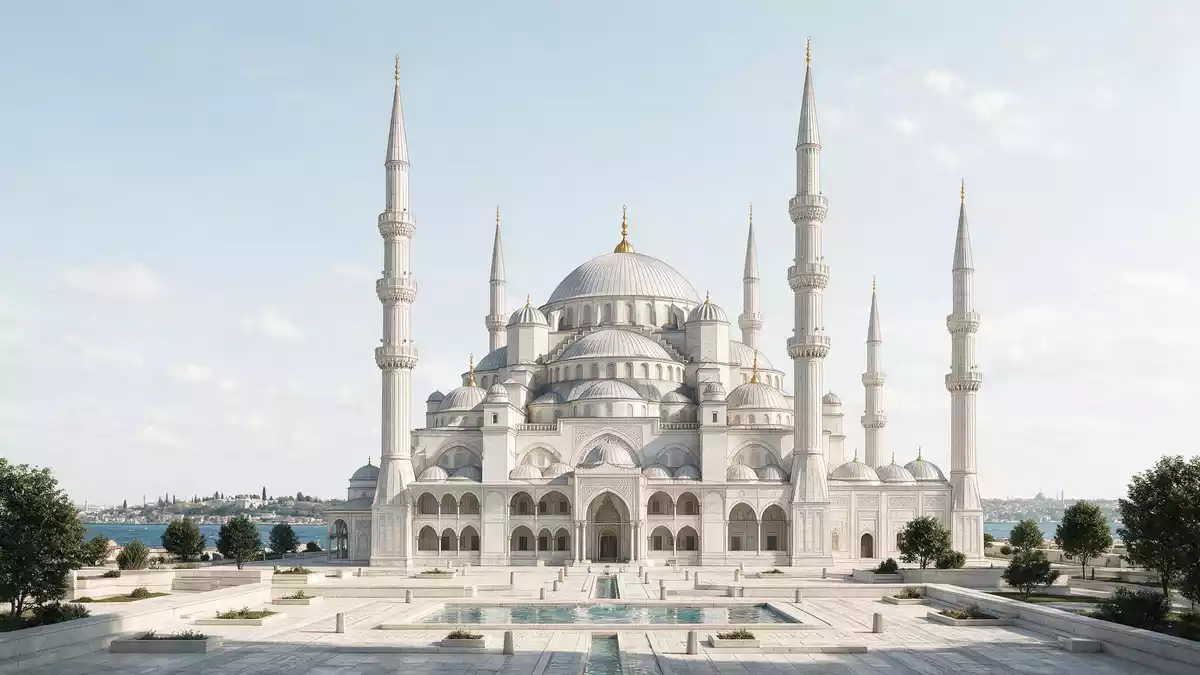
Sultanahmet Camii, widely known as the Sultan Ahmed Mosque or Blue Mosque, rises over Istanbul’s historic peninsula with a composition of cascading domes and slender minarets that frame the old Hippodrome and face Hagia Sophia across the square. Built for Sultan Ahmed I in the early seventeenth century, it anchors a wider religious complex on the former imperial centre of the city and remains one of the clearest statements of classical Ottoman mosque architecture.
Domes, minarets and classical Ottoman geometry
The overall massing of Sultanahmet Camii is a carefully stepped arrangement of a central dome flanked by semi-domes and smaller domes that descend towards the courtyard, a hallmark of Ottoman classical architecture. The central dome reaches about 43 m (141 ft) high and spans roughly 23.5 m (77 ft), forming a broad canopy supported on four massive interior piers that are often described as “elephant feet”. Inside, this structure reads as a single vaulted volume, while outside it appears as one layer in a tiered silhouette.
The six pencil-like minarets are the most immediately recognisable external feature of Sultanahmet Camii, distinguishing it from mosques with fewer minarets across Istanbul. They cluster around the main prayer hall and courtyard, rising with multiple balconies and emphasising the mosque’s status as an imperial foundation of Sultan Ahmed I.Known for having six minarets, the building sits directly beside the route of the Byzantine Hippodrome, tying its vertical emphasis to an area once lined with imperial seating and monuments.
Tiles, light and the interior of the Blue Mosque
Stepping inside Sultanahmet Camii, the shift from stone and lead on the exterior to ceramics and calligraphy becomes clear along the lower walls and galleries. More than 20,000 handmade ceramic tiles from ?znik line the interior, bearing floral motifs, trees and abstract arabesques that together give the mosque its “blue” identity.The interior of the mosque is lined with more than 20,000 handmade ceramic tiles from ?znik and, in combination with painted medallions and Qur’anic inscriptions, they create a continuous decorative field from floor level up to the base of the domes.
High above, bands of windows cut into the drum of the main dome, the semi-domes and the walls of the prayer hall. These openings admit daylight that falls across the tiles, carpets and carved wooden elements, making the layered structure of domes and arches legible from the floor.The mosque dominates Istanbul’s skyline with its elegant composition of ascending domes, and that same composition is echoed inside by the rhythm of semi-domes and arches overhead. Hanging chandeliers draw the scale back to human height, marking lines of prayer and leaving clear views towards the mihrab and minbar on the qibla wall.
Imperial context and the building programme of Ahmed I
Sultanahmet Camii belongs to the early seventeenth century, a period when the Ottoman Empire still centred its political and religious life on the historic peninsula of Istanbul. Construction began in 1609 under Sultan Ahmed I and was substantially completed by 1616 or 1617, when the mosque opened for worship.Construction started in 1609 and completed in 1617 and primary sources class the building as the central element in a wider complex that included medrese, market structures and service buildings.The Sultanahmet Mosque, known as the Blue Mosque, is the central element of the complex built by Ahmed I
The architect Sedefkâr Mehmed A?a, a pupil in the line of the celebrated court architect Mimar Sinan, drew on established imperial mosque forms while placing Sultanahmet Camii opposite Hagia Sophia and next to the former Hippodrome, a site that had long carried imperial associations.Construction began in 1609 in the area of the former Byzantine Great Palace and the ancient Hippodrome The complex’s layout with its courtyard, ablution fountains and surrounding structures follows the pattern of earlier imperial mosques but is often described as among the last major works in the classical Ottoman style.This mosque is considered to be the last example of Ottoman classical architecture
Visiting Sultanahmet Camii: what travellers from Western Europe should know
- Sultanahmet Camii stands in the Sultanahmet district of Istanbul’s historic peninsula, opposite Hagia Sophia and beside the site of the former Hippodrome. It is reached easily on foot from the surrounding streets and squares served by the city’s tram line.
- The mosque complex includes a large stone-paved courtyard and interior spaces reached by staircases and thresholds; visitors walk across carpets inside the main prayer hall and pass beneath low-hanging chandeliers.
- The official language is Turkish and the currency is the Turkish lira.
- Entry requirements depend on your nationality; UK travellers can check the FCDO travel advice at gov.uk/foreign-travel-advice, Irish travellers the Department of Foreign Affairs at ireland.ie.
Searching for Sultanahmet Camii on social platforms
These links open searches for Sultanahmet Camii on each platform.
Frequently asked questions about Sultanahmet Camii
Where is Sultanahmet Camii in Istanbul?
Sultanahmet Camii stands in the Sultanahmet district on Istanbul’s historic peninsula, facing Hagia Sophia across a public square and beside the former Hippodrome.
What should visitors expect inside the mosque?
Visitors enter a large domed prayer hall lined with ?znik tiles, carpets and hanging chandeliers, with daylight entering through multiple tiers of windows in the domes and walls.
What makes Sultanahmet Camii distinctive among Ottoman mosques?
Sultanahmet Camii combines a tiered system of domes with six minarets and extensive ?znik tile decoration, and as an imperial foundation of Ahmed I it marks one of the last major works of the classical Ottoman style.


