
Sultanahmet Camii and its sea of blue tiles in Istanbul
Published on 08/18/2026 at 14:53 | Editorial responsibility: Rafael Müller, Editor-in-Chief AD HOC NEWS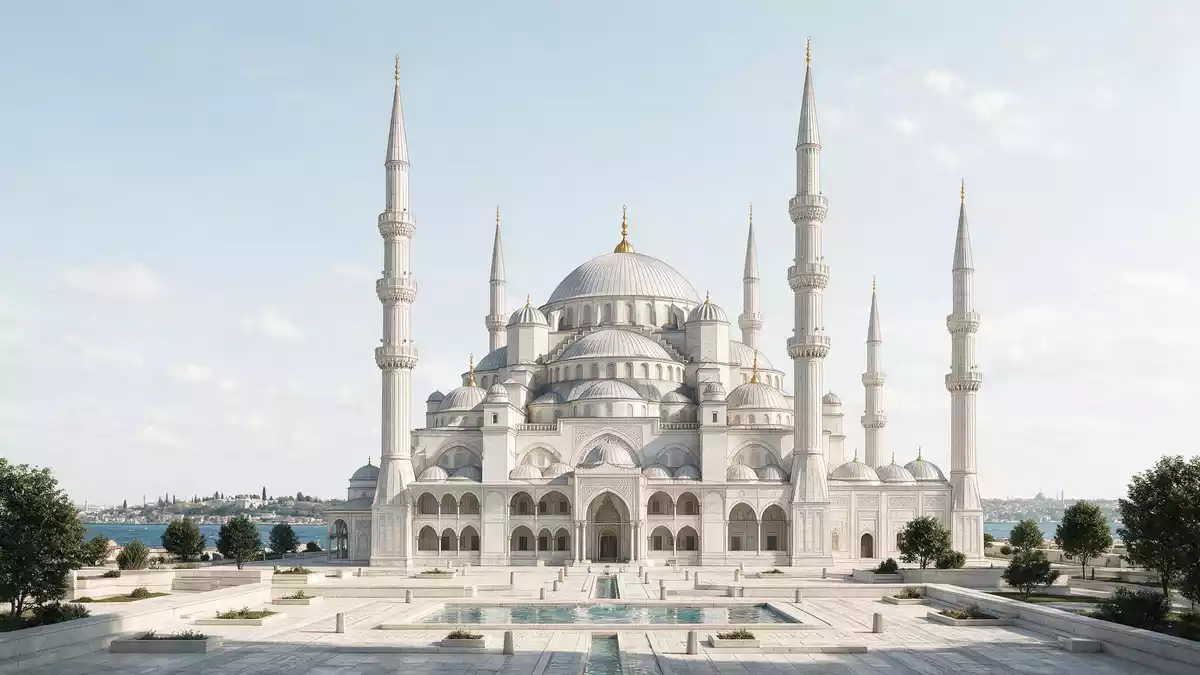
Sultanahmet Camii, better known to many visitors as the Blue Mosque, rises over Istanbul’s historic peninsula with a cascade of domes framed by six slender minarets. Completed in the early seventeenth century for Sultan Ahmed I, it stands opposite Hagia Sophia in the old imperial quarter that later became part of the Historic Areas of Istanbul on the UNESCO World Heritage list.
Domes, minarets and an imperial skyline
The core of Sultanahmet Camii dates from the first decades of the seventeenth century, when Sultan Ahmed I ordered a new imperial mosque near the old Hippodrome of Constantinople.The Blue Mosque was built between 1609 and 1616, at a time when the Ottoman court still centred on this part of Istanbul. The architect was Sedefkâr Mehmed A?a, a pupil of Mimar Sinan, whose name appears in Ottoman sources and in later architectural histories.His design draws on the proportions refined in earlier imperial mosques.
The mosque’s silhouette is dominated by a central dome supported by four massive pillars and ringed by smaller domes that step down towards the courtyard.The main dome reaches an inner height of about 43 m (141 ft), a figure that gives a sense of the vertical scale inside. Around the domes rise six minarets, an unusual number for a single mosque, which mark Sultanahmet Camii out in the city skyline and connect it visually with the other imperial structures around Sultanahmet Square.
An interior lined with ?znik tiles and filtered light
Inside Sultanahmet Camii, visitors step onto a carpeted prayer hall enclosed by tile-clad walls and a high, gently curving dome above. The interior takes its nickname from the large number of blue-toned ceramic tiles made in ?znik, a town in north-western Anatolia known in the Ottoman period for its tile workshops.More than 20,000 ?znik tiles decorate the walls, many carrying floral and geometric patterns associated with seventeenth-century Ottoman design.
The tiles are complemented by stained glass windows set into the upper walls of the mosque.Sources mention hundreds of stained glass openings, which admit daylight and pick out details of the calligraphy and tilework. Wooden galleries line parts of the interior, and the mihrab and minbar anchor the far wall of the prayer hall, aligning the space towards Mecca in accordance with Islamic practice.
Sultanahmet Camii in its historic urban setting
Sultanahmet Camii stands on the south-eastern side of the former Hippodrome, looking towards Hagia Sophia and the wider Historic Areas of Istanbul.The mosque forms part of the UNESCO-listed historic peninsula, where layers of Byzantine and Ottoman building still structure the streets. Its courtyard, with its arcades and ablution fountain, opens towards Sultanahmet Square, where tram lines and pedestrian routes cross the old parade ground of the Byzantine emperors.
The complex around the mosque includes elements typical of an Ottoman külliye, or imperial precinct.Alongside the mosque itself stand structures such as the tomb of Ahmed I and former madrasas, which frame the monument within its original religious and educational functions. From the outer courtyards, views open across the Sea of Marmara on one side and towards the Golden Horn on the other, underlining how closely this mosque is tied to Istanbul’s waterways and to the routes that once connected the Ottoman capital with its provinces.
Visiting Sultanahmet Camii: what travellers from Western Europe should know
- Sultanahmet Camii stands in the Fatih district of Istanbul, close to Sultanahmet Square and opposite Hagia Sophia, and is reached by tram services that stop near the square.
- The mosque complex includes a spacious courtyard with stone paving and colonnades, and access to the interior involves walking on carpeted floors and passing through controlled entry points.
- The official language in Turkey is Turkish and the currency is the Turkish lira.
- Entry requirements depend on your nationality; UK travellers can check the FCDO travel advice at gov.uk/foreign-travel-advice, Irish travellers the Department of Foreign Affairs at ireland.ie.
Searching for Sultanahmet Camii on social platforms
These links open searches for Sultanahmet Camii on each platform.
Frequently asked questions about Sultanahmet Camii
Where in Istanbul is Sultanahmet Camii located?
Sultanahmet Camii stands in the historic Fatih district on Istanbul’s European side, beside the former Hippodrome and facing Hagia Sophia across Sultanahmet Square.
What should visitors expect inside Sultanahmet Camii?
Visitors enter a carpeted prayer hall under a high central dome, with ?znik tiles covering the lower walls and stained glass windows admitting patterned daylight into the interior.
What makes Sultanahmet Camii distinctive among mosques?
The combination of six minarets, a cascading dome composition and extensive blue ?znik tilework, set within a UNESCO-listed historic quarter, gives Sultanahmet Camii a distinctive character.


