
Suwon Hwaseong, the 18th?century fortress encircling Suwon
Published on 08/24/2026 at 17:42 | Editorial responsibility: Rafael Müller, Editor-in-Chief AD HOC NEWS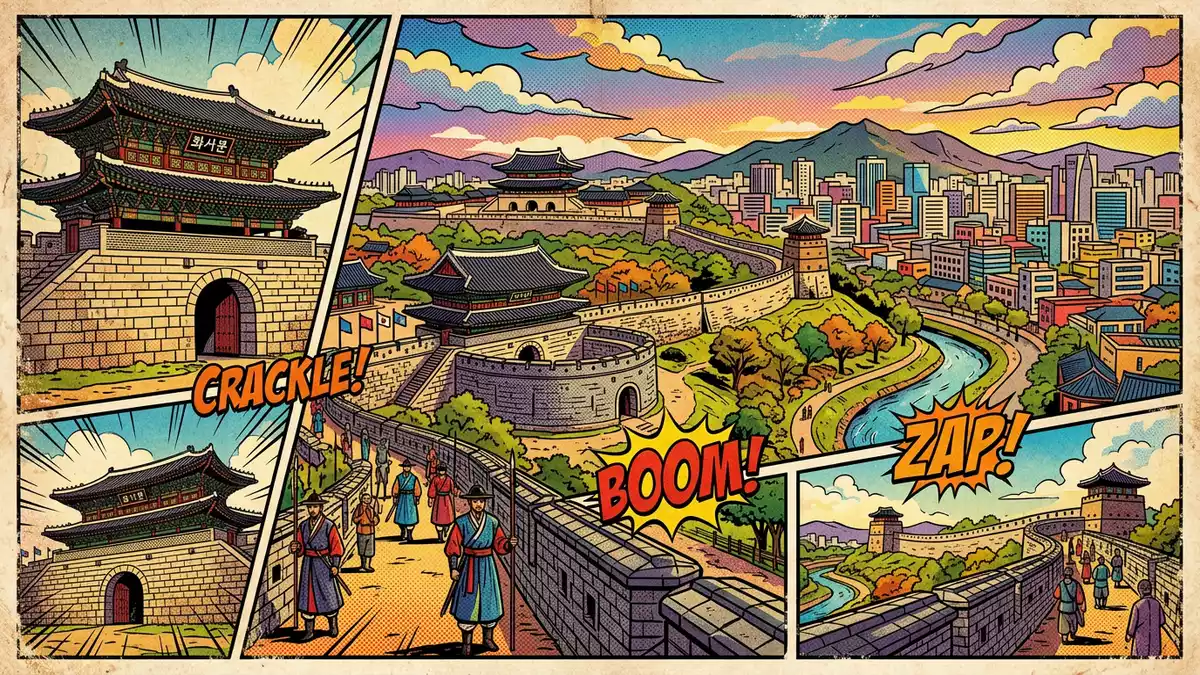
Suwon Hwaseong is an eighteenth?century stone and brick fortress that still wraps around the historic centre of Suwon in South Korea, climbing over ridges and dipping into valleys as it goes. Built under King Jeongjo of the Joseon dynasty between 1794 and 1796, it combines advanced military engineering with a planned urban layout, giving travellers a rare chance to walk a complete city wall that was conceived and constructed in a single, meticulously documented project.
A planned fortress city of the Joseon dynasty
The story of Suwon Hwaseong begins with King Jeongjo, the twenty?second monarch of the Joseon dynasty, who ruled from 1776 to 1800 and reshaped Suwon as a fortress town in the late eighteenth century.Built from 1794 to 1796, the walls form a rough loop around the city, following slopes and ridgelines rather than enforcing a rigid geometric plan.The circuit stretches for about 5.7 km, enclosing a broad area that was conceived as both a defensive perimeter and the outline of a new urban centre.
Joseon builders used piled stone and brick to create walls that could withstand artillery while still echoing older Korean fortification traditions.Construction records describe a two?and?a?half?year building campaign, unusually short for a work of this scale and a key reason why the fortress has attracted interest from historians of architecture and urban planning.Documents from the period show that scholars from the School of Practical Learning studied military science from East Asia and Europe before construction began, and the resulting design reflects that breadth of reference.
Walls, gates and watchtowers along the ridge
Walking Suwon Hwaseong today means tracing a band of fortifications that rises and falls with the terrain, particularly around Paldalsan Mountain, which forms a prominent high point within the circuit.The wall is generally four to six metres high, with a stone base and brick parapet that create a textured rhythm of blocks and battlements as it runs over slopes and along streets.Original plans show a 5.74 km length enclosing about 130 ha of land, which gives some sense of the scale of the project and the amount of city life that originally sat inside its ring.
The wall is punctuated by substantial gates and a variety of defensive structures that give each section a distinct profile.Four main gates mark the cardinal directions, with Janganmun to the north and Paldalmun to the south standing out for their broad stone bases and multi?tiered timber superstructures, which echo grand gates in Seoul in their use of painted wooden brackets and tiled roofs.Around and between the gates, the original design incorporated around forty?eight separate facilities on the walls, including guard platforms, command posts, sentry towers, angle towers and bastions for firearms, many of which have been restored using detailed eighteenth?century manuals.
A World Heritage site where engineering meets everyday life
Suwon Hwaseong is recognised internationally for its architectural ingenuity and its role in the history of Korean urbanism.In 1997 it was inscribed on the UNESCO World Heritage List as Hwaseong Fortress, Suwon, under cultural criteria ii and iii, highlighting both the exchange of technical ideas involved in its design and its value as a well?preserved example of an early modern fortress city.The inscription notes that the fortress incorporates the most advanced military science of its era from both East and West, particularly in its use of bricks, angle bastions and carefully sited artillery platforms.
The fortifications do not stand apart from Suwon; instead they thread through neighbourhoods, skirt markets and rise above streets, making them part of everyday movement as well as heritage visits.The area around the walls is designated as the Suwon Hwaseong Special Tourist Zone, and the fortress itself is protected as a major cultural property under Korean law.A significant portion of the original fabric survived into the twentieth century, and where sections were damaged, particularly in wartime, restorations have been guided by eighteenth?century construction drawings and manuals, maintaining the fortress’s characteristic mix of stone, brick and colourfully finished timber.
Visiting Suwon Hwaseong: what travellers from Western Europe should know
- Suwon Hwaseong encircles the old centre of Suwon in Gyeonggi Province, south of Seoul, and is reached by national rail services and metro lines that run to Suwon Station.
- The walls rise over hills such as Paldalsan, and many sections are accessed by stepped paths and stairs, including staircases inside towers and on steep slopes.
- The circuit passes close to neighbourhoods with narrow streets and small parks, and some stretches of wall stand above busy junctions, so crossings and approaches involve ordinary city pavements.
- The official language is Korean and the currency is the South Korean won.
- Entry requirements depend on your nationality; UK travellers can check the FCDO travel advice at gov.uk/foreign-travel-advice, Irish travellers the Department of Foreign Affairs at ireland.ie.
Searching for Suwon Hwaseong on social platforms
These links open searches for Suwon Hwaseong on each platform.
Frequently asked questions about Suwon Hwaseong
Where is Suwon Hwaseong and what does it surround?
Suwon Hwaseong is in Suwon, the capital of Gyeonggi Province in South Korea, and its walls surround the historic city centre and nearby slopes such as Paldalsan.
What can travellers expect when walking the fortress walls?
Travellers encounter stone and brick ramparts, timbered gates, guard platforms and towers, with sections that climb steep hills and others that run above streets and markets.
What makes Suwon Hwaseong distinctive among Asian fortresses?
The fortress combines Joseon?period traditions with late eighteenth?century military science from East Asia and Europe, forming a planned circuit recognised as a UNESCO World Heritage site.


