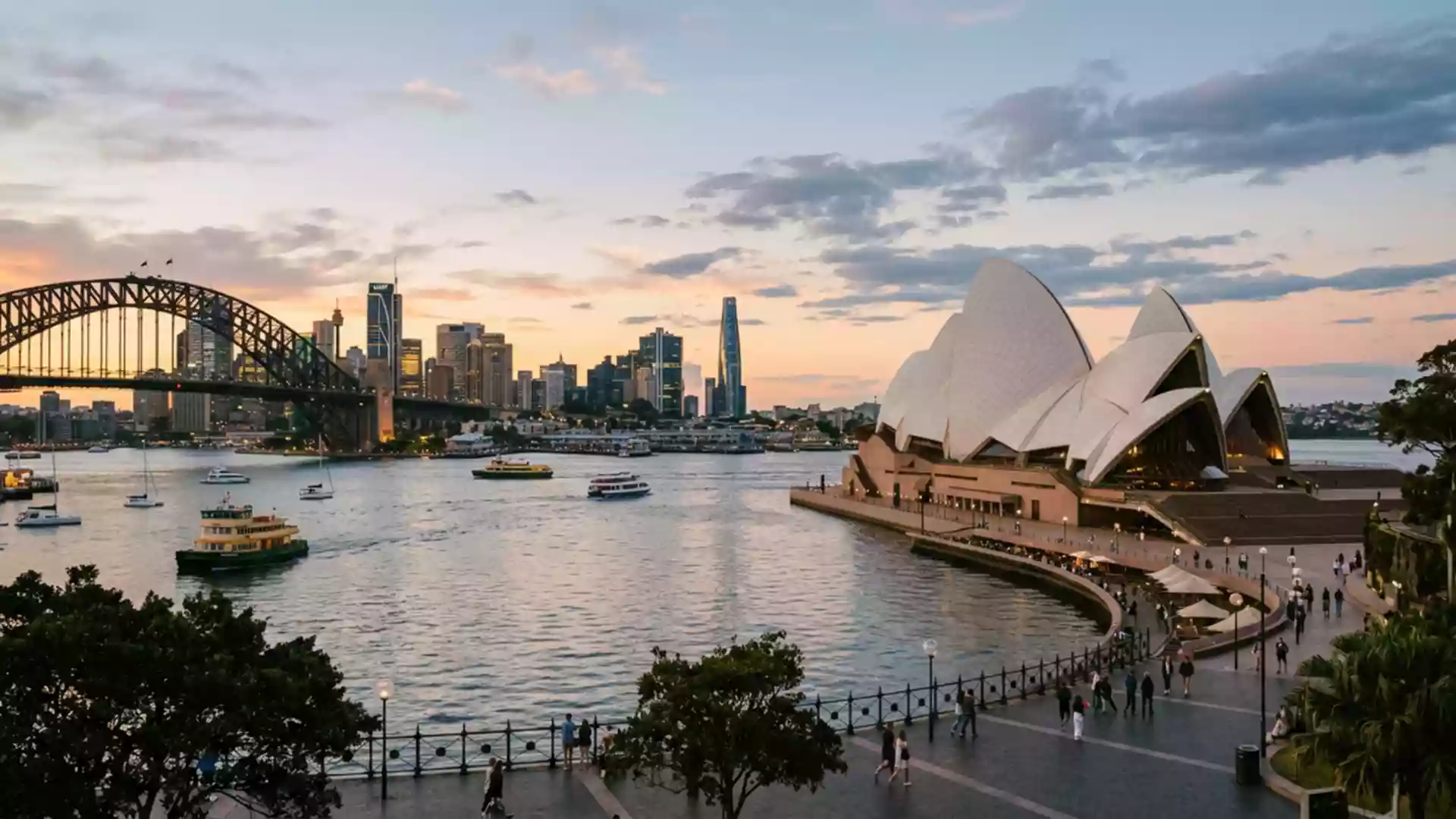
Sydney Opera House and its sculpted sails on Sydney Harbour
Published on 08/18/2026 at 13:59 | Editorial responsibility: Rafael Müller, Editor-in-Chief AD HOC NEWS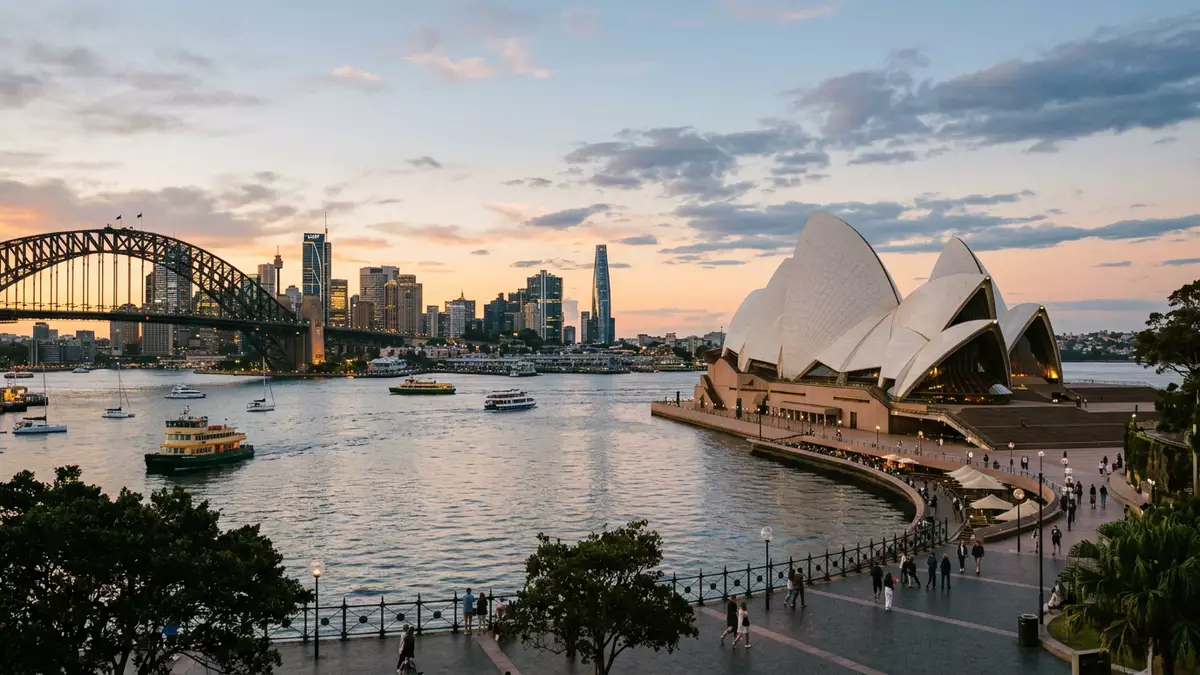
Sydney Opera House turns the edge of Sydney Harbour into a sculpted silhouette of pale shells and terraces, instantly recognisable long before any detail comes into focus. Completed in 1973 on Bennelong Point and designed by Danish architect Jørn Utzon, it stands as a major twentieth-century work of expressionist architecture in Australia.
A harbour promontory turned into architecture
Sydney Opera House occupies Bennelong Point, a rocky headland that projects into Port Jackson on the southern side of Sydney Harbour, just east of Sydney Harbour Bridge and beside the Royal Botanic Garden. From Circular Quay the building appears almost as an island, with water on several sides and ferries, harbour craft and bridge traffic forming a constantly shifting backdrop around its stepped podium.Bennelong Point on Sydney Harbour
The site places Sydney Opera House at the hinge between the historic city centre and the open water of the harbour, with the broad platform stretching out as a continuation of the foreshore. The building and its surrounding terraces fill the headland, so that walking around the promontory means passing between harbour views, granite-clad steps and the rising shells that frame vistas back towards the skyline.The building and its surrounds occupy the whole of Bennelong Point
Jørn Utzon’s expressionist shells and podium
The project began with an international design competition launched by the New South Wales government in the mid-1950s, which was won in 1957 by Jørn Utzon with a radical scheme of interlocking roof shells rising above a broad podium.The project of the Sydney Opera House was awarded by an international jury to Danish architect Jørn Utzon in 1957 Construction started in 1959, and the building was formally opened by Queen Elizabeth II on 20 October 1973, after a long and complex building process involving both Utzon and an Australian team led by architect Peter Hall.Construction started in 1959 and the building was formally opened by Queen Elizabeth II on 20 October 1973
The architecture combines a monumental stepped podium faced in pale granite with a cluster of large precast-concrete shells that rise above it, each shell segment cut from a common conceptual sphere to create a coherent geometry. The shells house several performance spaces, including the main Concert Hall and the Joan Sutherland Theatre, while the podium contains foyers, back-of-house rooms and service areas arranged around generous public concourses.Shells cut from one common sphere
A cultural landmark and World Heritage site
Sydney Opera House functions as a multi-venue performing arts centre, with major spaces for symphony concerts, opera, theatre and other staged events housed within the shell structures and in the podium below.Sydney Opera House is a multi-venue performing arts centre The building’s image has become closely associated with Sydney and with Australia more broadly, appearing frequently in visual culture as a shorthand for the country.
On 28 June 2007 Sydney Opera House was inscribed on the UNESCO World Heritage List as an outstanding example of twentieth-century architecture, recognised for its innovative structural design, sculptural form and prominent setting on the harbour.On 28 June 2007 the Sydney Opera House was included on the UNESCO World Heritage List The listing places it in a group of internationally significant cultural sites, and underlines the way its white-tiled shells, broad platform and waterside terraces have reshaped the outline of Sydney Harbour since its inauguration in 1973.World Heritage since 2007
Visiting Sydney Opera House: what travellers from Western Europe should know
- Sydney Opera House stands on Bennelong Point at the eastern side of Circular Quay, reached on foot from the city centre along Macquarie Street beside the Royal Botanic Garden.
- The approach from Circular Quay involves broad outdoor steps and open terraces, and the external walkways extend around the promontory with varied gradients but no internal lifts on the outer paths.
- For travellers arriving by rail, Circular Quay railway station and the adjacent ferry wharves provide access to the western side of Bennelong Point, from which signposted waterfront paths lead towards the podium.
- The official language is English and the currency is the Australian dollar.
- Entry requirements depend on your nationality; UK travellers can check the FCDO travel advice at gov.uk/foreign-travel-advice, Irish travellers the Department of Foreign Affairs at ireland.ie.
Searching for Sydney Opera House on social platforms
These links open searches for Sydney Opera House on each platform.
Frequently asked questions about Sydney Opera House
Where is Sydney Opera House located?
Sydney Opera House stands on Bennelong Point on Sydney Harbour, beside Circular Quay in central Sydney and next to the Royal Botanic Garden.
What can visitors expect when they come to Sydney Opera House?
Visitors encounter a broad granite podium rising from the harbour, interlocking concrete shells above it, and open terraces with views towards Sydney Harbour Bridge and the city skyline.
What makes Sydney Opera House distinctive among performing arts venues?
Its combination of shell-like concrete roofs, stepped waterfront podium and prominent promontory setting, together with its World Heritage status, gives it a singular presence on Sydney Harbour.