
Taipei 101 and its tuned mass damper above Taipeh
Published on 08/23/2026 at 11:49 | Editorial responsibility: Rafael Müller, Editor-in-Chief AD HOC NEWS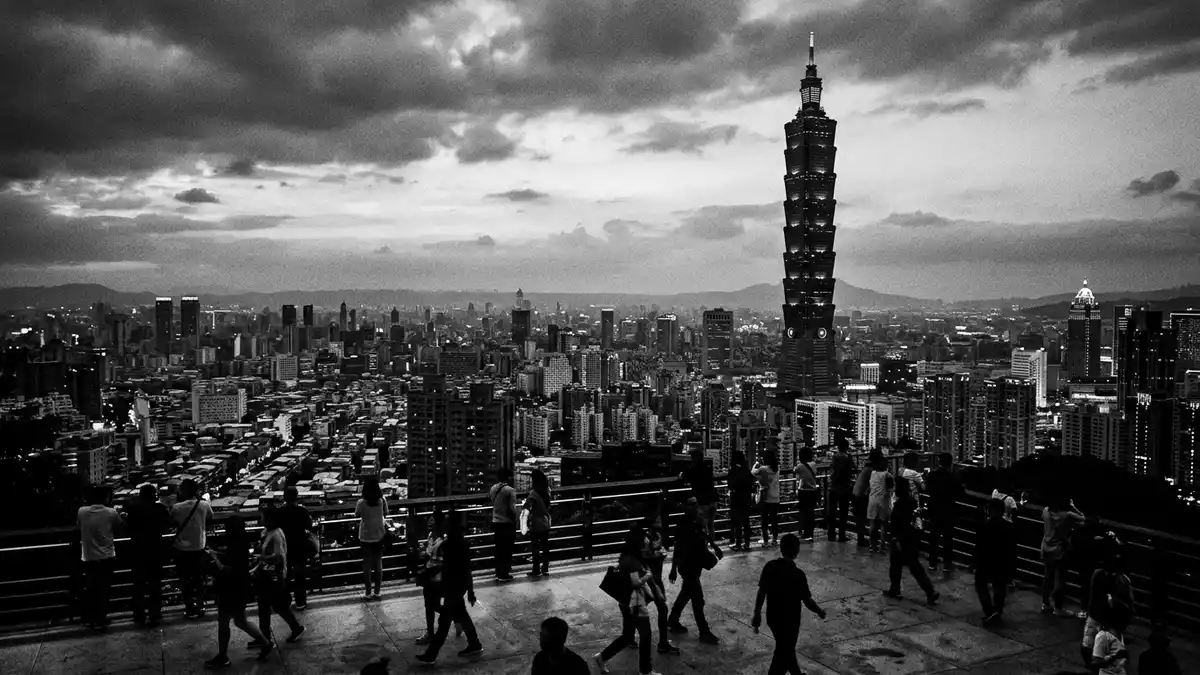
Taipei 101 in Taipeh is a neo-futurist skyscraper whose defining feature is a vast tuned mass damper suspended high in the tower, turning structural engineering into something visitors can see. Completed in 2004 and designed by C.Y. Lee and C.P. Wang, it rises more than 500 m (over 1,640 ft) above the Xinyi District and still dominates the city’s modern skyline.
A bamboo-like tower above Xinyi District
Taipei 101 stands in the Xinyi District of Taipeh, a business quarter laid out with broad streets and large plots that make space for high-rise construction. The tower’s address on Xinyi Road places it among commercial blocks, malls and office buildings rather than in the older low-rise quarters of the city.Taipei 101 in Xinyi District The plot carries not only the main tower but also a lower podium that houses retail spaces and connects directly to the surrounding street network.
In elevation the building recalls a stalk of bamboo segmented into stacked blocks, each slightly tapered and stepped, rising in a regular rhythm towards a spire. The structure reaches about 508 m (1,667 ft) including its pinnacle, and the name refers to its 101 floors above ground.508 m and 101 storeys The mass of the tower rests on eight prominent mega-columns around a central core, a configuration that supports both height and the wide floorplates needed for commercial use.mega columns and core
Neo-futurist design with traditional references
The architects C.Y. Lee and C.P. Wang set Taipei 101 in a neo-futurist style, combining contemporary structural solutions with references to East Asian forms.C.Y. Lee and C.P. Wang The exterior cladding uses glass and metal panels arranged in geometric patterns, while ornamental motifs pick up themes from traditional pagodas and lucky symbols. The stepped blocks that form the main shaft resemble tiers of a pagoda and also echo the joints in a bamboo stem.
Construction began in 1999 and the tower opened to the public in 2004, after topping out in 2003 when the final section of the spire was installed.construction and completion dates Inside, the lower floors contain a shopping mall and other public facilities, while most of the upper levels are laid out as office space served by express lifts and a central circulation core.retail and office distribution Restaurant levels sit above the bulk of the offices, providing views across Taipeh from dining rooms positioned near the upper part of the shaft.
Observation decks and the visible tuned mass damper
The tower contains several observation decks at different heights, giving visitors access to both indoor and outdoor platforms. An indoor observatory occupies floors 88 and 89, while an outdoor deck on floor 91 offers open-air views over Taipeh and the surrounding hills at around 392.8 m (1,285 ft).indoor and outdoor observatories At the very top a further indoor level on floor 101 is used as an additional observatory, though it is not part of the standard public route.upper observatory height
Between roughly the 88th and 92nd floors the building houses a tuned mass damper, a suspended steel sphere that counteracts movement under wind and seismic loading.tuned mass damper location The damper consists of stacked steel plates formed into a sphere weighing in the range of 730 tons, hung from cables and stabilised by hydraulic cylinders.steel sphere and weight Unusually for such a device, it is not hidden inside the structure: visitors on the observation levels can look directly into the space that holds the pendulum and see the engineering element that helps the building resist movement.
Visiting Taipei 101: what travellers from Western Europe should know
- Taipei 101 stands in the Xinyi District of Taipeh, on Xinyi Road, and is reached easily by city transport linking the business quarter with other districts.
- Reaching the observation decks involves lift rides that cover large height differences and walking through internal corridors and stairways near the top of the tower.
- The official language is Chinese and the currency is the New Taiwan dollar.
- Entry requirements depend on your nationality; UK travellers can check the FCDO travel advice at gov.uk/foreign-travel-advice, Irish travellers the Department of Foreign Affairs at ireland.ie.
Searching for Taipei 101 on social platforms
These links open searches for Taipei 101 on each platform.
Frequently asked questions about Taipei 101
Where is Taipei 101 located?
The skyscraper stands on Xinyi Road in the Xinyi District of Taipeh, an area of Taiwan developed as a major commercial and financial hub.
What can visitors expect inside Taipei 101?
Visitors encounter a large shopping mall in the podium, office floors rising in the main shaft, restaurant levels near the top and observation decks with city-wide views.
What makes Taipei 101 distinctive among tall buildings?
Taipei 101 is distinctive for its bamboo-like segmented silhouette, neo-futurist design by C.Y. Lee and C.P. Wang and a giant tuned mass damper that visitors can see.


