
Talat Nam Damnoen Saduak and the floating maze of Ratchaburi
Published on 08/23/2026 at 12:24 | Editorial responsibility: Rafael Müller, Editor-in-Chief AD HOC NEWS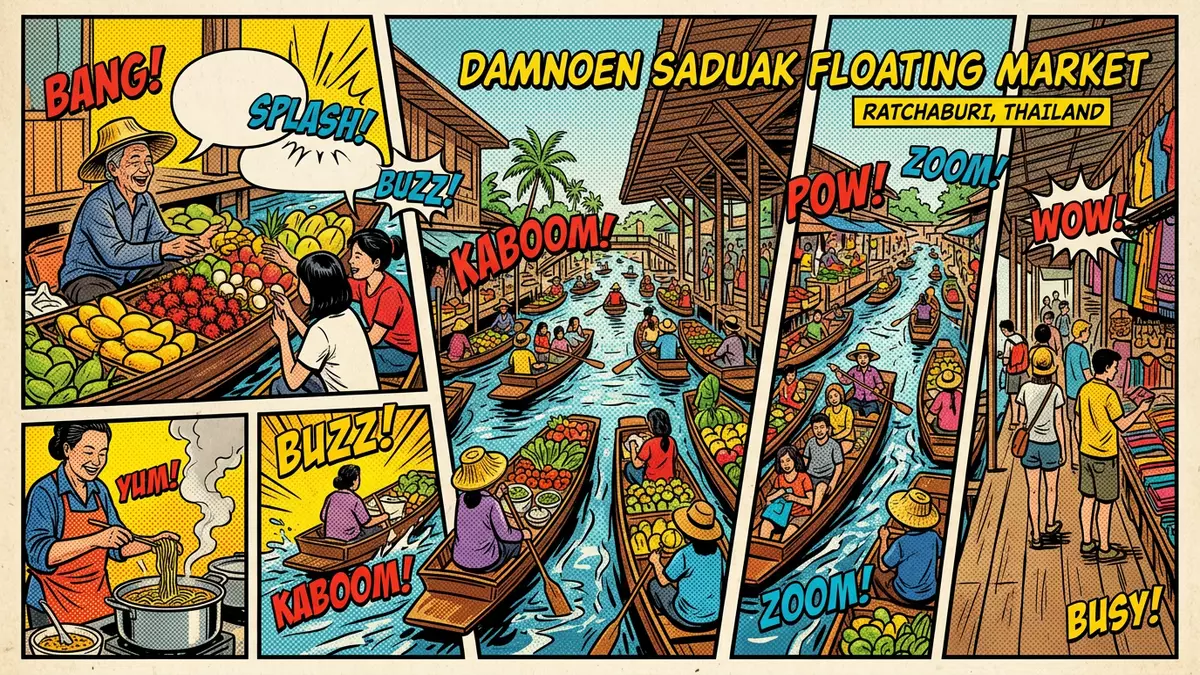
Talat Nam Damnoen Saduak in Ratchaburi is a floating market laid out along the straight Damnoen Saduak Canal, where boats, timber houses and narrow walkways form a dense waterside bazaar. Set in western Thailand, it grew on a canal excavated in the 1860s during the reign of King Rama IV, and it still shows how water once structured trade and settlement in the region.
A nineteenth-century canal turned marketplace
The starting point for Talat Nam Damnoen Saduak is the Damnoen Saduak Canal, a man-made waterway driven through the flat agricultural landscape of Ratchaburi in the nineteenth century during the reign of King Mongkut, known as Rama IV.The canal was cut to link existing rivers and runs for several dozen kilometres across the countryside.It forms part of a wider network of waterways in Ratchaburi Province that frame orchards, paddies and small settlements.
Along one stretch of this canal the settlement of Damnoen Saduak developed into a waterborne market, with narrow feeder canals reaching back into the orchards and fields.The floating market occupies a section of the main canal and adjoining side channels, so the commercial area feels like a compact maze of waterways rather than a single straight line.
Boats, houses and walkways along the water
The core image of Talat Nam Damnoen Saduak is of wooden boats drawn up alongside one another in the canal, their hulls low in the water and their decks loaded with fruit, vegetables, cooked dishes and household goods.Vendors use hand-paddled boats to move along the narrow waterways, steering carefully between moored craft and concrete banks. The boats themselves vary from small, flat craft suited to a single paddler to longer vessels that carry both goods and passengers.
On either side of the canal, low timber and concrete buildings line the banks, many raised slightly above the water on short stilts or piers, with verandas facing the canal and steps or short ladders leading down to boat level.Shophouses and stalls front directly onto the water, and a network of narrow walkways and bridges spans the side channels. For a visitor approaching on foot, the market reads as a strip of wooden and concrete structures pressed tightly against the canal, with roofs and awnings projecting over the water and hanging goods almost within reach of the passing boats.
From local water trade to international emblem
Damnoen Saduak’s floating market activity began as a practical way for farmers and traders to move goods along the canal network once it opened in the 1860s.Commercial boat traffic developed along the canal in the late nineteenth century, linking orchards and farms to trading points on the water. By the middle of the twentieth century, Damnoen Saduak had become one of several floating markets in central Thailand and a recognised symbol of canal-side trade.It has been described as a century-old waterborne trading hub.
The market today combines this canal-based trading pattern with a wide range of goods aimed at visitors from Thailand and abroad. Boat vendors sell fruit, noodles and snacks directly from their craft, while fixed stalls on the banks offer clothing, kitchenware and souvenirs. The result is a layered scene: working boats in the canal, permanent shophouses behind them and orchards and smallholdings stretching away from the waterways into the wider Damnoen Saduak district.
Visiting Talat Nam Damnoen Saduak: what travellers from Western Europe should know
- Talat Nam Damnoen Saduak lies in Damnoen Saduak District in Ratchaburi Province in western Thailand, roughly south-west of Bangkok, and is reached along highways leading from the Thai capital towards Ratchaburi.
- The market area sits directly on the Damnoen Saduak Canal, with narrow concrete walkways, small bridges and steps down to the water, so moving around involves walking on uneven surfaces and navigating tight passages beside the canal.
- Buses and minibuses run between Bangkok’s Southern Bus Terminal and Damnoen Saduak village, and boat tours along the canal depart from piers close to the market area rather than from the city itself.
- The official language is Thai and the currency is the Thai baht. Entry requirements depend on your nationality; UK travellers can check the FCDO travel advice at gov.uk/foreign-travel-advice, Irish travellers the Department of Foreign Affairs at ireland.ie.
Searching for Talat Nam Damnoen Saduak on social platforms
These links open searches for Talat Nam Damnoen Saduak on each platform.
Frequently asked questions about Talat Nam Damnoen Saduak
Where is Talat Nam Damnoen Saduak located?
Talat Nam Damnoen Saduak is in Damnoen Saduak District in Ratchaburi Province in western Thailand, along the Damnoen Saduak Canal south-west of Bangkok.
What should visitors expect during a visit?
Visitors encounter a canalside market with wooden boats selling food and goods, waterside shophouses, narrow walkways and a dense pattern of bridges and canal branches.
What makes Talat Nam Damnoen Saduak distinctive among markets?
Its defining feature is that trading activity takes place on and beside a nineteenth-century canal, so boats, canal banks and houses together form the market space.


