
Tallinna vanalinn, Tallinn’s layered medieval city on the Baltic Sea
Published on 09/08/2026 at 20:17 | Editorial responsibility: Rafael Müller, Editor-in-Chief AD HOC NEWS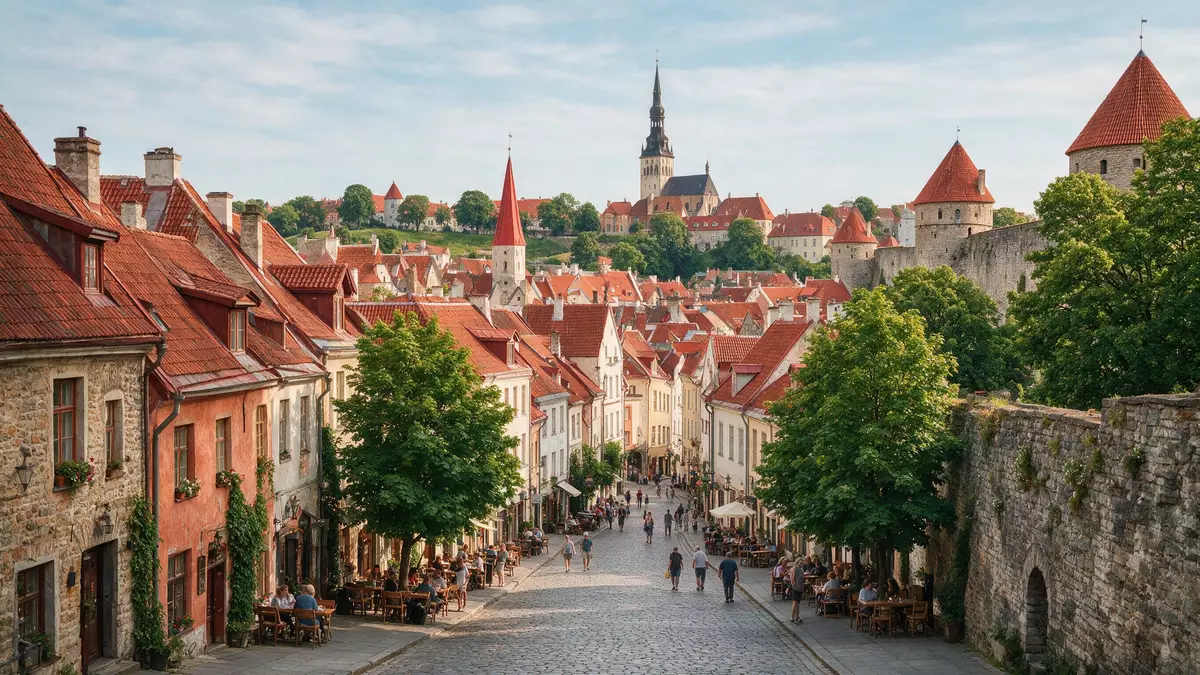
Tallinna vanalinn, the Old Town of Tallinn in Estonia, is a compact medieval city quarter where stone houses, fortifications and church towers still follow a city plan rooted in the thirteenth century. Since 1997 it has formed the Historic Centre (Old Town) of Tallinn on the UNESCO World Heritage List, recognised for its remarkably complete northern European trading town on the Baltic coast.
A Hanseatic trading town preserved in stone
The core of Tallinna vanalinn lies between the harbour and the limestone ridge of Toompea, forming an exceptionally intact medieval and Hanseatic-era urban layout of narrow streets and densely built plots. The area is registered on the UNESCO World Heritage List as the Historic Centre (Old Town) of Tallinn, a cultural property inscribed in 1997 for its well-preserved medieval city structure and layers of archaeological remains.Historic Centre (Old Town) of Tallinn The Old Town’s plan reflects a merchant city that grew as part of the Baltic trading network, with streets aligned to the harbour and plots packed close behind the town walls.
Within this protected core the urban fabric reaches back to the thirteenth century, with Gothic and later Renaissance stone structures concentrated particularly in the Lower Town at the foot of Toompea.Gothic and Renaissance Lower Town The UNESCO listing draws attention to how completely this medieval northern European trading city has survived, including its street labyrinth and substantial stone houses, which together form a unified historic grouping around the harbour.
Upper Town and Lower Town: Toompea above the merchants’ streets
A defining feature of Tallinna vanalinn is the contrast between the Upper Town on Toompea Hill and the Lower Town spread across the flatter ground below. Toompea is a limestone ridge rising above the Old Town, historically occupied by rulers, bishops and fortified compounds, while the Lower Town developed as the domain of merchants, guilds and tradespeople around the marketplace. This two-level structure gives Tallinn’s Old Town its characteristic silhouette of ramparts, towers and clustered roofs.
The linear streets of the Lower Town converge on Raekoja plats, the Town Hall Square that has long been at the centre of civic life and trade.Raekoja plats marketplace From here lanes lead towards the harbour and up towards Toompea, where the upper stronghold continues the pattern of stone structures and defensive walls described in heritage and conservation studies of the Old Town.town-fortress role of Tallinn The relationship between hilltop fortress and mercantile streets below is one of the clearest visible narratives in Tallinna vanalinn’s cityscape.
Walls, towers and churches in the medieval skyline
Tallinna vanalinn is encircled and punctuated by fortifications that once defended a northern European port city, including substantial sections of city wall and a chain of towers that mark the edge of the medieval core. Inside these defences, stone town houses, warehouses and public buildings line the streets, many with Gothic gables and later additions that show how the city has grown while keeping its medieval framework.medieval and Hanseatic origin The extent of surviving fortifications is one of the reasons the Old Town is cited as an exceptionally complete trading city on the Baltic Sea.exceptionally complete medieval trading city
Church towers rise above this compact stone fabric, providing vertical accents that are visible from both harbour and hill. Among them, St Olaf’s Church (Oleviste kirik) in the Lower Town is particularly prominent, with a Gothic form that once gave Tallinn one of the tallest church spires in its region.St Olaf’s Church in the Lower Town Together with the Town Hall and other ecclesiastical buildings, these towers shape the skyline that travellers associate with Tallinna vanalinn’s medieval character.
Visiting Tallinna vanalinn: what travellers from Western Europe should know
- Tallinna vanalinn lies at the centre of Tallinn, directly inland from the Baltic harbour and below the limestone ridge of Toompea. It is reached on foot from the ferry terminals and central transport hubs that serve the Estonian capital.
- The Old Town consists of cobbled streets, uneven surfaces and some steep lanes between the Lower Town and the Upper Town on Toompea. Exploring on foot involves gradients and stairways in historic buildings and along the fortifications.
- The Old Town of Tallinn is in Estonia, where the official language is Estonian and the currency is the euro.
Searching for Tallinna vanalinn on social platforms
These links open searches for Tallinna vanalinn on each platform.
Frequently asked questions about Tallinna vanalinn
Where is Tallinna vanalinn located within Tallinn?
Tallinna vanalinn forms the historic centre of Tallinn, lying between the Baltic harbour and the limestone ridge of Toompea at the heart of Estonia’s capital.
What can travellers expect when visiting Tallinna vanalinn?
Travellers encounter a dense medieval cityscape of cobbled streets, stone town houses, fortifications and church towers that still follow a thirteenth-century trading town plan.
What makes Tallinna vanalinn distinctive among Baltic cities?
The Old Town is distinctive for its exceptionally intact Hanseatic-era layout, its combination of Upper Town and Lower Town and its recognised status as a UNESCO World Heritage historic centre.


