
Te Puia’s geothermal terraces and living M?ori arts
Published on 08/22/2026 at 14:40 | Editorial responsibility: Rafael Müller, Editor-in-Chief AD HOC NEWS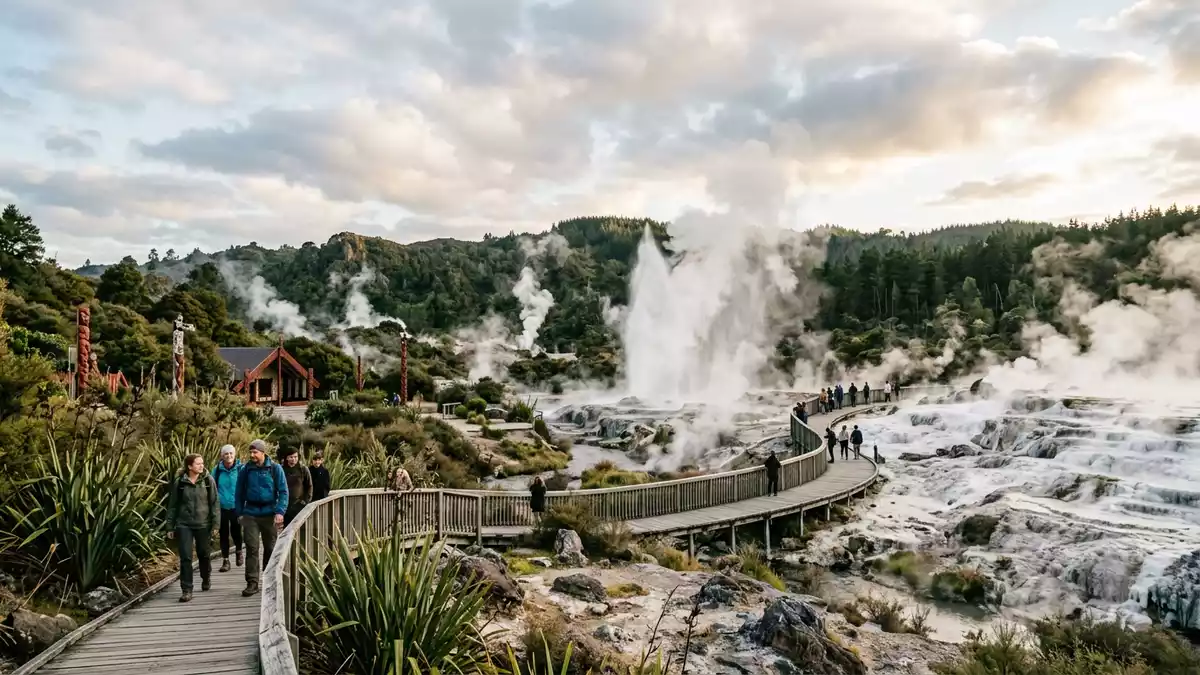
Te Puia in Rotorua is a geothermal valley where plumes of steam, erupting geysers and M?ori carving workshops share the same hillside. Set within Te Whakarewarewa Geothermal Valley in New Zealand’s North Island, it combines an active landscape of hot pools and mud with the New Zealand M?ori Arts and Crafts Institute, making landscape and craft part of the same visit.
Geysers and terraces in Te Whakarewarewa
Te Puia occupies part of Te Whakarewarewa Geothermal Valley on the southern edge of Rotorua, where ground-level terraces carry vents, hot pools and mud features in close succession.The 60-hectare Te Puia complex brings together these geothermal formations and a managed visitor route through them. The valley lies within a wider geothermal field that also includes the M?ori settlement of Whakarewarewa, giving this section of Rotorua a dense concentration of thermal features.
At the heart of Te Puia stands P?hutu Geyser, a column of hot water that rises repeatedly from the terrace.P?hutu is described as the largest active geyser in the Southern Hemisphere, and it shares the terrace with other vents including the Prince of Wales Feathers geyser and additional named springs.The wider Te Puia geyser field includes several regularly active and dormant vents, creating a stepped landscape where steaming water runs over mineral ledges. Between the geysers sit mud pools and fumaroles, so a walk through the valley moves from splashing eruptions to slow, bubbling craters and smaller vents close to the paths.
A geothermal valley woven with M?ori culture
Te Puia is more than a geothermal park; it is also home to the New Zealand M?ori Arts and Crafts Institute, which brings a working carving and weaving school into the same site as the terraces.The institute is described as Aotearoa’s leading centre for traditional M?ori arts training, and its carving, weaving and other workshops occupy buildings beside the geothermal valley. The institute’s origins lie in legislation passed in 1963 under the M?ori Arts and Crafts Act, which formalised support for M?ori arts and their teaching.
Visitors to Te Puia encounter this arts school through open workshops and galleries where wood carving, bone work and flax weaving are carried out in view of the public.Te Puia’s own overview describes a living school where tohunga teach students in multi-year apprenticeships, tying practice-based training to the site. This co-location means that carved meeting houses, structural elements and artworks stand directly above geothermal features, so M?ori design and the valley’s steam, vents and terraces are read together rather than as separate attractions.
Kiwi conservation and meeting houses above the steam
Alongside the geysers and arts school, Te Puia contains a Kiwi Conservation Centre that holds New Zealand’s national bird in a controlled nocturnal setting.The Kiwi Conservation Centre is listed as a core part of the Te Puia experience, giving visitors a view of kiwi in a purpose-built enclosure. The centre sits within the wider grounds, so a visit can move in one circuit from terraces to animal conservation and back to cultural exhibits.
Te Puia also includes a carved meeting house, or wharenui, and a model M?ori village that refer to the long occupation of this geothermal valley by Te Arawa iwi.Descriptions of the site highlight a carved meeting house and a re-created precolonial village, with walking routes passing these structures on the way to the terraces. The combination of wharenui, marae spaces, learning spaces and geothermal features means that performances, guided walks and demonstrations take place against a backdrop of steam and mineral terraces rather than in a separate auditorium complex.
Visiting Te Puia: what travellers from Western Europe should know
- Te Puia stands on Hemo Road on the southern side of Rotorua, with the entrance facing Te Whakarewarewa Geothermal Valley and road access from the city’s central streets.
- The terrain inside Te Puia includes undulating paths over geothermal ground, with boardwalks and terraces that can involve slopes and steps between the viewing areas.
- Te Puia lies within New Zealand, where the official languages include English and te reo M?ori and the currency is the New Zealand dollar.
- Entry requirements depend on your nationality; UK travellers can check the FCDO travel advice at gov.uk/foreign-travel-advice, Irish travellers the Department of Foreign Affairs at ireland.ie.
Searching for Te Puia on social platforms
These links open searches for Te Puia on each platform.
Frequently asked questions about Te Puia
Where is Te Puia located?
Te Puia sits on Hemo Road beside Te Whakarewarewa Geothermal Valley in Rotorua, on New Zealand’s North Island.
What can visitors expect during a visit?
A visit to Te Puia combines geothermal sights such as P?hutu Geyser and mud pools with M?ori carving and weaving workshops, a carved meeting house and a Kiwi Conservation Centre.
What makes Te Puia distinctive among geothermal sites?
Te Puia stands out for its combination of an active geyser field, including P?hutu Geyser, and the New Zealand M?ori Arts and Crafts Institute, where traditional arts are taught and practised on site.


