
Teatro Antico di Taormina and its hilltop stage of stone
Published on 09/09/2026 at 11:42 | Editorial responsibility: Rafael Müller, Editor-in-Chief AD HOC NEWS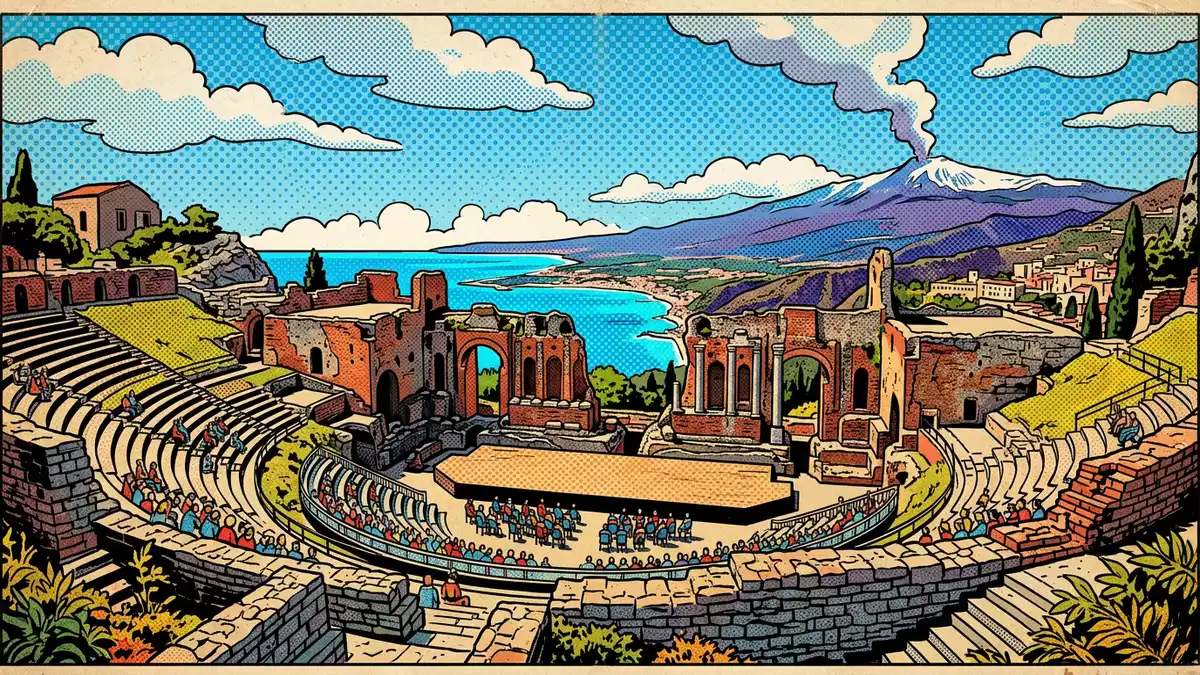
Teatro Antico di Taormina is an ancient theatre cut into the hillside above Taormina in Sicily, with stone tiers that open towards the Ionian Sea and the distant outline of Mount Etna. Built on a Hellenistic foundation in the third century BC and reshaped under Roman rule in the first and second centuries AD, it combines Greek siting with Roman brickwork and monumental scale. The theatre’s curved seating, framed by fragments of its stage building, makes the relationship between architecture and landscape the defining experience of a visit.
An ancient theatre between Tauromenion and the sea
Theatre and terrain are bound together at Teatro Antico di Taormina, because the cavea, the stepped auditorium, is carved directly into the rock of Mount Tauro rather than raised as a freestanding structure. In antiquity the theatre served the city of Tauromenion, later Taormina, and its plan follows the classical model, with a curved bank of seating around a central performance space and the remains of a stage building behind.the auditorium The Greek foundation is traditionally dated to the third century BC, associated with the period when Hiero II ruled Syracuse and Tauromenion underwent major urban development.a Hellenistic foundation
The Roman phases, carried out broadly between the first century BC and the second century AD, enlarged the seating and rebuilt the stage structure in brick, transforming the Greek theatre form into something closer to a Roman entertainment venue.radical Roman remodelling In its later Imperial configuration the central performance area was adapted for arena spectacles, including animal hunts known as venationes, a change that required substantial alteration of the orchestra and the addition of protective barriers.conversion into an arena These historical layers are legible in the surviving masonry, where cut rock, brick arches and reconstructed sections sit together above the semi-circular floor.
Scale, layout and stonework
One of the striking aspects of Teatro Antico di Taormina is its scale, measured through the diameter of the cavea. The auditorium reaches a diameter of around 107–109 m (351–357 ft), placing it among the largest ancient theatres in Sicily and the wider region.diameter of the theatrelargest theatre after Syracuse The seating rises in concentric tiers divided by staircases, and ancient accounts and archaeological studies indicate that the theatre, in its Roman form, could accommodate several thousand spectators, reflecting its role as a major venue for performances and spectacles in the region.
The construction blends rough-hewn rock with carefully laid masonry. The lower tiers are cut directly into the slope, while upper sections and the stage building rely more heavily on brick and stonework from the Roman phases.cavea carved into rock The orchestra, the central floor where performances once took place, forms a level circle of stone, framed by low walls and the line of the first seating rows.orchestra area Above it, the remnants of the stage building still show doorways, niches and vertical elements that once formed the backdrop to plays, music and later arena events.
Landscape views and later reinterpretation
The position of Teatro Antico di Taormina on the hillside above the Ionian coast gives the theatre a second life as a viewpoint, in which the ancient architecture frames the surrounding landscape. Standing on the upper tiers, visitors look over the curve of the cavea and the stone edge of the stage towards the sea, with the broad mass of Mount Etna visible on the southern horizon.Ionian Sea and Mount Etna The contrast between deeply embedded stone seating and open sky above the ruined scaenae frons is one of the theatre’s most characteristic features, and the way the ancient structure aligns with the slope helps explain why the site retains such presence even in partial ruin.
After the collapse of the Western Roman Empire the theatre fell into disuse and suffered damage, and for centuries its masonry decayed or was quarried before interest in antiquities brought renewed attention. In the nineteenth century parts of the stage building were reconstructed to give a clearer sense of the original architecture, using surviving foundations and fragments as a guide.nineteenth-century reconstruction The site now forms part of the archaeological park system of Naxos and Taormina, linking it administratively with other classical remains in the region and underlining its status as a major monument of Sicilian heritage.archaeological park of Naxos and Taormina
Visiting Teatro Antico di Taormina: what travellers from Western Europe should know
- Teatro Antico di Taormina stands on the slope above the town centre of Taormina in north-eastern Sicily, reached on foot from the historic streets around Corso Umberto and Via Teatro Greco.
- The site occupies a terraced position on Mount Tauro, and movement through the theatre involves staircases, stone steps and sloping paths between different levels of the cavea and the stage remains.
- Taormina lies on the Ionian coast of Sicily, south of Messina, and is served by regional rail at nearby stations and by roads linking it with other towns along the shoreline.
- The official language is Italian and the currency is the euro.
Searching for Teatro Antico di Taormina on social platforms
These links open searches for Teatro Antico di Taormina on each platform.Frequently asked questions about Teatro Antico di Taormina
Where is Teatro Antico di Taormina?
Teatro Antico di Taormina is an ancient hillside theatre above the town of Taormina in north-eastern Sicily, Italy, reached from the historic centre via Via Teatro Greco.
What should visitors expect on a visit?
Visitors encounter a large stone auditorium carved into the rock, the remains of a Roman stage building and wide views over the Ionian Sea with Mount Etna on the horizon.
What makes Teatro Antico di Taormina distinctive among ancient theatres?
Its combination of a Hellenistic origin, extensive Roman remodelling, substantial diameter and a setting that frames sea and mountain together gives the site a character that is strongly tied to its landscape.


