
Temple of Edfu and the monumental Ptolemaic vision of Horus
Published on 08/20/2026 at 09:20 | Editorial responsibility: Rafael Müller, Editor-in-Chief AD HOC NEWS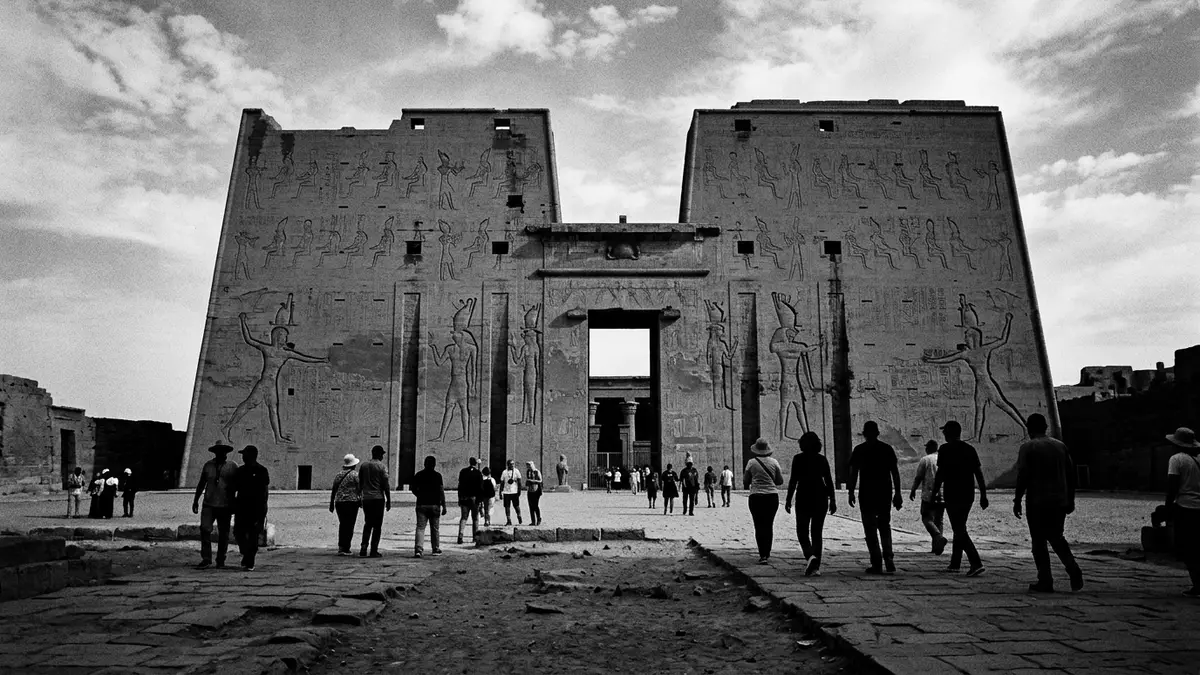
On the western bank of the Nile at Edfu in Upper Egypt, the Temple of Edfu stands as a vast sandstone complex dedicated to the falcon god Horus and laid out in the full Ptolemaic style.
A Ptolemaic temple completed in stone and inscription
The Temple of Edfu, also known as the Temple of Horus at Edfu, belongs to the Ptolemaic period and was constructed between 237 BC and 57 BC under successive Greek pharaohs ruling Egypt.
Construction began in 237 BC under Ptolemy III Euergetes I, and the work of building and decorating the temple continued under rulers including Ptolemy VIII and Ptolemy XII until final completion in 57 BC.construction between 237 BC and 57 BC The temple forms part of the Greco-Roman-period monuments of Egypt and shows how Ptolemaic builders adopted and extended older pharaonic temple forms.Greco-Roman period monuments
Layout, pylons and hypostyle halls
The Temple of Edfu follows a classical Egyptian temple plan, with a monumental pylon leading into an open court and then into covered halls supported by stone columns.
The complex extends for over 130 m (426 ft) along its main axis and reaches heights of more than 30 m (98 ft) at the pylon facade, giving visitors a clear sense of the scale achieved by Ptolemaic temple building.overall measurements of the temple Inside, the sequence from the court to the hypostyle hall and on towards the sanctuary mirrors older New Kingdom layouts, yet the stonework and reliefs belong to the later dynasty of Ptolemy.plan of Edfu temple
Reliefs, myth and cult of Horus of Behdet
The temple’s walls carry extensive reliefs and inscriptions linked to Horus of Behdet, the local form of the falcon god for whom Edfu was a major cult centre.
Narrative scenes carved on the sandstone depict rituals, offerings and mythological episodes, including the conflict between Horus and Seth, and the inscriptions record both religious texts and details about the building phases under different Ptolemaic rulers.dedication to Horus of Behdet The interior sequence culminates in a sanctuary area aligned along the temple axis, enclosed deep within the complex and marking the ritual heart of the site.dedicated temple complex
Visiting Temple of Edfu: what travellers from Western Europe should know
- The Temple of Edfu stands on the western bank of the Nile at Edfu in Upper Egypt, between Luxor and Aswan, and is reached by road and river transport.
- The approach from the town leads across level ground into the temple enclosure, after which visitors encounter stone pavements, sizeable courtyards and interior spaces with stone floors.
- The temple lies in a desert climate zone along the Nile valley, and the enclosure walls and high pylons rise above the surrounding townscape and riverbank.
Searching for Temple of Edfu on social platforms
These links open searches for Temple of Edfu on each platform.
Frequently asked questions about Temple of Edfu
Where is the Temple of Edfu located in Egypt?
The Temple of Edfu stands on the western bank of the Nile at the town of Edfu in Upper Egypt, between Luxor and Aswan.
What should visitors expect when entering the Temple of Edfu complex?
Visitors pass through a high sandstone pylon into an open court and then into roofed halls, moving deeper towards the sanctuary at the heart of the temple.
What makes the Temple of Edfu distinctive among Egyptian temples?
The Temple of Edfu combines a near-complete Ptolemaic temple layout with extensive reliefs dedicated to Horus, giving a clear sense of later pharaonic-style architecture in stone.


