
Temple of Edfu and the sandstone axis of Horus
Published on 08/23/2026 at 12:00 | Editorial responsibility: Rafael Müller, Editor-in-Chief AD HOC NEWS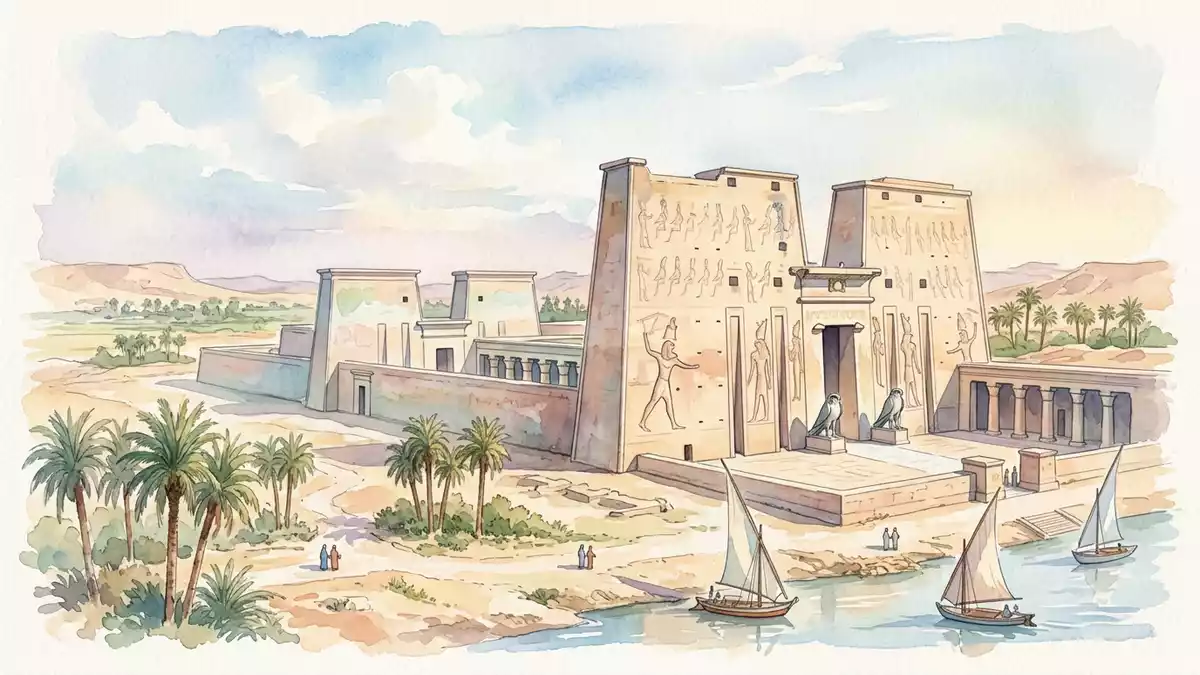
Temple of Edfu in southern Egypt lines up its pylons, courts and inner chambers along a straight sandstone axis, giving one of the clearest surviving ground plans of a Ptolemaic temple. Construction of the present complex began in 237 BC under Ptolemy III Euergetes and continued into the reign of Ptolemy XII Auletes, when work finished in 57 BC.
A Ptolemaic sanctuary on the Nile
Temple of Edfu stands on the west bank of the Nile at Edfu, between Luxor and Aswan, in a region where the river and the desert meet closely.Situated on the western bank of the Nile the sanctuary faces the river with its great entrance front. The whole complex is dedicated primarily to Horus of Behdet, the falcon god associated with kingship, whose cult gave the town its importance.Dedicated to the god Horus
The building history stretches across the Ptolemaic dynasty. Ptolemy III Euergetes initiated construction in 237 BC, and successive rulers of his line added courts, pylons and enclosure walls. Under Ptolemy XII Auletes, father of Cleopatra VII, the sandstone temple reached completion in 57 BC, after roughly 180 years of building and decoration.
Axis, courts and hypostyle halls
The plan of Temple of Edfu follows a sequence familiar from major Egyptian sanctuaries but survives here with unusual completeness. From the twin entrance pylons, visitors pass into a broad open court ringed by colonnades, then through progressively darker hypostyle halls towards the limestone and granite sanctuary at the heart of the complex.The hypostyle hall and peristyle court form key stages Every major space sits on the same central line, reinforcing the sense of a ceremonial route leading inward.
Behind the great hall of columns lie transverse chambers and chapels that cluster around the sanctuary of Horus, which contains a monolithic granite shrine. Walls, columns and door frames carry dense reliefs and hieroglyphic inscriptions, including long narrative texts collectively known as the Edfu Texts, which describe rituals and mythological episodes connected with Horus.The Edfu Texts cover large parts of the interior walls
Sandstone mass and carved surfaces
Temple of Edfu is built mainly of sandstone blocks, giving its walls and pylons a solid, continuous appearance. The entrance façade rises in two massive tapering towers, or pylons, whose smooth faces are carved with large-scale reliefs of Horus and related scenes from Ptolemaic religious life.Its sandstone pylons frame the main gate From the river, these forms read as a single monumental block marking the sacred precinct.
Inside, the columns of the hypostyle halls carry capitals inspired by Egyptian plant forms, and the walls are divided into registers filled with hieroglyphs and figures. The stone surfaces preserve details of Ptolemaic temple decoration, including scenes showing the falcon god Horus, Hathor of Dendera and their son Harsomtus in ritual settings.Reliefs depict Horus of Behdet, Hathor and Harsomtus The combination of heavy masonry and finely carved surfaces characterises the interior, from the open court to the innermost chapels.
Visiting Temple of Edfu: what travellers from Western Europe should know
- Temple of Edfu lies in Edfu on the west bank of the Nile between Luxor and Aswan, and is reached along the Nile corridor through southern Egypt.
- Within the enclosure visitors pass through the main pylons, cross an open stone court and continue into covered halls where floors and thresholds are made of solid masonry.
- The official language is Arabic and the currency is the Egyptian pound. Entry requirements depend on your nationality; UK travellers can check the FCDO travel advice at gov.uk/foreign-travel-advice, Irish travellers the Department of Foreign Affairs at ireland.ie.
Searching for Temple of Edfu on social platforms
These links open searches for Temple of Edfu on each platform.
Frequently asked questions about Temple of Edfu
Where is Temple of Edfu located?
Temple of Edfu stands on the west bank of the Nile at the town of Edfu in southern Egypt, between Luxor and Aswan.
What can visitors expect inside Temple of Edfu?
Visitors move from a large colonnaded court through hypostyle halls into chapels and a central sanctuary, with sandstone walls and columns covered in reliefs and hieroglyphs.
What makes Temple of Edfu distinctive among Egyptian temples?
Temple of Edfu preserves a nearly complete Ptolemaic temple layout in sandstone, with a clear axial sequence from pylons to sanctuary and extensive inscriptions known as the Edfu Texts.


