
Teotihuacan’s grand avenue of pyramids in Mexico
Published on 08/13/2026 at 14:06 | Editorial responsibility: Rafael Müller, Editor-in-Chief AD HOC NEWS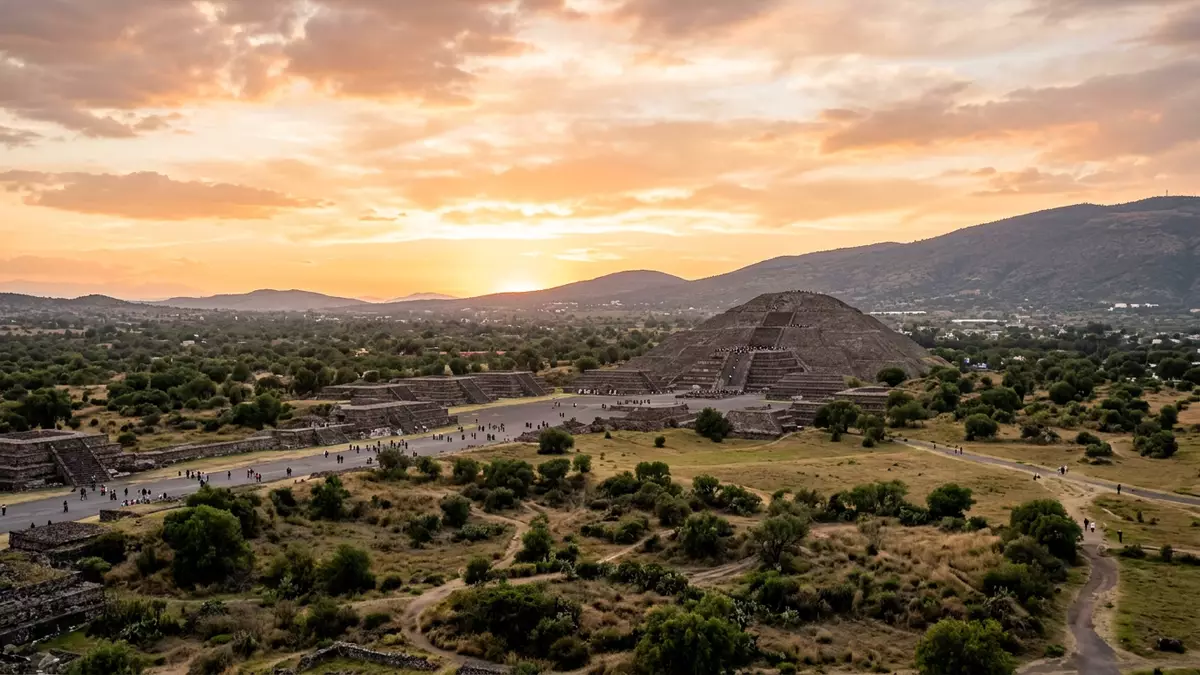
Teotihuacan near San Juan Teotihuacan in Mexico is an ancient Mesoamerican city laid out around a broad processional avenue flanked by monumental pyramids and plazas. Rising from a valley north-east of Mexico City, this pre-Hispanic urban landscape is defined by geometric order on a vast scale, a pattern still legible in stone and earthworks centuries after the city’s peak in the first millennium AD.
A pre-Hispanic metropolis on the Mexican plateau
The ruins of Teotihuacan lie in a sub-valley of the wider Valley of Mexico, within the municipality of San Juan Teotihuacan in the State of Mexico. The archaeological zone preserves the heart of a metropolis that grew between the first and seventh centuries AD, at a time when Teotihuacan became one of the major urban centres of ancient Mesoamerica.Built between the 1st and 7th centuries AD The city’s name is commonly translated as “the place where the gods were created”, a reflection of the sacred associations the site held for later cultures in central Mexico.
Teotihuacan today is recognised as a UNESCO World Heritage Site, a status granted in 1987 to the pre-Hispanic city and its monumental architecture.World Heritage listing in 1987 Within the protected area, the archaeological zone concentrates the main ceremonial and residential complexes, including large pyramids, platform mounds and compounds with mural painting documented by Mexico’s Instituto Nacional de Antropología e Historia.Zona Arqueológica de Teotihuacán
The Avenue of the Dead and the city’s ceremonial core
The organising feature of Teotihuacan’s central area is the broad Avenue of the Dead, a straight processional axis running roughly north–south through the ceremonial core. Along this avenue stand stepped platform mounds, plazas and the bases of temples, creating a sequence of open spaces framed by stone structures.Avenue of the Dead At the southern end of this axis lies La Ciudadela, a vast quadrangular complex whose central temple platform is associated with the Feathered Serpent, known in Nahuatl as Quetzalcoatl.Temple of the Feathered Serpent
From La Ciudadela, the Avenue of the Dead extends towards the north, where it meets the plaza of the Pyramid of the Moon. The arrangement of plazas and pyramids along the avenue reflects a planned ceremonial landscape, with major monuments aligned to the urban grid and surrounding residential compounds. The avenue’s width and length contribute to the sense of scale that characterises Teotihuacan’s central zone, even as many structures survive only as foundations or reconstructed platforms.
Pyramids of the Sun and Moon: mass and geometry
Teotihuacan’s most prominent structures rise beside the Avenue of the Dead as great stepped pyramids built from stone and earth. The Pyramid of the Sun dominates the central section of the avenue from the east side, its mass rising above the surrounding plazas and platforms.Pyramid of the Sun Constructed around 100 to 200 AD, this pyramid stands about 66 m (216 ft) high and measures roughly 220 m by 230 m (720 ft by 760 ft) at its base, making it one of the largest structures of its type in the Western Hemisphere.Height and base dimensions
Further north along the avenue, the Pyramid of the Moon closes the vista with another large stepped mass overlooking a plaza. While lower than the Pyramid of the Sun, it still rises several tens of metres above the surrounding terrain and anchors the northern ceremonial precinct.Pyramids of the Sun and the Moon These pyramids and the Temple of Quetzalcoatl within La Ciudadela together form the trio of major monuments that define the skyline of Teotihuacan’s archaeological zone.Sun, Moon and Quetzalcoatl temples
Visiting Teotihuacan: what travellers from Western Europe should know
- Teotihuacan lies north-east of Mexico City in the State of Mexico, with the archaeological zone located in and around the town of San Juan Teotihuacan. It is reached by road routes that follow the valley out from the capital.
- The core monuments stand on a plateau with broad plazas and stepped platforms; exploring the central area involves walking over firm ground with occasional climbs onto low terraces and staircases.
- The wider landscape around the archaeological zone is semi-arid highland terrain, with low hills such as Cerro Gordo near the Pyramid of the Sun and views across the Valley of Mexico.
- The official language is Spanish and the currency is the Mexican peso.
- Entry requirements depend on your nationality; UK travellers can check the FCDO travel advice at gov.uk/foreign-travel-advice, Irish travellers the Department of Foreign Affairs at ireland.ie.
Searching for Teotihuacan on social platforms
These links open searches for Teotihuacan on each platform.Frequently asked questions about Teotihuacan
Where is Teotihuacan and what kind of place is it?
Teotihuacan is an ancient pre-Hispanic city and archaeological site in the municipality of San Juan Teotihuacan in the State of Mexico, north-east of Mexico City.
What should visitors expect when exploring the site?
Visitors encounter a planned ceremonial centre organised along the Avenue of the Dead, with large stepped pyramids, plazas, platform mounds and residential compounds arranged on a broad urban grid.
What makes Teotihuacan distinctive among ancient cities?
The combination of vast pyramids such as the Pyramid of the Sun and the Pyramid of the Moon, the length of the Avenue of the Dead and the city’s geometric layout together give Teotihuacan an exceptional monumental character.


