
Tiantan and the measured ritual landscape of Peking
Published on 09/12/2026 at 06:26 | Editorial responsibility: Rafael Müller, Editor-in-Chief AD HOC NEWS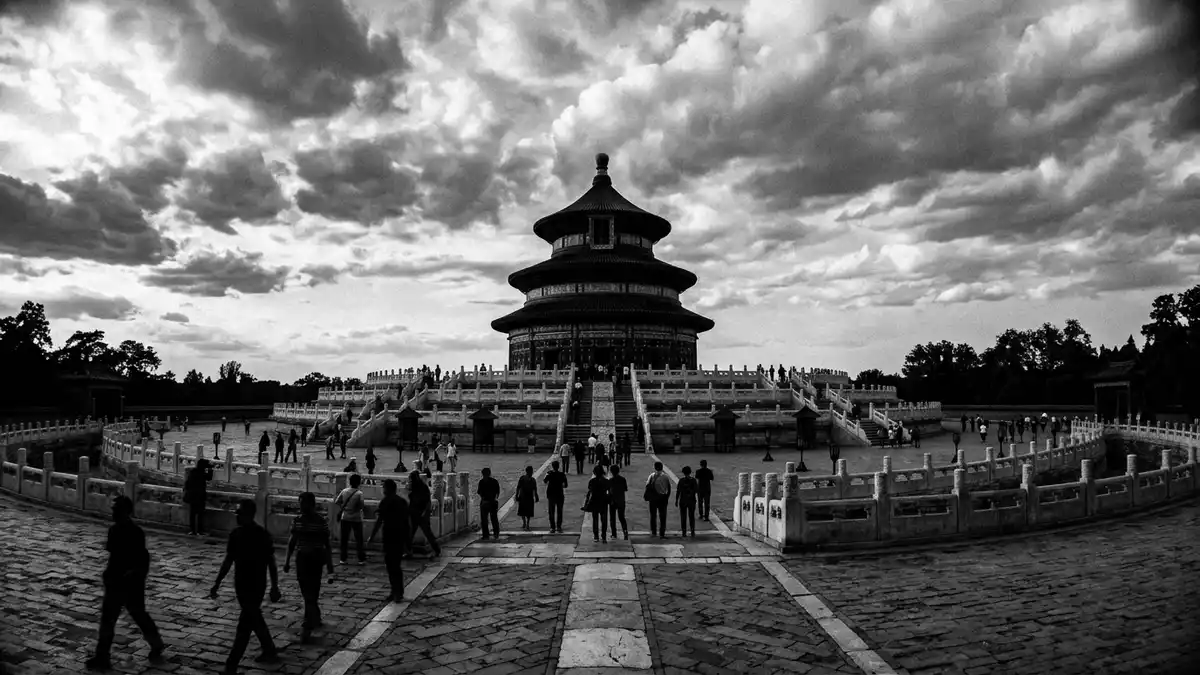
Tiantan in Peking is the common English name for the Temple of Heaven, a Ming dynasty ritual complex founded in the first half of the fifteenth century. Its most striking quality is not scale alone, but the ordered relationship between altars, halls, walls and gardens.
Tiantan’s imperial ritual layout
The Temple of Heaven was built in 1420 during the reign of the Ming Emperor Yongle and later extended under the Ming and Qing dynasties. Its World Heritage inscription dates from 1998, and the site remains one of Beijing’s best preserved imperial ceremonial ensembles.
The complex is laid out on a north-south axis. The Circular Mound Altar stands to the south, the Imperial Vault of Heaven lies to its north, and the Hall of Prayer for Good Harvests rises further north within the same ceremonial sequenceWorld Heritage inscription.
Walls, roofs and the garden enclosure
The enclosure combines a double wall, pine woods and formal buildings. The outer wall is described as semicircular in the north and square in the south, while the inner and outer spaces divide the main ritual buildings from the rest of the compoundouter surrounding wall.
UNESCO describes the property as a dignified complex of cult buildings set in gardens and surrounded by historic pine woods. The same account notes the site’s layout as a symbolic arrangement within Chinese cosmologyhistoric pine woods.
Ritual buildings and imperial ceremony
Tiantan was the place where Ming and Qing emperors offered sacrifices to Heaven and prayed for good harvests. The Hall of Prayer for Good Harvests, the Circular Mound Altar, the Fasting Palace and the Divine Music Administration remain the best-known parts of the compoundritual buildings.
The site is also associated with the Qing emperor Qianlong, whose reign saw further reconstruction, and with the Ming emperor Yongle, under whom the original altar was completed. Those names belong to the historic identity of the place, not to a single building phase aloneMing Emperor YongleQing emperors Qianlong.
Visiting Tiantan: what travellers from Western Europe should know
- The site lies in southern Peking, and Beijing Subway Line 5 serves the east gate while Line 8 serves the west gate.
- The compound has a double wall and a ceremonial axis, so the main buildings are spread across a large walled park rather than gathered in one courtyard.
- The outer wall is semicircular to the north and square to the south.
- The official language is Chinese and the currency is the renminbi.
- Entry requirements depend on your nationality; UK travellers can check the FCDO travel advice at gov.uk/foreign-travel-advice, Irish travellers the Department of Foreign Affairs at ireland.ie.
Searching for Tiantan on social platforms
These links open searches for Tiantan on each platform.
Frequently asked questions about Tiantan
Where is Tiantan?
Tiantan is in southern Peking, in Dongcheng District. It is the Temple of Heaven complex in Beijing.
What does a visit involve?
The place is a large walled ceremonial park with altars, halls, pine woods and broad axial spaces. The main buildings are separated across the compound, rather than gathered into a single block.
What makes Tiantan distinctive?
Its formal layout links heaven, earth and imperial ritual through walls, axes and freestanding cult buildings. The 1420 foundation and the 1998 World Heritage listing are central parts of its identity.


