
Times Square between neon towers and Broadway stages
Published on 09/08/2026 at 12:18 | Editorial responsibility: Rafael Müller, Editor-in-Chief AD HOC NEWS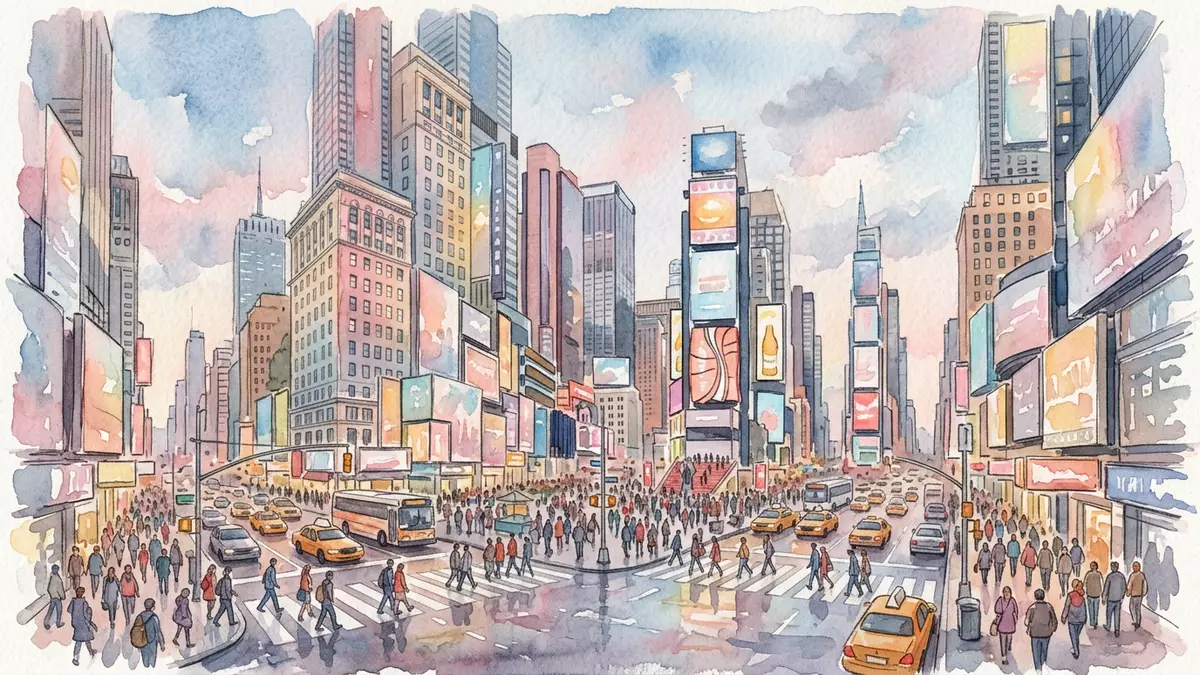
Times Square in New York City is a dense wedge of streets where Broadway and Seventh Avenue cut across the Midtown grid and tower blocks rise above illuminated advertising. It grew out of a crossroads once known as Longacre Square in the nineteenth century and took its present name in 1904, when The New York Times moved into the Times Tower on the square.
From Longacre Square to Times Square
In the nineteenth century the area that became Times Square lay on the western side of Midtown Manhattan and combined workshops, stables and housing around the junction of Broadway and what is now Seventh Avenue. City authorities designated the district Longacre Square, borrowing the name from London’s carriage-making quarter because this part of New York had become a centre for horse-related businesses and for William H. Vanderbilt’s American Horse Exchange.Longacre Square The land had earlier formed part of the estate of John Morin Scott, an American Revolution-era figure whose farm was gradually absorbed into the growing city.Scott’s farm
A decisive change came in the first years of the twentieth century, when publisher Adolph Ochs shifted The New York Times into a new headquarters on the square and persuaded Mayor George B. McClellan Jr. to authorise a subway station beneath it. On 8 April 1904 the city formally renamed the area Times Square in honour of the newspaper, and the Times Tower stood above tracks that connected the emerging theatre district with the rest of Manhattan.renamed in 1904 The paper later relocated its offices nearby, but the square retained both the name and the association with press and spectacle.
Broadway lights and electric billboards
At the turn of the twentieth century, theatre owners began clustering their venues around 42nd Street, using the central location and direct subway access to draw audiences into what became one of the most recognisable entertainment districts in the United States.theatres on 42nd Street Broadway came to be closely linked with American theatre and especially musical productions, and the blocks around Times Square filled with marquees, ticket offices and stage doors. The nickname “Crossroads of the World” reflected both the concentration of theatres and the flow of visitors moving through the junction day and night.
Electric advertising arrived alongside the theatres, and Times Square became a showcase for large illuminated billboards and signs. Neon technology spread during the 1920s, and vertical signboards mounted to building facades rose above the pavements, while screens and glowing banners wrapped around corners and tower roofs.neon signs in the 1920s The space between the buildings narrowed into canyons of light where advertising occupies multiple storeys, and street-level displays compete with screens mounted high above traffic. Even away from the main junction, the side streets carry a dense mix of signage, theatre fronts and shops that extend the visual field beyond a single square.
Celebrations, decline and renewal
Almost as soon as it acquired its new name, Times Square became a gathering point for New Year celebrations, with crowds converging beneath the Times Tower to mark the change of year. In 1907 the newspaper introduced the lowering of a large illuminated ball from the tower’s flagpole at midnight on 31 December, creating a ritual that has been repeated annually except during the Second World War.New Year’s Eve ball drop The square has also formed the backdrop for major public gatherings, including celebrations at the end of conflicts, because of its symbolic status and the amount of urban space that opens at the crossing of several wide streets.
The district’s character shifted during the twentieth century as theatres closed or changed use during the Great Depression and later decades. Some performance spaces converted into cinemas, and by the 1960s and 1970s the area gained a reputation for adult entertainment venues and street crime that contrasted sharply with the festive image of the neon-lit junction.adult entertainment centre In the late twentieth century redevelopment projects led by New York City administrations and supported by major companies such as Disney began reshaping the streetscape, encouraging the restoration of historic theatres on 42nd Street and the arrival of branded shops and restaurants that sit alongside long-established venues.
Street layout and built form
The geometry of Times Square owes much to the angle at which Broadway cuts across the grid of numbered streets and avenues in Midtown Manhattan. Where Broadway meets Seventh Avenue around 42nd Street and nearby blocks, triangular traffic islands and irregular building plots appear between the streets, forming spaces that function as plazas or widened pavements rather than conventional rectangular squares.Broadway crossing The result is a series of linked spaces rather than a single enclosed square, with roadways and pedestrian zones weaving between tower bases.
The buildings themselves range from early twentieth-century towers such as One Times Square to later glass-fronted high-rises and large-format retail structures, many of them carrying advertising on their facades. Some historic theatres on 42nd Street retain earlier architectural details behind updated fronts, while adjacent buildings present flat surfaces designed to carry screens and billboards. Viewed from street level, the corridor of Broadway through Times Square rises between tall structures whose heights and signage vary, creating a layered skyline above the traffic and crowds at ground level.tower blocks and signage
Visiting Times Square: what travellers from Western Europe should know
- Times Square occupies the junction of Broadway and Seventh Avenue in Midtown Manhattan, with the main cluster of theatres extending along 42nd Street nearby.
- The streets and pavements around the square are on level ground but can feel enclosed by high-rise buildings and are crossed by several multi-lane roads.
- New York City Subway services stop at Times Square–42nd Street station beneath the square, linking it with other parts of Manhattan and the wider city.
- The official language is English and the currency is the United States dollar.
- Entry requirements depend on your nationality; UK travellers can check the FCDO travel advice at gov.uk/foreign-travel-advice, Irish travellers the Department of Foreign Affairs at ireland.ie.
Searching for Times Square on social platforms
These links open searches for Times Square on each platform.
Frequently asked questions about Times Square
Where is Times Square located in New York City?
Times Square lies in Midtown Manhattan where Broadway and Seventh Avenue intersect around 42nd Street, forming a cluster of streets and small plazas rather than a single enclosed square.
What should a visitor expect on a first visit?
A visit centres on walking through canyons of high-rise buildings lined with theatres, shops and large illuminated billboards, with traffic moving across several junctions and crowds filling the pavements.
What makes Times Square distinctive among New York districts?
The combination of the Broadway theatre district, the angled street layout and the concentration of neon-lit advertising gives Times Square a visual character and density that differ from other parts of New York City.


