
Tiwanaku and the stone architecture of the high Andes
Published on 09/24/2026 at 04:59 | Editorial responsibility: Rafael Müller, Editor-in-Chief AD HOC NEWS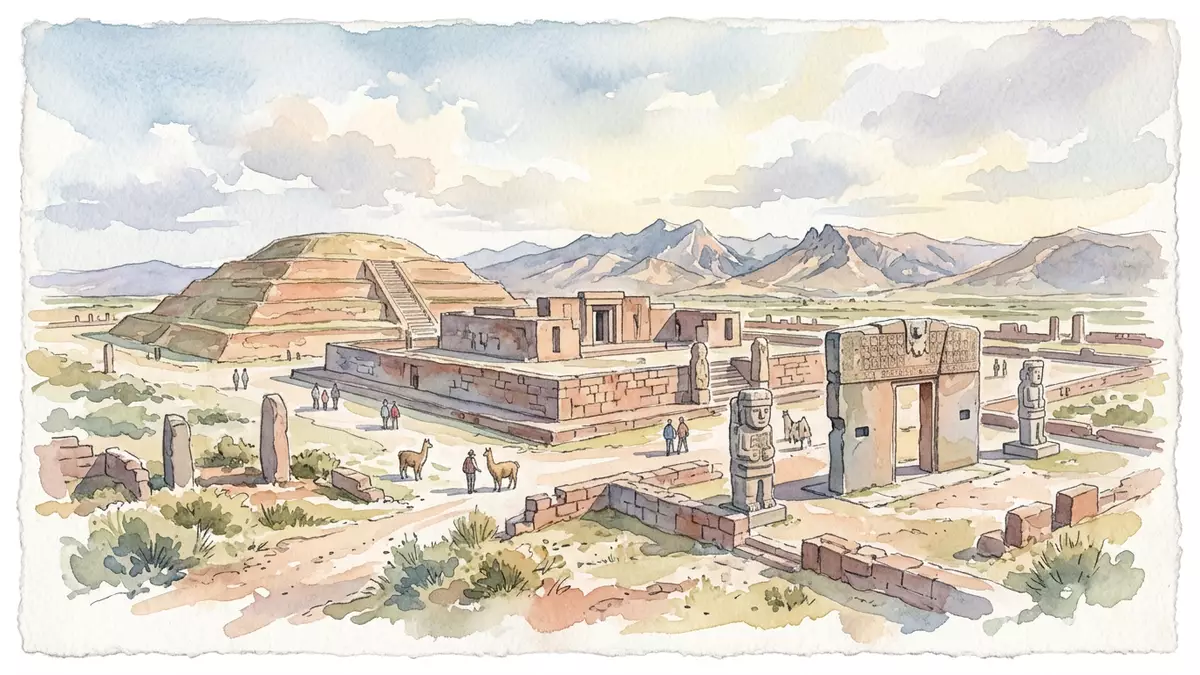
Tiwanaku is an archaeological city on Bolivia’s Altiplano, near the southern shore of Lake Titicaca. Its monumental core is defined by cut stone, broad platforms, carved figures and open ceremonial enclosures that belong to a pre-Hispanic Andean civilisation.
Tiwanaku: a city shaped in stone
The site lies at an altitude of about 3,850 metres (12,600 ft) in the Department of La Paz. The high plateau stretches around the ruins, while the surviving architecture gathers into a sequence of platforms, temples, courtyards and monumental gateways.
Tiwanaku reached its apogee between 500 and 900 AD, when its political and cultural influence extended across parts of the southern Andes. The city was the centre of a state whose artistic language appears in architecture, sculpture, ceramics and metalwork.
The Akapana, Kalasasaya and the Semi-Subterranean Temple
The Akapana is a stepped platform mound faced with cut andesite. Its broad mass differs from the upright blocks and enclosed spaces found elsewhere in the ceremonial centre. The structure remains a defining feature of the archaeological landscape.
Kalasasaya is an open enclosure built on a raised platform, with tall stone columns and smaller rectangular blocks. The UNESCO World Heritage inscription identifies Tiwanaku’s buildings as exceptional examples of ceremonial and public architecture in the Andean region.
The Semi-Subterranean Temple is set below the surrounding ground level. Stone heads appear within its walls, creating a distinct sculptural environment beside the larger platforms and enclosures.
The Gate of the Sun and Tiwanaku’s wider cultural world
The Gate of the Sun is a monolithic stone gateway carved with a central figure and rows of smaller forms. Its surface combines architectural mass with finely worked relief, making it one of the site’s most recognisable objects.
Tiwanaku began as a settlement around 1200 BCE and developed into a major centre across the following centuries. A recorded early settlement date places its village period in the second millennium BCE.
The city’s influence reached areas corresponding to present-day Bolivia, Peru, Chile and Argentina. Its buildings and sculpture belong to a cultural tradition distinct from the Inca world, although Tiwanaku’s legacy forms part of the longer history of Andean architecture.
Tiwanaku also remains connected with Aymara cultural identity. Its stonework presents a historical landscape rather than a single monument: platforms, gateways, carved stelae and temple spaces stand together across the archaeological complex.
Visiting Tiwanaku: what travellers from Western Europe should know
- Tiwanaku lies west of La Paz, near Lake Titicaca, on the Bolivian Altiplano. Road transport from La Paz is the usual way to reach the archaeological complex.
- The site is at about 3,850 metres (12,600 ft), so the altitude forms part of the physical setting. The grounds include broad open areas, raised platforms and uneven archaeological surfaces.
- The official language is Spanish and the currency is the Bolivian boliviano.
- Entry requirements depend on your nationality; UK travellers can check the FCDO travel advice at gov.uk/foreign-travel-advice, Irish travellers the Department of Foreign Affairs at ireland.ie.
Searching for Tiwanaku on social platforms
These links open searches for Tiwanaku on each platform.
Frequently asked questions about Tiwanaku
Where is Tiwanaku?
Tiwanaku is in western Bolivia, near the southern shore of Lake Titicaca. The archaeological site lies in the Department of La Paz on the Altiplano.
What can visitors see at Tiwanaku?
The main remains include the Akapana platform, the Kalasasaya enclosure, the Semi-Subterranean Temple, carved stelae and the Gate of the Sun.
What makes Tiwanaku distinctive?
Its identity rests on the combination of high-altitude setting, monumental stone architecture and sculpture from a civilisation that flourished between 500 and 900 AD.


