
Tiwanaku, Bolivia’s high-altitude ceremonial city of stone
Published on 08/19/2026 at 22:24 | Editorial responsibility: Rafael Müller, Editor-in-Chief AD HOC NEWS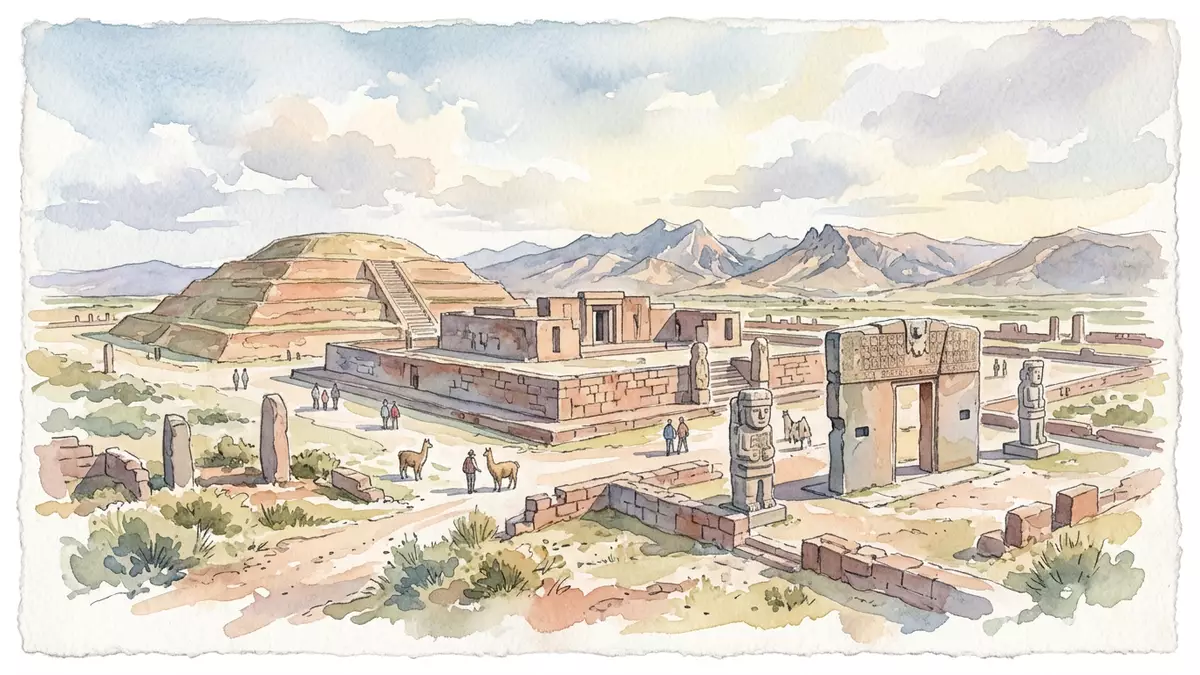
On the Bolivian Altiplano, Tiwanaku presents an expansive ceremonial city of stone platforms, temple enclosures and carved monoliths set at high altitude. Recognised as Tiwanaku: Spiritual and Political Centre of the Tiwanaku Culture, it stands as a UNESCO World Heritage archaeological site dating to the first millennium AD.
The Andean setting and scale of Tiwanaku
Tiwanaku lies in the Department of La Paz in western Bolivia, near the southern shores of Lake Titicaca on the Altiplano plateau at an elevation of around 3,850 m (12,630 ft) above sea level.near the southern shores of Lake Titicaca The surrounding landscape is a broad, open plain framed by distant Andean ranges, which makes the low but extensive stone constructions of the site stand out clearly against the horizon.
The civic and ceremonial centre occupies a defined core of stone monuments within a wider area of archaeological remains that extend across the Altiplano surface.civic and ceremonial centre Much of the ancient city beyond this stone core was built in adobe and has been overtaken by the present-day town, but the principal temples and platforms remain in protected zones that visitors can walk through along marked paths.
Monumental platforms, courts and carved stones
The monumental heart of Tiwanaku consists of a sequence of platforms, walled courts and freestanding monoliths that articulate a planned ceremonial complex.planned city One of the most prominent structures is the Akapana, a stepped platform that rises above the surrounding terrain with a broad summit and flanking terraces built from large stone blocks.
To one side stands the Kalasasaya, a raised rectangular enclosure defined by tall stone uprights and lower walls, with gateways leading into an interior space that contains carved stelae and the celebrated Gateway of the Sun.Gateway of the Sun Nearby, a semi-subterranean temple presents a sunken courtyard lined with stone blocks, many of them bearing carved faces that peer out from the walls. Further away, the complex of Pumapunku is formed by low platforms, finely cut stone blocks and architectural elements lying close to the surface, inviting close inspection of their joins and reliefs.
Tiwanaku as capital of a pre-Columbian Andean state
Archaeological and historical research places the flourishing of Tiwanaku between about AD 500 and 900, when the city functioned as the political and ceremonial centre of a powerful Andean state.apogee between 500 and 900 AD From this highland capital, Tiwanaku influence extended across large parts of what is now Bolivia, Peru, Chile and Argentina through networks of settlement, ritual and agricultural infrastructure.
Tiwanaku is closely associated with Aymara-speaking communities of the region and holds significance in Bolivian cultural identity as a national emblem of pre-Hispanic civilisation.symbol of Bolivian national identity The site was inscribed on the UNESCO World Heritage List in 2000, underlining its role as a spiritual and political centre whose monumental remains document an Andean civilisation distinct from neighbouring cultures.inscribed on the World Heritage List in 2000
Visiting Tiwanaku: what travellers from Western Europe should know
- Tiwanaku lies in the La Paz Department of Bolivia, west of the city of La Paz, and is reached by road across the Altiplano from the metropolitan area.
- The site stands at around 3,850 m (12,630 ft), and moving between the main platforms, sunken courts and enclosures involves walking on uneven ground and climbing stone steps.
- The archaeological core of Tiwanaku sits close to a small town with basic services; the official language is Spanish and the currency is the Boliviano.
- Bolivia lies outside the UK, Ireland and the EU. Entry requirements depend on your nationality; UK travellers can check the FCDO travel advice at gov.uk/foreign-travel-advice, Irish travellers the Department of Foreign Affairs at ireland.ie.
Searching for Tiwanaku on social platforms
These links open searches for Tiwanaku on each platform.
Frequently asked questions about Tiwanaku
Where is Tiwanaku and what kind of place is it?
Tiwanaku is an archaeological site in the Department of La Paz in western Bolivia, near the southern shore of Lake Titicaca on the Altiplano.
What should visitors expect when walking through Tiwanaku?
Visitors encounter stepped platforms, sunken courtyards, walled enclosures and carved monoliths in stone, spread across open ground at high altitude with some uneven surfaces.
What makes Tiwanaku distinctive among Andean archaeological sites?
Tiwanaku combines a planned ceremonial centre with monumental architecture, intricate stone carving and a documented role as the spiritual and political capital of a major Andean state.


