
Todai-ji and the Great Buddha hall shaping Nara’s skyline
Published on 08/16/2026 at 14:16 | Editorial responsibility: Rafael Müller, Editor-in-Chief AD HOC NEWS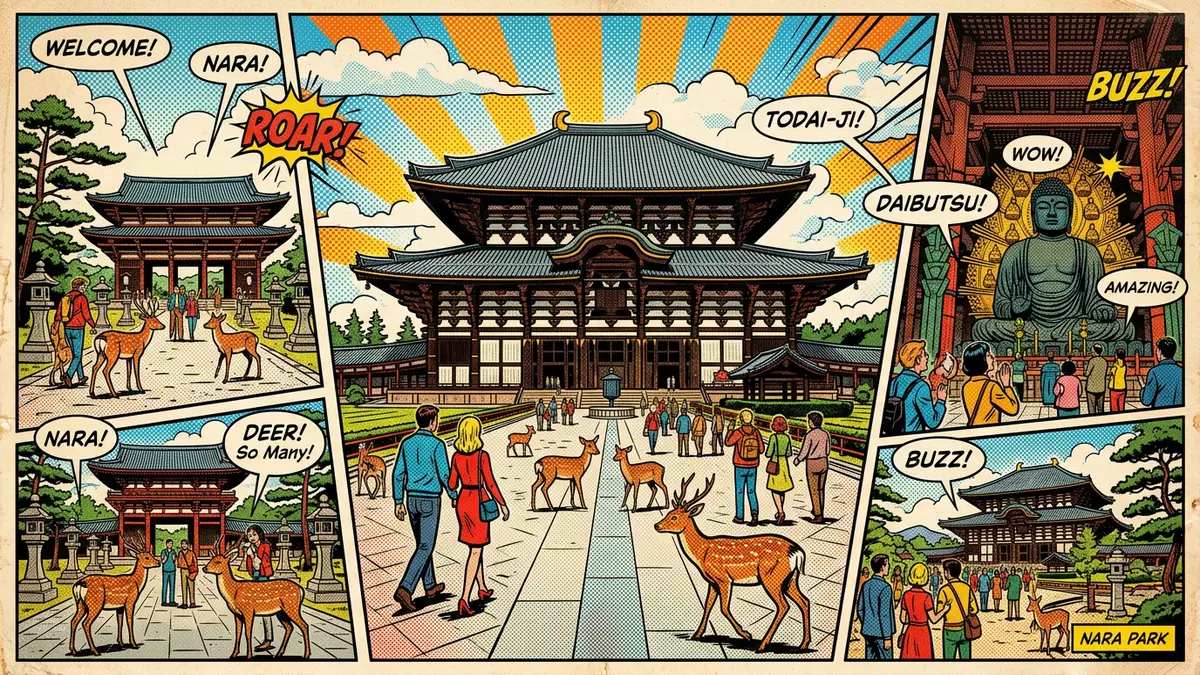
Todai-ji in Nara is a Buddhist temple complex where an immense wooden hall and a bronze Great Buddha statue dominate both the skyline and the story of early Japanese Buddhism. Built under Emperor Sh?mu in the eighth century, it later became part of the UNESCO-listed Historic Monuments of Ancient Nara, fixing this collection of buildings and grounds among Japan’s most carefully protected religious landscapes.
The Great Buddha and its wooden hall
At the heart of Todai-ji stands the Daibutsuden, or Great Buddha Hall, a timber structure housing a monumental bronze image of Vairocana Buddha known locally as the Daibutsu.The Great Buddha Hall The present hall dates from the Edo period, rebuilt under the monk K?kei after earlier fires, and extends over a footprint that reads as one of the defining timber constructions of its era.Todai Temple history Inside, the bronze Buddha rises above seated visitors, flanked by other sculpted figures and backed by a complex of wooden supports and roof beams that draw the eye up towards the ceiling.
The hall’s timber frame and tiled roof form a massive volume that has often been described through its measurements, with the building recorded at over 50 m (164 ft) in length and nearly that again in width.Great Buddha Hall dimensions The bronze Daibutsu itself dates to the eighth century and occupies a raised platform, creating a vertical sequence from the stone base of the hall through wooden flooring to the gilded surfaces of the statue.Bronze Vairocana Buddha Walking through the hall, visitors pass supporting pillars and side altars before reaching the main image, making the approach part of the way the building reveals its scale.
A temple of the Kegon school in Nara’s religious landscape
Todai-ji was founded in the eighth century under the patronage of Emperor Sh?mu as the head temple of the Kegon school of Buddhism, a tradition drawing on the Avatamsaka Sutra and associated with elaborate doctrinal systems.Head temple of the Kegon school The temple grew into a complex of halls and gates at the northern edge of what is now Nara Park, forming one of the Seven Great Temples that once marked the city’s status as Japan’s capital.Nara Great Buddha temple Within this complex, the Daibutsuden sits alongside spaces such as the Hokke-d? (also called Sangatsu-d?) and the Kaidan-d?, each with its own set of images and ritual roles.
Todai-ji forms one component of the “Historic Monuments of Ancient Nara” World Heritage inscription, which brings together several temples, a shrine, an archaeological palace site and the forested slopes of Kasugayama.Historic Monuments of Ancient Nara The temple precinct occupies tens of hectares, connected to parkland where deer roam and paths lead towards other religious sites.World Heritage map entry for Todai-ji This setting means that a visit to Todai-ji rarely stands alone: the temple’s gates, lantern-lined approaches and side halls interlock visually and spatially with the wider Nara landscape.
Layouts, gates and approaches
The Todai-ji complex is entered through large wooden gates, with the Nandaimon acting as a principal southern entrance where guardian statues stand within a deep timber frame.Todai-ji temple complex From here, broad paths cross lawns and pass stone lanterns before rising towards the Daibutsuden terrace. Within the grounds, subsidiary halls sit to the east and west, while storehouses and administrative buildings complete the picture of a functioning temple.
The complex lies in the northern part of Nara Park, reached on foot or by city bus from Nara’s railway stations, with the address recorded as Z?shi-ch? in Nara City.Todaiji Temple location Within the park, Todai-ji’s roofs rise above trees, while open courtyards and stone-paved areas offer different perspectives on the hall’s mass and the seated Buddha inside.Todai-ji Temple address and setting Moving between these spaces, visitors encounter a mixture of timber architecture, bronze statuary and landscaped ground that together define the temple’s character.
Visiting Todai-ji: what travellers from Western Europe should know
- Todai-ji stands in the northern section of Nara Park in Nara City, with approaches from both JR Nara Station and Kintetsu Nara Station on the city’s rail lines.
- Within the complex, the walk from the main southern gate to the Great Buddha Hall crosses open ground and involves gentle gradients and steps up to the hall’s raised platform.
- In warm seasons, tree cover in Nara Park provides shade along parts of the approach, while open courtyards around the Daibutsuden expose visitors to direct sun and reflect light from stone surfaces.
- The official language is Japanese and the currency is the yen; signage at Todai-ji includes a mixture of Japanese characters and romanised names.
- Entry requirements depend on your nationality; UK travellers can check the FCDO travel advice at gov.uk/foreign-travel-advice, Irish travellers the Department of Foreign Affairs at ireland.ie.
Searching for Todai-ji on social platforms
These links open searches for Todai-ji on each platform.
Frequently asked questions about Todai-ji
Where is Todai-ji located?
Todai-ji stands in Nara City in central Japan, occupying the northern part of Nara Park with its official address in the Z?shi-ch? district.
What can visitors expect when they enter Todai-ji?
Visitors pass through large timber gates, cross lawns and stone-lined paths, and finally reach the Great Buddha Hall, where an immense bronze Buddha sits inside a vast wooden interior.
What makes Todai-ji distinctive among Japanese temples?
The combination of its eighth-century foundation under Emperor Sh?mu, its role as head temple of the Kegon school and its World Heritage-recognised complex dominated by the Daibutsuden and Daibutsu makes Todai-ji distinctive.


