
Topkapi Sarayi and the courtyards of Ottoman power
Published on 09/24/2026 at 12:01 | Editorial responsibility: Rafael Müller, Editor-in-Chief AD HOC NEWS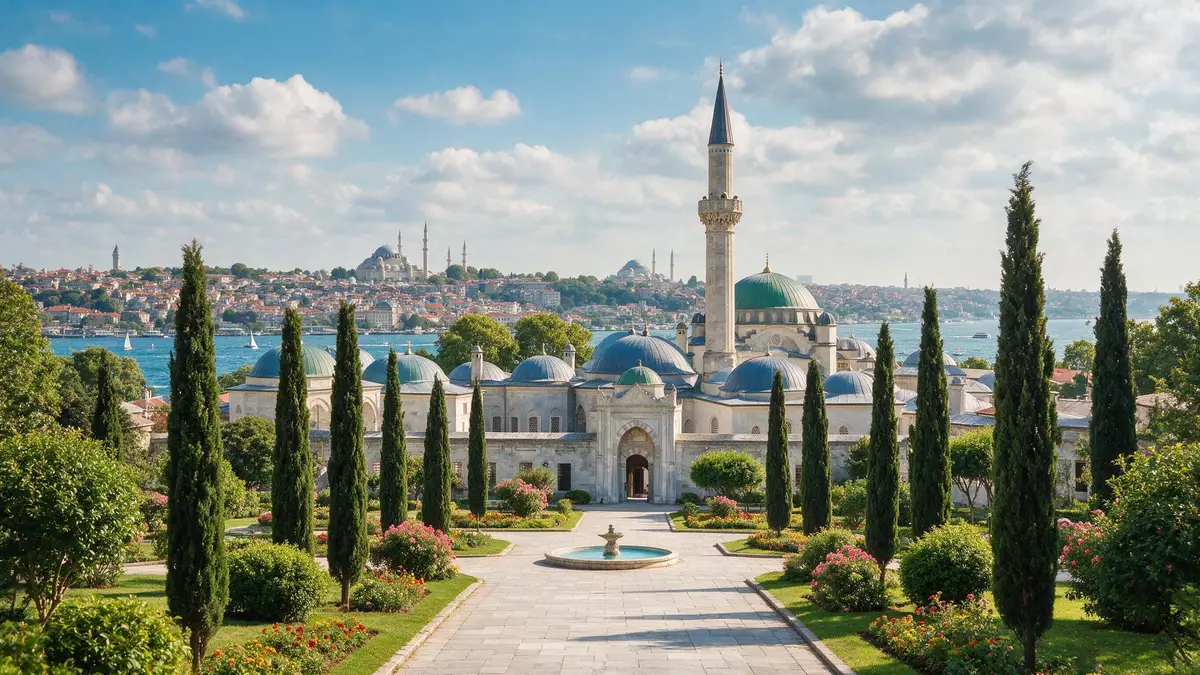
Topkapi Sarayi spreads across Istanbul’s historic peninsula as a palace of courtyards, pavilions, gardens and collections. Built under Sultan Mehmed II after the Ottoman conquest of Constantinople, it served as an imperial residence and administrative centre until 1856.
Its defining feature is not a single monumental façade, but the gradual movement through enclosed spaces. Ottoman architecture, ceremonial routes, gardens and museum rooms appear in sequence, creating a complex whose character comes from its layered plan.
Topkapi Sarayi: a palace arranged through courtyards
Construction began in 1460, and the palace reached its principal form in the fifteenth century. The complex occupies Sarayburnu, the promontory where the historic peninsula meets the Bosphorus and the Golden Horn.
Topkapi Sarayi developed through successive additions. Its courtyards connect gateways, reception spaces, kitchens, pavilions, treasury rooms and garden terraces. The arrangement belongs to Ottoman palace architecture, where separate buildings form a larger courtly landscape.
The palace served as the residence and administrative centre of Ottoman sultans from about 1478 to 1856. Its function included government, ceremony, education and artistic production, while the imperial household occupied adjoining parts of the complex.
From imperial residence to museum collection
The court moved to Dolmabahçe Palace in 1856. Topkapi Sarayi became a museum on 3 April 1924, during the early Turkish Republic, and its buildings acquired a public cultural function.
The museum preserves imperial collections associated with the Ottoman court. Displays include manuscripts, weapons, ceremonial objects, textiles, porcelain, religious relics and works of calligraphy.
The Imperial Treasury contains objects made from precious metals and stones. The collection is associated with Ottoman dynastic history, while the palace library preserves books and manuscripts connected with the intellectual life of the court.
The former Harem occupies a distinct section of the complex. Its rooms, tiled surfaces, courtyards and passages record the domestic organisation of the imperial household without reducing the palace to a single ceremonial space.
Tiles, pavilions and Istanbul’s historic peninsula
Topkapi Sarayi combines restrained exterior buildings with richly decorated interiors. Iznik tiles, carved wood, painted surfaces, marble elements and metalwork appear across rooms and courtyards.
The palace’s pavilions look towards the Bosphorus and the Golden Horn. Their position within the gardens gives the complex a close relationship with Istanbul’s waterfront geography.
One of the most recognisable spaces is the Divan courtyard, associated with the imperial council and its administrative work. The Imperial Council chamber, gates and arcades form a compact group within the larger palace plan.
The palace belongs to the Historic Areas of Istanbul, inscribed on the UNESCO World Heritage List in 1985. The designation includes Topkapi Palace alongside other historic monuments on the peninsula, including Hagia Sophia and major Ottoman mosque complexes.
Topkapi Sarayi therefore reads as both a building and a district of buildings. Its courtyards preserve the scale of an imperial institution, while its collections bring objects from that institution into museum galleries.
Visiting Topkapi Sarayi: what travellers from Western Europe should know
- Topkapi Sarayi is in Sarayburnu, within Istanbul’s historic peninsula. It lies near Hagia Sophia, the former Byzantine centre that forms part of the same historic urban area.
- The palace is reached through Istanbul’s historic city centre. Tram services connect the peninsula with other central districts, and nearby streets include steep sections and extensive pedestrian paving.
- The complex contains courtyards, gardens, galleries and separate palace sections. A visit involves walking between buildings and crossing uneven historic surfaces.
- The official language is Turkish and the currency is the Turkish lira.
Searching for Topkapi Sarayi on social platforms
These links open searches for Topkapi Sarayi on each platform.Frequently asked questions about Topkapi Sarayi
Where is Topkapi Sarayi?
Topkapi Sarayi stands in Sarayburnu on Istanbul’s historic peninsula, between the Bosphorus and the Golden Horn. Hagia Sophia and other historic monuments are nearby.
What does a visit include?
The complex includes courtyards, gardens, pavilions, palace chambers, treasury displays, religious relics, manuscripts and the former Harem section.
What makes Topkapi Sarayi distinctive?
Its identity comes from the combination of an Ottoman palace plan and museum collections. The complex presents imperial architecture and court objects across connected courtyards.


