
Tottori Sakyu, Japan’s coastal desert of wind-shaped sand
Published on 09/10/2026 at 13:04 | Editorial responsibility: Rafael Müller, Editor-in-Chief AD HOC NEWS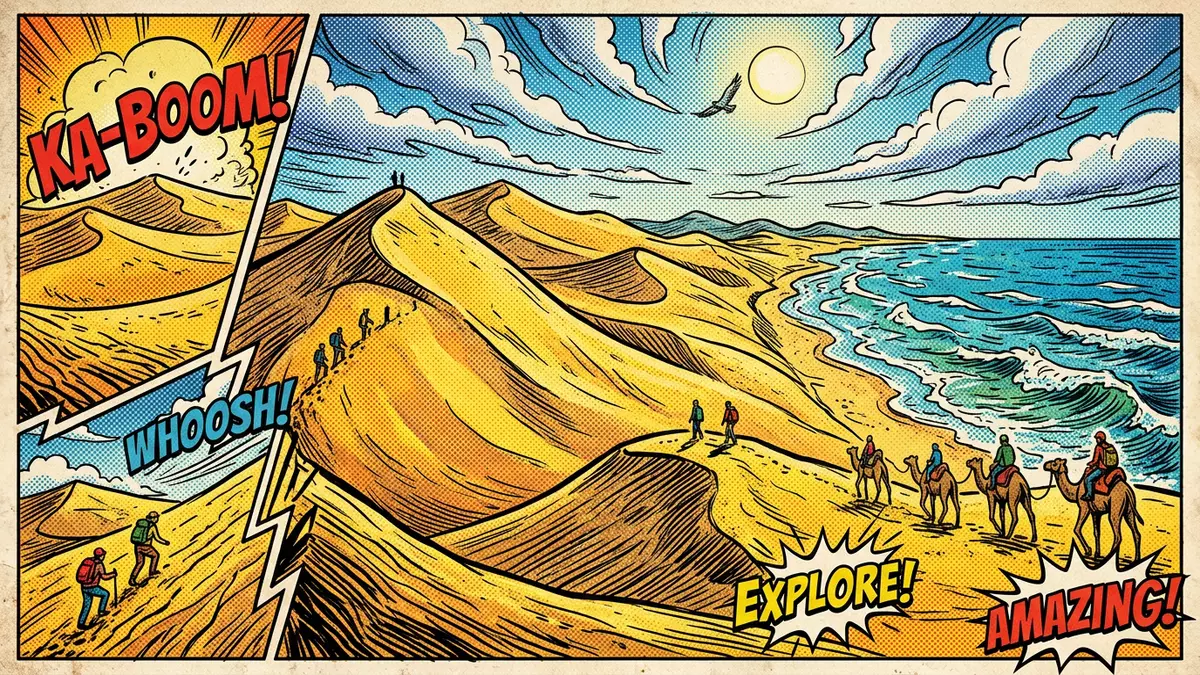
Tottori Sakyu, known in English as the Tottori Sand Dunes, is a coastal dune landscape on the Sea of Japan just outside the city of Tottori in western Honshu. Stretching for many kilometres along the shoreline and rising to dune ridges tens of metres high, it forms Japan’s largest coastal sand-dune field and sits within the wider San’in Kaigan National Park and UNESCO Global Geopark.
A ribbon of sand between sea and city
Tottori Sakyu occupies a strip of coast north-east of central Tottori City, where the Sendai River reaches the Sea of Japan and loose sand has accumulated into a broad dune belt. Measured along the shore, the dune field runs for roughly 16 km (10 mi) east to west and reaches about 2.4 km (1.5 mi) inland at its broadest point, creating a sizeable area of undulating sand between the sea and the settled hinterland.dunes stretching 16 km Within this band, the tallest dune crests rise to around 50 m (164 ft) above sea level, providing elevated viewpoints over the waves of the Sea of Japan and the agricultural plain behind.up to 50 metres high
The Sendai River plays a central role in the landscape’s formation. Sand from upstream is transported to the river mouth, where coastal currents and prevailing winds rework it into dune ridges and hollows that shift subtly over the years.sand carried by the Sendai River The result is a series of slopes facing different directions, some running down towards the sea and others dipping into sheltered depressions. Standing on the higher ridges, the transition from planted fields in the interior to open sand by the water is striking, with the city of Tottori visible in the distance beyond the dune fringe.
National park protection and geopark recognition
Beyond its visual impact, Tottori Sakyu carries formal protection within Japan’s system of conserved landscapes. The dunes form part of San’in Kaigan National Park, a coastal park that traces sections of the Sea of Japan shoreline across Tottori, Hyogo and Kyoto prefectures.part of Sanin Kaigan National Park Within this framework, Tottori Sakyu is recognised as a National Natural Monument, highlighting both its rarity in the Japanese context and its scientific interest.designated as a National Natural Monument
The dunes also sit at the heart of the San’in Kaigan UNESCO Global Geopark, an area acknowledged for geological sites of international significance.San’in Kaigan UNESCO Global Geopark In this context, Tottori Sakyu illustrates how river sediment, coastal currents and wind can combine to build a large dune field in a temperate setting. The geopark designation, confirmed in 2015, places the dunes alongside other notable rock formations and coastal features in the region and underlines the importance of conserving both the physical landforms and the ecological communities that have adapted to life on shifting sand.designation as a UNESCO Global Geopark in 2015
Experiencing the dunes at ground level
On foot, Tottori Sakyu reveals patterns and textures that are less obvious from a distance. Wind-formed ripples run across exposed surfaces, while steeper slip faces mark the leeward sides of dune ridges. In places, the sand is interrupted by patches of stabilising vegetation, and shallow hollows can retain moisture that supports specialised plants and small animals.depressions with flora and fauna The contrast between bare slopes, vegetated pockets and glimpses of the sea reinforces the character of Tottori Sakyu as a meeting point between marine and terrestrial environments rather than a uniform desert.
The dunes have long attracted visitors from across Japan and beyond, and a cluster of facilities has emerged near the main access points. A visitor centre introduces the geology and ecology of the dune field, while paths and waymarked routes lead from the built-up edge onto the sand itself.Tottori Sand Dunes Visitor Center Climbing a higher ridge offers wide views across the San’in Kaigan coastline, with the Sea of Japan stretching out in front and low hills framing the horizon behind Tottori City. The sense of scale is amplified by the absence of large structures on the sand, leaving the contours of the dunes as the dominant feature.
Visiting Tottori Sakyu: what travellers from Western Europe should know
- Tottori Sakyu lies on the Sea of Japan coast just outside Tottori City in Tottori Prefecture, on the western side of Japan’s main island of Honshu. Access is commonly via JR Tottori Station and onward local buses that run to stops near the main dune entrance.
- The terrain consists of soft sand with a mixture of gentle slopes and steeper climbs; walking on the dunes involves sustained effort and requires footwear suitable for sandy gradients.
- The official language is Japanese and the currency is the yen.
- Entry requirements depend on your nationality; UK travellers can check the FCDO travel advice at gov.uk/foreign-travel-advice, Irish travellers the Department of Foreign Affairs at ireland.ie.
Searching for Tottori Sakyu on social platforms
These links open searches for Tottori Sakyu on each platform.
Frequently asked questions about Tottori Sakyu
Where is Tottori Sakyu located?
Tottori Sakyu lies on the Sea of Japan coast just outside the city of Tottori in Tottori Prefecture, on the western side of Japan’s main island of Honshu.
What can visitors expect on a visit to the dunes?
Visitors encounter a wide area of coastal sand with ridges, hollows and wind-shaped ripples, along with views over the Sea of Japan and nearby farmland and hills.
What makes Tottori Sakyu distinctive compared with other Japanese landscapes?
The dune field is recognised as Japan’s largest coastal sand-dune system and is both a National Natural Monument and a core site within the San’in Kaigan UNESCO Global Geopark.


