
Tower Bridge and its twin towers over the Thames
Published on 08/20/2026 at 07:22 | Editorial responsibility: Rafael Müller, Editor-in-Chief AD HOC NEWS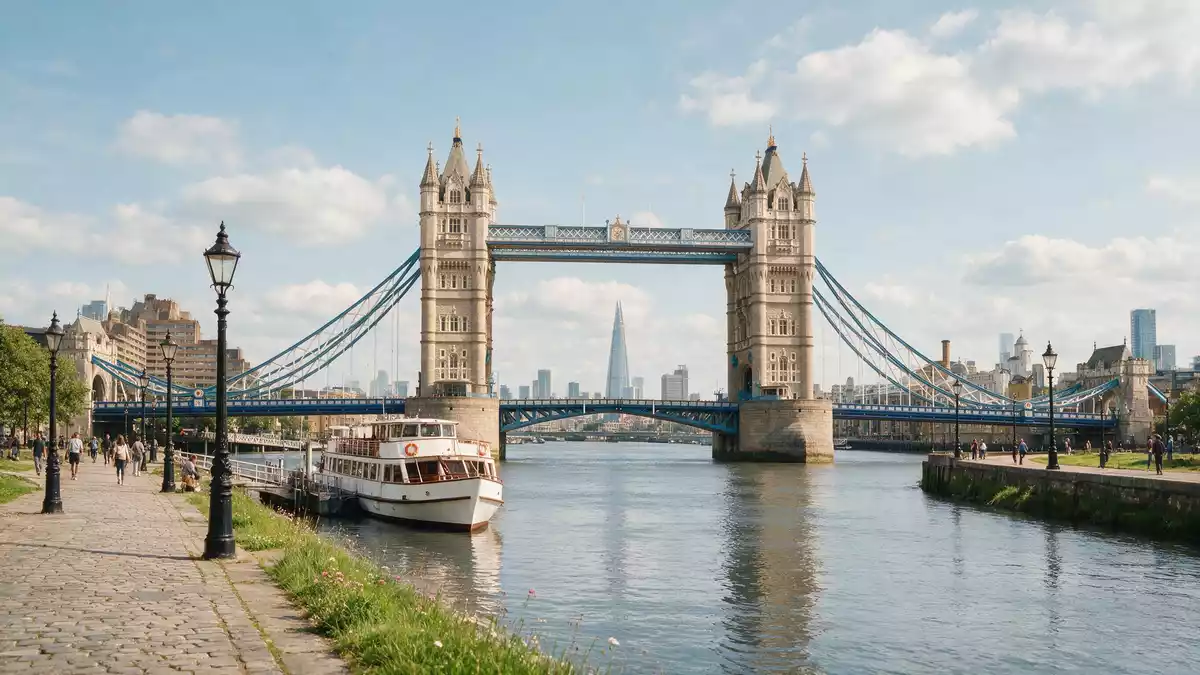
Tower Bridge is the Thames crossing where Victorian engineering is wrapped in neo-Gothic stonework, with twin towers rising above the river to frame one of London’s most recognisable silhouettes. Built in the late nineteenth century, it links the historic core around the Tower of London with the districts to the south while remaining a working movable bridge for river traffic.
A neo-Gothic bridge with a steel heart
Tower Bridge spans the River Thames near the Tower of London, combining a bascule roadway with suspension sections that carry traffic between the two riverbanks.Movable bascule and suspension work together here, so the central part of the road deck can lift while the outer spans stay in place. Above the river, two masonry-clad towers stand on massive piers, linked by high-level walkways that form a fixed frame even when the roadway is raised.
Behind the stone and granite, the bridge’s structure is a steel framework that carries the loads of the towers, walkways and roadway.Steel frame partially visible sections can be seen from inside, where the clad surfaces give way to exposed girders and riveted members. The towers themselves rise to about 65 m (213 ft), giving the whole composition a vertical emphasis that balances the long horizontal sweep of the roadway.Tower height and overall length The finishes follow a neo-Gothic vocabulary, with turrets, pointed detailing and battlement-like parapets echoing the nearby medieval fortress.
The making of a Victorian landmark
The idea of Tower Bridge emerged from nineteenth-century London’s need for another Thames crossing east of London Bridge, where the city’s population and commercial activity were expanding.Construction facts and context A Special Bridge or Subway Committee was formed in 1876 to find a solution for road traffic that would not obstruct ships heading to the Pool of London, the stretch of river beside the Tower. The chosen design combined a bascule mechanism with tall towers so that the roadway could swing upwards to create a clear channel for sizeable vessels.
The City Architect, Sir Horace Jones, produced the concept for the bridge, working with civil engineer Sir John Wolfe Barry to turn it into a buildable scheme approved in the 1880s.Horace Jones and John Wolfe Barry Construction began in 1886 and continued for eight years under Barry’s supervision, involving several major contractors and hundreds of workers.Eight-year building period When the bridge was completed, it was opened on 30 June 1894 by the Prince and Princess of Wales, later King Edward VII and Queen Alexandra, marking its formal entry into London’s river landscape.Opening date and ceremony
How Tower Bridge works and how it is used
Tower Bridge carries a roadway and pedestrian pavements between its towers, with a central section subdivided into two bascules that can be raised to allow river traffic through.Bascule mechanism and layout Each bascule is counterweighted, so the heavy deck can pivot upwards from the middle of the span. When they are lowered, traffic passes along the continuous deck from the north bank to the south, while the high-level walkways remain available above.
The bridge originally used hydraulic machinery to power the raising and lowering of the bascules, a system later updated to an electro-hydraulic arrangement while retaining the same basic principles.Hydraulic and electro-hydraulic systems Alongside this working role, the towers and walkways house exhibition spaces that present its history and engineering, making the bridge both infrastructure and visitor destination. From the upper level, views extend along the Thames towards the City of London to the west and the docks and riverside developments to the east, setting the bridge within the broader sweep of London’s riverside architecture.
Visiting Tower Bridge: what travellers from Western Europe should know
- Tower Bridge stands on the River Thames between the City of London and Southwark, close to the Tower of London. It is reached by road and on foot along Tower Bridge Road.
- The river crossing includes a standard roadway and pedestrian pavements at deck level, while the interior involves stairs and escalators inside the towers and walkways.
- The surrounding streets form part of central London’s urban fabric, with the bridge linking directly to the Thames Path on both banks.
- The official language is English and the currency is the pound sterling.
Searching for Tower Bridge on social platforms
These links open searches for Tower Bridge on each platform.
Frequently asked questions about Tower Bridge
Where in London is Tower Bridge located?
Tower Bridge crosses the River Thames near the Tower of London, linking the City of London on the north bank with Southwark on the south.
What should visitors expect when walking across Tower Bridge?
Visitors encounter a road bridge with pavements at deck level and enclosed spaces inside the towers and walkways, with river views through windows and openings.
What makes Tower Bridge distinctive among London’s bridges?
Its combination of movable bascules, neo-Gothic towers and high-level walkways, built between 1886 and 1894, gives Tower Bridge a form and profile distinct from neighbouring crossings.


