
Tower of London’s layered stone fortress on the Thames
Published on 08/23/2026 at 11:07 | Editorial responsibility: Rafael Müller, Editor-in-Chief AD HOC NEWS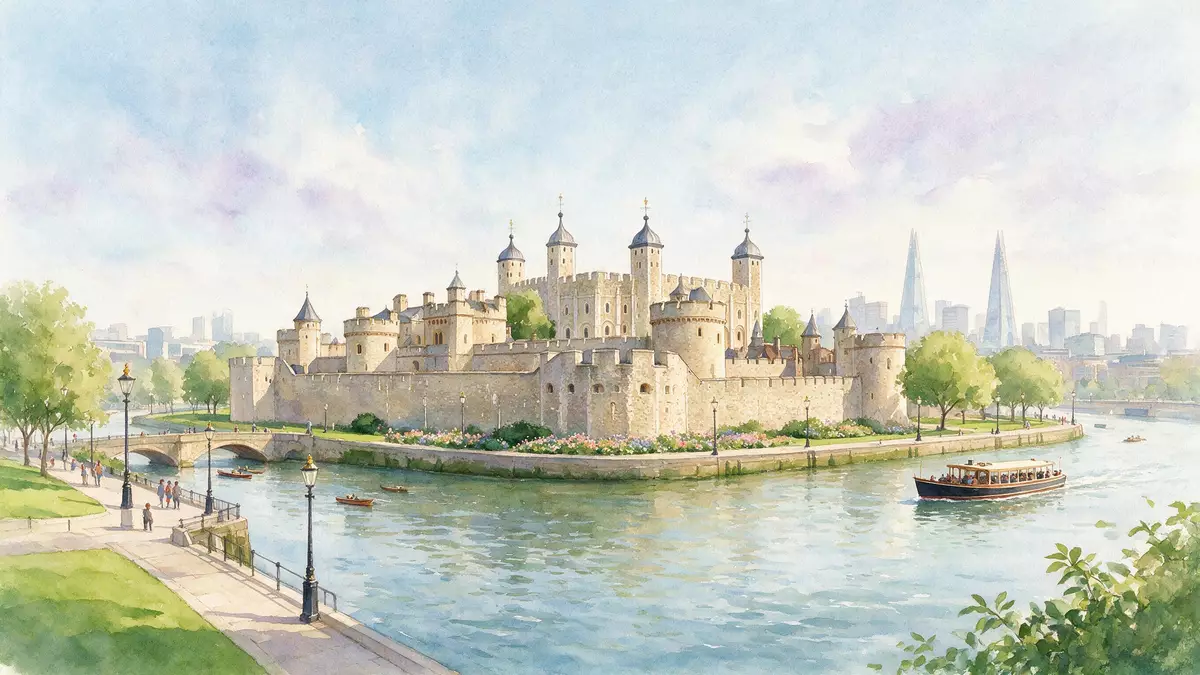
Rising above the north bank of the Thames, the Tower of London is a compact stone fortress where a royal residence, prison and armoury sit inside the same set of walls. First established by William the Conqueror in the eleventh century, it shows how a single riverside stronghold could shape the history of England across many generations.
A Norman keep at the core
At the centre of the complex stands the White Tower, the great stone keep begun under William the Conqueror in the late 1070s and completed around 1100.The White Tower dates from this period and gave the fortress its name. Its thick masonry and high position above the river made it a visible statement of Norman power over London.
The White Tower is built of pale stone, including Caen stone from northern France, laid in massive blocks around a compact rectangular plan.The keep rises as a solid masonry shell with towers at its corners and small openings set deep into the walls. Inside, stacked floors contain great halls and chapel spaces arranged one above another, so that the building works as both a stronghold and a residence.
Concentric defences and a riverside setting
Around this Norman core spreads a ring of later medieval walls, towers and wards, creating a dense defensive circuit within a relatively small footprint.The castle developed as a series of enclosing defences so that the White Tower sits inside successive lines of fortification. Stone curtain walls, projecting towers and a wide moat, now dry, show how the site evolved from an early Norman fort into a full medieval citadel.
The fortress occupies a strategic position beside the Thames, just east of the historic core of the City of London.It stands on the north bank of the river close to what is now Tower Hill, where the old city wall once met the waterfront. The relationship between stone walls, river edge and the line of the former moat remains clearly legible, so that visitors can see how the stronghold once controlled movement along both land and water.
From royal residence to Crown Jewels and museum
Across the centuries the Tower of London has held a succession of roles, each leaving physical traces in stone, timber and iron. In the medieval period it served as a royal residence, with lodgings arranged within the inner wards and upper levels of the White Tower.It also functioned as armoury, treasury and home of the royal mint, turning the compact site into the administrative and military heart of the kingdom.
The fortress is closely associated with imprisonment and execution, particularly in the Tudor period, when high-status prisoners were held within its walls.Figures such as Anne Boleyn and Lady Jane Grey were executed here, and memorials and named locations within the grounds mark these events. The presence of the Crown Jewels, housed in secure display spaces, underlines the continuing association between the site, the monarchy and state ceremony.
Visiting Tower of London: what travellers from Western Europe should know
- The fortress stands on the north bank of the River Thames, at the eastern edge of the historic City of London and beside the road and Underground interchange known as Tower Hill.
- Within the outer walls the ground is largely level but paved, with steps and staircases inside towers and on ramparts that require steady footing.
- The site lies beside the modern road crossing known as Tower Bridge, so a visit can easily be combined with walks along the Thames riverside paths.
- The official language is English and the currency is the pound sterling.
Searching for Tower of London on social platforms
These links open searches for Tower of London on each platform.
Frequently asked questions about Tower of London
Where is the Tower of London located?
The fortress stands on the north bank of the River Thames in London, beside Tower Hill and just east of the historic City of London.
What should a visitor expect on a visit?
A visit brings staircases inside medieval towers, open wards between stone walls, views towards the Thames and secure displays that show the Crown Jewels.
What makes the Tower of London distinctive?
Its combination of Norman keep, concentric medieval defences and later royal and ceremonial uses is concentrated on a single riverside site, so multiple layers of English history remain side by side.


