
Trinidad’s cobbled old town between sugar palaces and pastel streets
Published on 09/05/2026 at 09:12 | Editorial responsibility: Rafael Müller, Editor-in-Chief AD HOC NEWS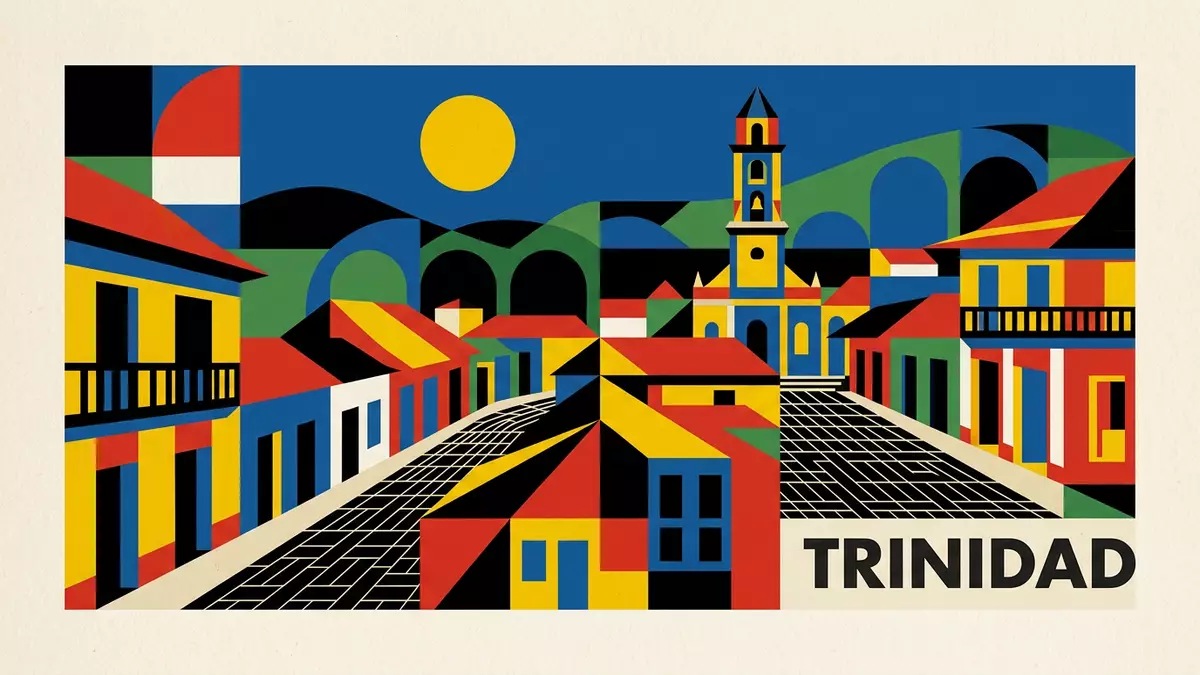
Trinidad in central Cuba is a colonial town whose historic centre still reads as a compact ensemble of cobbled streets, pastel houses and sugar-era mansions clustered around Plaza Mayor. Recognised together with the Valley de los Ingenios as a UNESCO World Heritage Site since 1988, Trinidad preserves an eighteenth- and nineteenth-century urban fabric shaped by the Caribbean sugar trade.
Plaza Mayor at the heart of the colonial grid
Plaza Mayor forms the clear focus of Trinidad’s historic centre, laid out as a formal square edged by low balustrades and small fenced gardens planted with palm trees and ornamental statues. Around the square, grand residences such as Palacio Brunet and Palacio Cantero stand alongside civic and religious buildings, giving the space a concentration of Spanish colonial architecture in one compact area.Plaza Mayor in Trinidad Palacio Cantero houses the municipal history museum, while other former mansions around Plaza Mayor now contain collections on local culture or art in rooms of high ceilings, tiled floors and internal courtyards.Palacio Brunet and Palacio Cantero
The square sits within a small grid of uneven cobbled streets, where the historic houses remain low-rise and closely spaced. Walking away from Plaza Mayor, the streets retain a mixture of one- and two-storey buildings, some with commercial uses at ground level and living spaces above, reflecting patterns of Cuban colonial architecture seen elsewhere in the town.Trinidad de Cuba’s colonial houses
Pastel facades, terracotta roofs and sugar-era houses
Trinidad’s historic houses are distinguished by pastel-coloured facades, red terracotta tiled roofs and timber elements that extend beyond the masonry walls. Many of the houses are painted in soft tones, with wood and plaster details picked out in contrasting colours to the brickwork, giving the streets a varied but coherent appearance.colonial houses of Trinidad Past fortunes from sugar and the slave trade funded the construction of the grand mansions around Plaza Mayor and in the nearby streets, where façades carry moulded plaster surrounds to doors and windows and balconies overlook the cobbles.sugar-era mansions in Trinidad
In Trinidad’s houses, large main doors often contain smaller entrance doors within them, opening directly into living areas rather than into vestibules. Windows traditionally lacked glass and were fitted instead with wooden bars known as barrotes, which were later complemented by wooden shutters and wrought-iron grilles in the nineteenth century.barrotes and shutters on windows Many nineteenth-century houses are organised around internal courtyards, with rooms facing onto paved patios that bring light into the centre of the compact plots.courtyard houses in Trinidad
Trinidad, the Valley de los Ingenios and the Escambray foothills
Trinidad lies in Sancti Spíritus Province on Cuba’s southern coast, set near the foothills of the Escambray Mountains and linked historically to the nearby Valley de los Ingenios.Trinidad near the Escambray Mountains The Valley de los Ingenios once contained many sugar mills associated with Trinidad’s owners and merchants, and together the town and valley were inscribed by UNESCO in 1988 as the “Historic Centre of Trinidad and the Valley de los Ingenios”.UNESCO listing for Trinidad and the Valley de los Ingenios
Within this wider setting, Trinidad’s historic centre occupies around 91 acres of cobbled streets and irregular blocks where colonial houses, churches and civic buildings have been preserved with comparatively few alterations to their external form.extent of Trinidad’s historic centre The campanile of the former Convento de San Francisco is among the town’s more prominent vertical landmarks, rising above the low roofs and acting as a clear point of orientation around Plaza Mayor.Convento de San Francisco tower
Visiting Trinidad: what travellers from Western Europe should know
- Trinidad is a city in Sancti Spíritus Province on Cuba’s southern coast, with the historic centre clustered around Plaza Mayor and the nearby Valley de los Ingenios.
- The old town is built on cobbled streets that rise and fall gently, and many routes involve uneven paving and short flights of steps between terraces.
- The historic centre sits at low altitude near the foothills of the Escambray Mountains, with views towards the surrounding hills from higher streets and towers.
- The official language is Spanish and the currency is the Cuban peso.
- Entry requirements depend on your nationality; UK travellers can check the FCDO travel advice at gov.uk/foreign-travel-advice, Irish travellers the Department of Foreign Affairs at ireland.ie.
Searching for Trinidad on social platforms
These links open searches for Trinidad on each platform.
Frequently asked questions about Trinidad
Where is Trinidad in Cuba?
Trinidad is a city in Sancti Spíritus Province on Cuba’s southern coast, roughly in the central part of the island, with its historic centre around Plaza Mayor.
What should visitors expect in the historic centre?
Visitors encounter cobbled streets, pastel-coloured houses, colonial churches and museums housed in former sugar-era mansions, all within a compact district that retains its nineteenth-century scale.
What makes Trinidad distinctive among Cuban towns?
Trinidad is distinctive for its well-preserved colonial urban ensemble, the close relationship between Plaza Mayor and surrounding streets, and its documented UNESCO link to the Valley de los Ingenios.


