Tsodilo Hills and the desert gallery of ancient rock art
Published on 09/08/2026 at 13:02 | Editorial responsibility: Rafael Müller, Editor-in-Chief AD HOC NEWS
West of Shakawe in north-western Botswana, Tsodilo Hills rises abruptly from the Kalahari sands as a compact group of quartzite outcrops covered with ancient paintings and archaeological traces of human presence stretching back tens of thousands of years.
Quartzite hills on the edge of the Kalahari
Tsodilo Hills forms a small cluster of massive quartzite inselbergs on the margin of the Kalahari Desert in Botswana’s Ngamiland region, close to the border with Namibia and the Okavango Panhandle.quartzite inselbergs The hills rise sharply from surrounding sand dunes and a fossil lake bed, creating a sudden change of relief that is visible from far across the otherwise low-lying landscape.ancient sand dunes and fossil lake bed This compact rocky area contrasts with the wide, sandy plains and sparse vegetation that frame it.
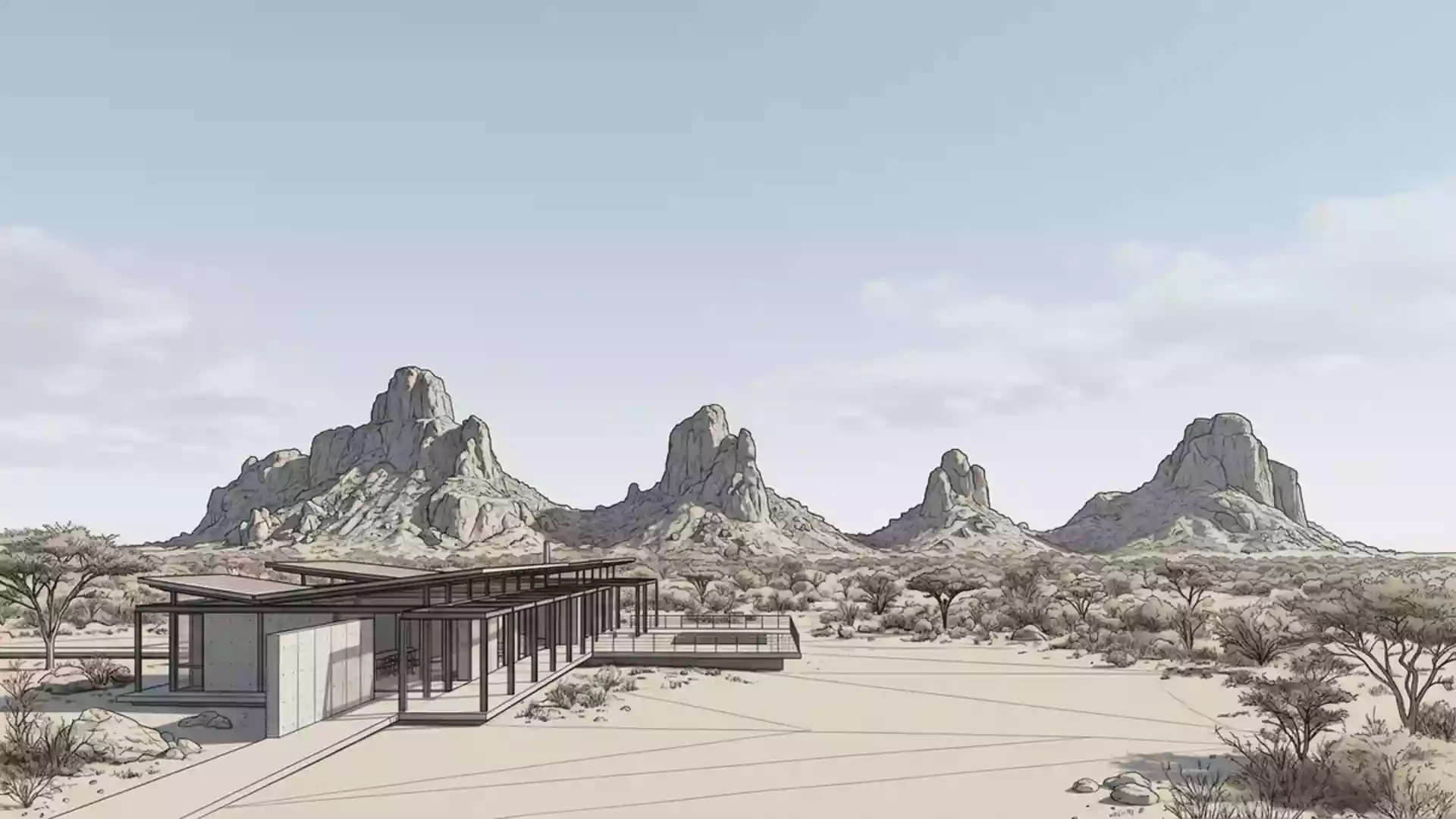
The site comprises four main hills known as Male Hill, Female Hill, Child Hill and North Hill, a grouping that stands out against the horizon like a small mountain range isolated within the desert.four main hills Between and around these heights lie rock shelters, shallow valleys and ledges, many of them marked by archaeological deposits and rock art panels. The compact size of the hills and the density of features give the area a feeling of being a self-contained landscape, distinct from the surrounding Kalahari.
A UNESCO World Heritage landscape of deep time
Tsodilo Hills was inscribed on the UNESCO World Heritage List in 2001 as a cultural site, recognised for both its long record of human occupation and its continuing spiritual significance for local communities.inscribed on the UNESCO World Heritage List in 2001 Archaeological work at the hills has documented an exceptionally long sequence of human presence, with occupation extending over roughly 100,000 years in this corner of the Kalahari Desert.approximately 100,000 years of occupation Excavated rock shelters and mines reveal traces from the Middle Stone Age through the Later Stone Age into more recent farming communities.
Within the protected area, researchers have documented prehistoric specularite mines, Early Iron Age farmer villages and extensive deposits of stone tools and cultural material beneath overhangs and along the slopes.prehistoric mines and farmer villages This concentration of evidence, layered over a long period, makes Tsodilo Hills one of the most intensively studied archaeological landscapes in Botswana, and underpins its designation as a World Heritage Site representing a continuous relationship between people and place.
The open-air gallery of rock paintings
The most immediately visible feature of Tsodilo Hills is the dense concentration of rock paintings that covers panels on all four main hills, creating an open-air gallery spread across the cliffs and shelters.over 4,500 rock paintings UNESCO and specialist surveys estimate that more than 4,000 individual images have been recorded here, clustered at around 400 separate rock art sites within an area of roughly 10 km².around 400 rock art sites The paintings appear on exposed cliff faces, beneath rocky overhangs and inside shelters, turning plain rock surfaces into picture panels.
Many of the images are executed in red pigment, with several thousand such figures recorded, while a smaller number are painted in powdery or greasy white pigment, forming a distinct group of motifs.red and white pigment groups The paintings include depictions of animals and abstract forms, and reflect different periods and traditions of marking the rock. Combined with the archaeological deposits under and around them, the panels contribute to a layered record of human activity, belief and artistic practice embedded in the hills.
Visiting Tsodilo Hills: what travellers from Western Europe should know
- Tsodilo Hills lies west of Shakawe in north-western Botswana, near the Namibian border, and is approached on roads branching from the main route through the Okavango Panhandle.
- The terrain at the hills is rocky and uneven, with paths that climb over quartzite slopes and into shallow valleys, and some approaches pass through sandy stretches of Kalahari desert.
- The site stands in Botswana, where the official language is English and the currency is the Botswana pula.
- Entry requirements depend on your nationality; UK travellers can check the FCDO travel advice at gov.uk/foreign-travel-advice, Irish travellers the Department of Foreign Affairs at ireland.ie.
Searching for Tsodilo Hills on social platforms
These links open searches for Tsodilo Hills on each platform.
Frequently asked questions about Tsodilo Hills
Where is Tsodilo Hills located in Botswana?
Tsodilo Hills stands in north-western Botswana, west of Shakawe in Ngamiland, close to the Namibian border on the edge of the Kalahari Desert.
What can visitors expect when exploring Tsodilo Hills?
Visitors encounter quartzite hills rising from sand, rocky paths and shelters, along with extensive rock paintings and archaeological traces distributed across the four named hills.
What makes Tsodilo Hills distinctive among desert landscapes?
The combination of compact quartzite hills, thousands of rock paintings, prehistoric mines and a documented human occupation lasting around 100,000 years gives Tsodilo Hills an unusual concentration of cultural features.