
Tsodilo Hills and the painted stones of Botswana’s Kalahari
Published on 08/18/2026 at 14:14 | Editorial responsibility: Rafael Müller, Editor-in-Chief AD HOC NEWS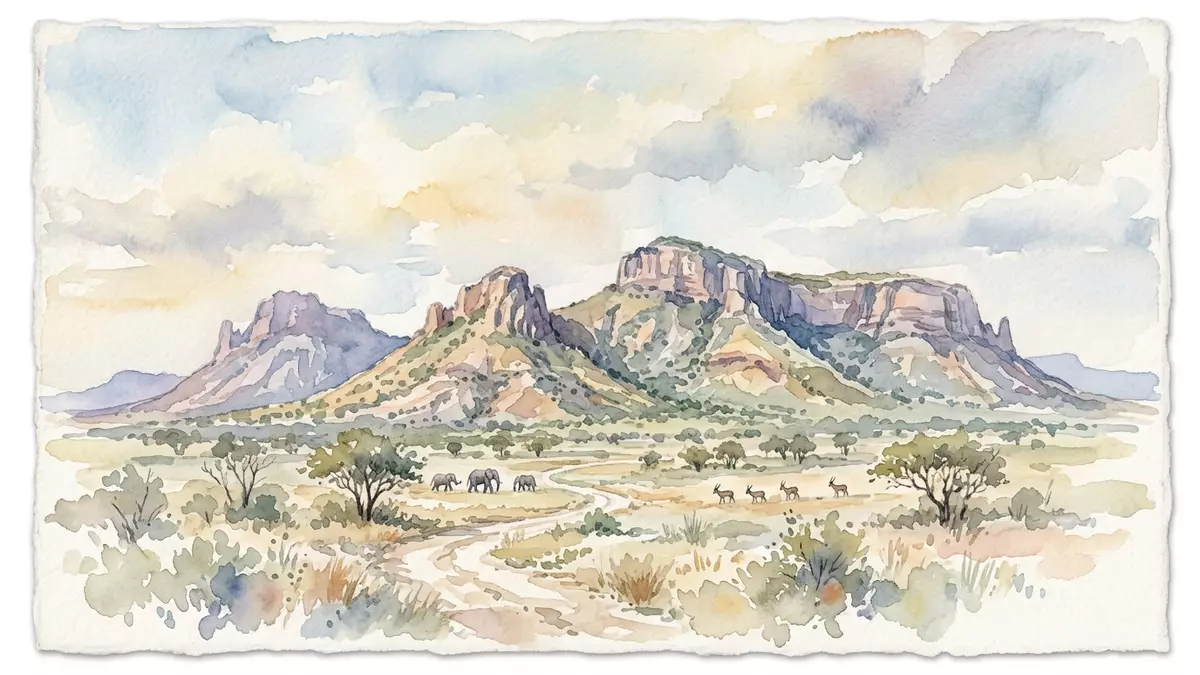
Rising abruptly from the flat Kalahari sands of north?west Botswana, Tsodilo Hills brings rock, colour and human history together on one compact group of quartzite outcrops. Designated a UNESCO World Heritage Site in 2001, this sacred landscape near Shakawe is known for thousands of rock paintings spread across its cliffs and shelters.
Quartzite hills above the Kalahari
Tsodilo Hills lies in the Ngamiland District of north?west Botswana, close to the Namibian border and south of Shakawe, on the edge of the Kalahari Desert. A cluster of quartzite inselbergs rises from ancient sand dunes on one side and a fossil lake bed on the other, creating a clear landmark in otherwise low, sandy terrain.quartzite rock formations The hills stand as separate masses, with steep flanks leading up to more broken ground and rock platforms.
The site is usually described as four main hills, commonly known as Male Hill, Female Hill, Child Hill and a smaller northern hill, each carrying rock art and archaeological traces.four main hills Their quartzite strata include metaquartzite and related metamorphosed sandstones, recording a Precambrian geological history that long predates human settlement.Tsodilo Hills Group strata Around the base of the hills, Kalahari sands and calcrete deposits soften the transition from rock to desert floor.
Rock art and traces of millennia of settlement
Tsodilo Hills is widely recognised for its dense concentration of rock paintings, created on cliff faces, boulders and the walls of shallow shelters. Surveys have recorded around 4,500 individual images across an area of roughly 10 km², making it one of Africa’s best documented rock art landscapes.some 4,500 paintings Many are executed in red pigment, while others use paler, whitish paints.
The paintings depict a range of subjects, from wild animals such as antelope and giraffe to cattle, human figures and geometric motifs.wild animals, people and symbols Archaeological work has shown that the hills preserve evidence of human occupation over tens of thousands of years, including stone tools and occupation layers in rock shelters, linking the paintings to long sequences of settlement and ritual activity.record of human settlement
A sacred landscape in north?west Botswana
For local communities such as San groups and Hambukushu people, Tsodilo Hills form part of a living sacred landscape as well as a heritage site recognised internationally. The World Heritage inscription highlights the outstanding concentration of rock art and its association with belief systems, noting the site’s cultural significance alongside its archaeological value.World Heritage cultural landscape Oral traditions in the region treat the hills as places of power, with particular cliffs, shelters and water sources linked to stories that span generations.
Tsodilo Hills stands apart from Botswana’s better known wildlife reserves by focusing on human history and belief rather than large mammals alone. Visitors walk among rock faces bearing superimposed layers of painting, where newer images share space with older lines whose exact age remains a subject of research.major geological landmark in the Kalahari Desert The combination of stark quartzite, desert light and traces of long habitation gives the hills a character distinct from the nearby Okavango wetlands.
Visiting Tsodilo Hills: what travellers from Western Europe should know
- Tsodilo Hills lies in north?west Botswana in the Ngamiland District, south of Shakawe near the Namibian border, reached from regional roads serving the Okavango area.
- The hills rise steeply from the surrounding Kalahari sands, and paths to painted panels and viewpoints follow rocky slopes with uneven surfaces and some sustained gradients.
- The wider landscape is semi?arid Kalahari terrain, with strong sunlight and limited natural shade once away from the foot of the hills.
- The official language is English and the currency is the Botswana pula.
- Entry requirements depend on your nationality; UK travellers can check the FCDO travel advice at gov.uk/foreign-travel-advice, Irish travellers the Department of Foreign Affairs at ireland.ie.
Searching for Tsodilo Hills on social platforms
These links open searches for Tsodilo Hills on each platform.
Frequently asked questions about Tsodilo Hills
Where are Tsodilo Hills in Botswana?
Tsodilo Hills lies in the Ngamiland District of north?west Botswana, near the Namibian border and south of Shakawe on the edge of the Kalahari Desert.
What can visitors expect to see at Tsodilo Hills?
Visitors encounter steep quartzite hills rising from Kalahari sands, with rock shelters and cliffs bearing thousands of ancient paintings depicting animals, people and abstract motifs.
What makes Tsodilo Hills distinctive compared with other Botswana destinations?
Instead of a focus on wildlife alone, Tsodilo Hills combines a dramatic inselberg landscape with a dense concentration of rock art and archaeological evidence of very long human use.


