
Uluru: a sandstone monolith shaped by geology and law
Published on 09/22/2026 at 09:43 | Editorial responsibility: Rafael Müller, Editor-in-Chief AD HOC NEWS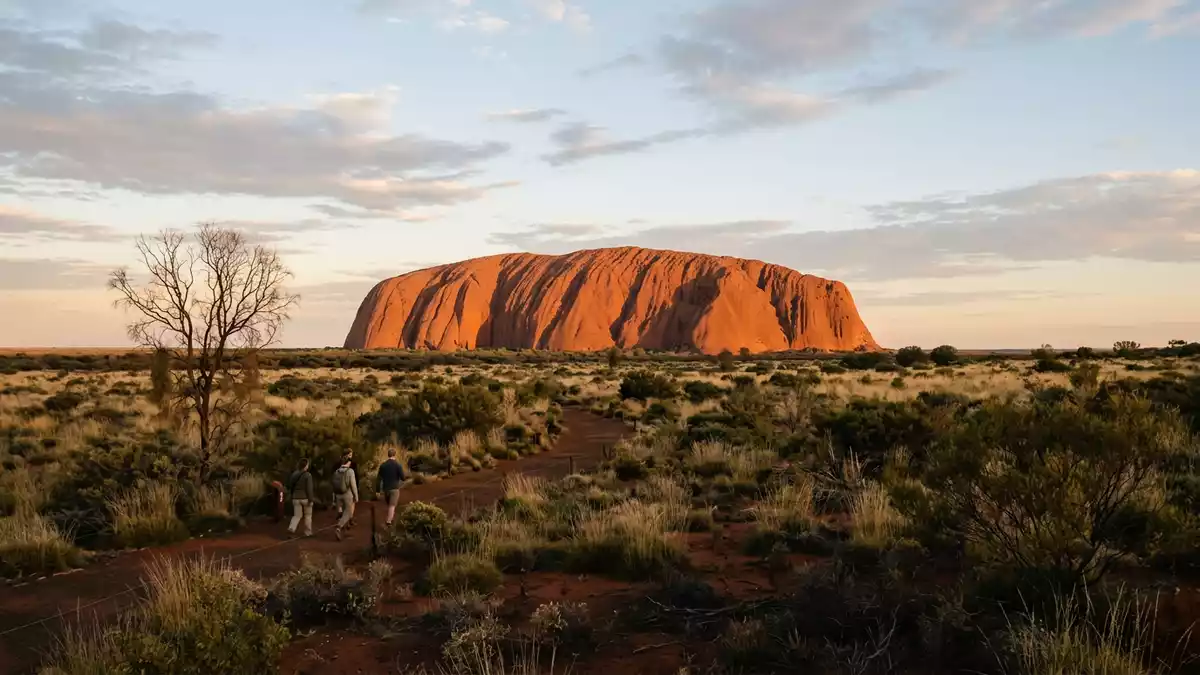
Uluru rises from the red plain near Yulara as a single mass of sandstone, its steep sides marked by caves, grooves and shadowed waterholes. The monolith stands 348 metres above the surrounding plain, while its full circumference measures 9.4 kilometres.
Uluru’s sandstone form above the Red Centre
Uluru is made of arkose, a coarse sandstone that began forming about 550 million years ago. The rock is part of a much larger geological structure, with slabs continuing underground for several kilometres beneath the desert.
Its visible surface changes across the base. Long walls rise above sheltered paths, bands of rock cut across the slopes, and narrow gullies carry water after rain. Caves and overhangs contain rock art, while Mu?itjulu Waterhole forms a permanent source of water at the foot of the monolith. Uluru’s arkose geology connects the visible rock with the buried formation below it.
From Ayers Rock to Ulu?u
The name Ulu?u belongs to the language and cultural landscape of the A?angu, the Traditional Owners of the area. The English name Ayers Rock entered colonial mapping after William Gosse saw the monolith in 1873.
For A?angu peoples, Ulu?u is inseparable from Tjukurpa, the body of traditional law, creation knowledge and cultural practice. Ancestral beings are associated with particular cliffs, caves, waterholes and routes around the rock. These places are not simply scenic features; they form part of a living cultural landscape.
The park was declared a national park in 1950. In 1985, the deeds were handed back to A?angu Traditional Owners, who lease the land to the Australian Government under a joint-management arrangement. The history of the handback remains central to the park’s identity.
A living cultural landscape around the monolith
Walking routes reveal different parts of Uluru without reducing the place to a single viewpoint. The Mala Walk follows the base towards Kantju Gorge, where vertical rock walls and cultural sites appear beside the route. The Kuniya Walk leads to Mu?itjulu Waterhole and follows the setting of the Kuniya and Liru creation story.
The climb closed permanently on 26 October 2019. The decision reflects the place of Uluru within Tjukurpa and Australian law, as climbing was not generally permitted under A?angu law and culture. Routes at the base remain connected to cultural knowledge, rock art and named ancestral stories.
Uluru-Kata Tju?a National Park combines natural and cultural World Heritage values. UNESCO added the park for its geological formations in 1987, then recognised its cultural landscape in 1994. The park covers about 1,325 square kilometres of arid country and includes the neighbouring domes of Kata Tju?a. Uluru’s World Heritage status covers both the landforms and their cultural meaning.
Visiting Uluru: what travellers from Western Europe should know
- Uluru lies in Australia’s Northern Territory, near Yulara in the Red Centre. Ayers Rock Airport serves Yulara, while the Lasseter Highway links the area with the Stuart Highway and Alice Springs.
- The base routes cross exposed desert terrain beside rock walls, caves and drainage channels. The Kuniya Walk reaches Mu?itjulu Waterhole, while the Mala Walk continues towards Kantju Gorge.
- The park’s Cultural Centre stands on the road towards Uluru and presents A?angu culture, Tjukurpa, local geology and the surrounding environment.
- The official language is English and the currency is the Australian dollar.
- Entry requirements depend on your nationality; UK travellers can check the FCDO travel advice at gov.uk/foreign-travel-advice, Irish travellers the Department of Foreign Affairs at ireland.ie.
Searching for Uluru on social platforms
These links open searches for Uluru on each platform.Frequently asked questions about Uluru
Where is Uluru?
Uluru is in Australia’s Northern Territory, near Yulara in the Red Centre. It lies within Uluru-Kata Tju?a National Park.
What can visitors expect at Uluru?
Visitors can follow base routes to named cultural and natural features, including Kantju Gorge and Mu?itjulu Waterhole. The Cultural Centre introduces A?angu culture, Tjukurpa and the park’s geology.
What makes Uluru distinctive?
Uluru combines a 348-metre sandstone formation with a cultural landscape shaped by A?angu law and knowledge. Its World Heritage status recognises both natural and cultural values.


