
Uluru and its red sandstone face in central Australia
Published on 09/01/2026 at 11:04 | Editorial responsibility: Rafael Müller, Editor-in-Chief AD HOC NEWS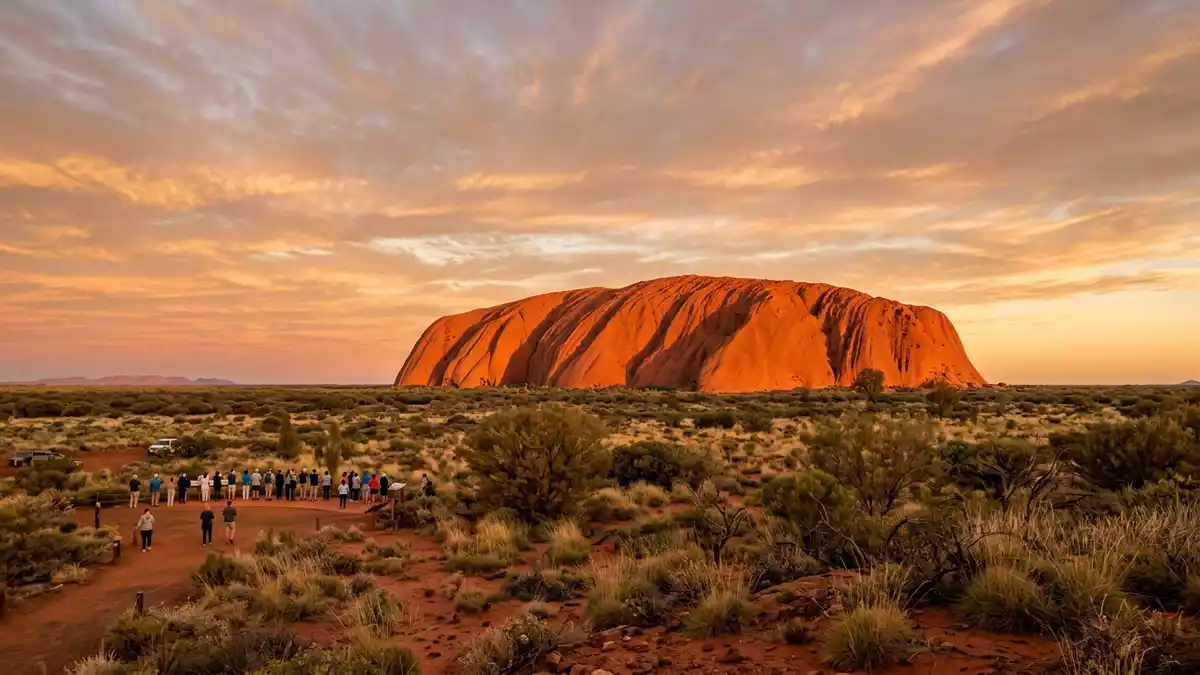
Uluru rises from the red plains of central Australia as a single sandstone monolith near Yulara. Its broad face, steep sides and weathered surface make the rock itself the main subject.
Uluru’s sandstone body and red surface
Uluru is a large sandstone formation and an inselberg, made of arkose, a feldspar-rich sandstone. The Geological Survey of Australia describes it as an eroded remnant laid down in the Cambrian Period about 500 million years agoCambrian Period.
The rock rises about 345 m (1,132 ft) above the surrounding plains and has a base measuring 9.4 km (5.8 mi) around9.4 km around. Iron-bearing minerals give the surface its red-brown colour, while weathering has left grey patches and a flaky outer skinred-brown colour.
Uluru and the cultural landscape of Anangu country
Uluru forms part of Ulu?u-Kata Tju?a National Park, a World Heritage site inscribed in 1987 for natural values and in 1994 for cultural valuesWorld Heritage site. The park sits on the traditional lands of the Anangu Aboriginal people, and the rock belongs to a landscape shaped by geology and cultural meaningtraditional lands.
The name Uluru is used alongside the older English name Ayers Rock, and the surrounding park also includes Kata Tjuta to the west. Together they form a central Australian setting of open plain, sandstone and desert vegetation, with Uluru standing apart as the most recognisable mass in the park.
Uluru as a monolith in the centre of Australia
Uluru is a monolith, a single rock body that rises from a much broader surrounding plain. The exposed shape is long and massive rather than layered into separate summits, and its sides change in colour and tone across the day.
The rock sits in the southern part of the Northern Territory, close to the centre of Australia. Yulara serves as the nearest settlement named in many maps and travel references, while the park’s open country stretches around the rock in every direction.
Visiting Uluru: what travellers from Western Europe should know
- Uluru lies near Yulara in the Northern Territory, and road access runs through Ulu?u-Kata Tju?a National Park. Alice Springs is the main inland reference point.
- The rock has steep sides and a broad base. The surface is uneven, with weathered sandstone and exposed patches of grey and red.
- The official language is English and the currency is the Australian dollar.
- The park also includes Kata Tjuta to the west of Uluru. Both formations belong to the same protected landscape.
Searching for Uluru on social platforms
These links open searches for Uluru on each platform.
Frequently asked questions about Uluru
Where is Uluru?
Uluru is in the Northern Territory of Australia, near Yulara and within Ulu?u-Kata Tju?a National Park. It sits close to the centre of the continent.
What does a visit involve?
A visit means seeing a vast sandstone monolith, its weathered surface and the surrounding desert plain. The landscape includes nearby Kata Tjuta and the park’s open red country.
What makes Uluru distinctive?
Its scale, isolated form and cultural setting make it unmistakable. The rock is also a World Heritage place with both natural and cultural significance.


