
Uluru near Yulara: a sandstone monolith with deep Aboriginal roots
Published on 09/02/2026 at 19:07 | Editorial responsibility: Rafael Müller, Editor-in-Chief AD HOC NEWS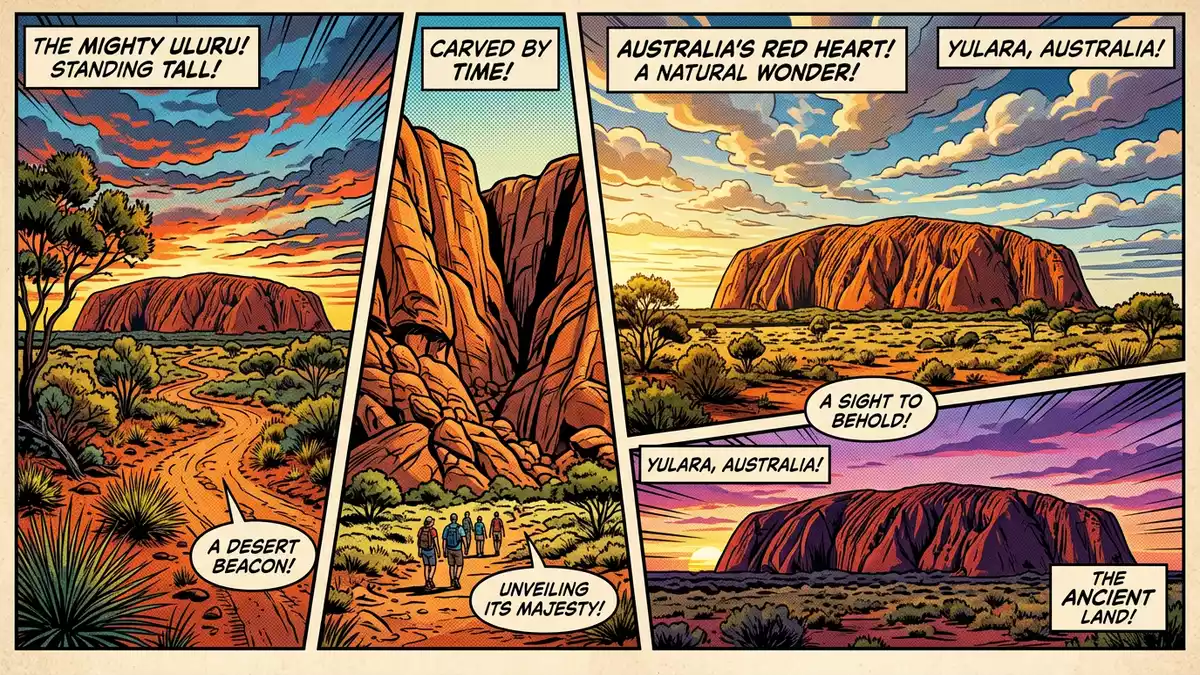
Uluru is a vast sandstone monolith in Australia’s Northern Territory, rising from the desert near the service town of Yulara and forming the heart of Ulu?u-Kata Tju?a National Park. It is sacred to the A?angu, the Aboriginal people whose ancestral lands surround the rock, and its sheer scale and presence make it one of the most recognisable landmarks in the country.
A single block of arkose in the central Australian desert
Uluru stands over 340 m (around 1,115 ft) above the surrounding plain and reaches an elevation of about 863 m (2,831 ft) above sea level, with most of its bulk extending underground.The sandstone formation stands 348 m high The rock forms an inselberg, an isolated hill rising from relatively flat erosion lowlands in a hot, dry region, so it dominates views across the central Australian desert.Uluru/Ayers Rock is an inselberg
Geologically, Uluru is composed mainly of arkose, a coarse sandstone rich in feldspar that was deposited as part of an ancient alluvial fan system and later hardened and tilted close to vertical.The monolith rock is homogenous and made of arkose The arkose layers are estimated to date back more than 500 million years, linking Uluru to wider geological processes in the region around the Petermann, Mann and Musgrave Ranges.The sedimentary bed was laid down some 600 million years ago Weathering of iron-bearing minerals in the sandstone gives Uluru its characteristic red-brown colour under desert light.
Country, creation stories and World Heritage status
For the Pitjantjatjara and other A?angu groups of Central Australia, Uluru is a sacred place intertwined with Tjukurpa, often translated as “Dreaming”, the law and creation stories that shape their culture.Uluru is sacred to the Pitjantjatjara Specific features on the rock are associated with ancestral beings, and many areas on and around Uluru are restricted in line with cultural protocols, reflecting ongoing custodianship by traditional owners.
Uluru sits within Ulu?u-Kata Tju?a National Park, which was inscribed on the UNESCO World Heritage List in 1987 for its natural values and in 1994 for its cultural landscape.The park was first added to the list in 1987 This dual recognition reflects both the geological significance of the sandstone monolith and the long-standing relationship between A?angu and their land.Uluru-Kata Tjuta National Park was inscribed under natural and cultural criteria The park is jointly managed, with structures that recognise traditional ownership and Australian government responsibilities.
Walking the base and reading the rock
The base of Uluru has a circumference of about 9.4 km (5.8 mi), and a circuit on level ground reveals overhangs, gullies, waterholes and ancient rock surfaces bearing paintings in ochre.Ulu?u is a monolith 9.4 kilometres in circumference Sections of the rock show streaks and dark stains where rainwater runs down from the summit, and shaded recesses provide shelter in a landscape otherwise exposed to sun and wind.
Close views reveal the texture of the arkose, with coarse grains and scattered pebbles cemented into the sandstone, alongside pockets where erosion has undercut the rock to form fluted surfaces and shallow caves.The sandstone that makes up Uluru is estimated to be around 600 million years old Around the base, desert vegetation includes shrubs and grasses adapted to arid conditions, and the contrast between the red rock and the surrounding plains remains striking from any viewpoint.
Visiting Uluru: what travellers from Western Europe should know
- Uluru lies in Ulu?u-Kata Tju?a National Park in Australia’s Northern Territory, with Yulara serving as the nearby service settlement and access point for the area.
- The base circuit runs over largely level desert terrain, but some approaches involve sandy paths and sections of exposed rock, so stable footwear is important.
- Temperatures in the central Australian desert can be extreme, and shade at the rock itself is limited away from overhangs and recesses.
- The official language is English and the currency is the Australian dollar.
- Entry requirements depend on your nationality; UK travellers can check the FCDO travel advice at gov.uk/foreign-travel-advice, Irish travellers the Department of Foreign Affairs at ireland.ie.
Searching for Uluru on social platforms
These links open searches for Uluru on each platform.
Frequently asked questions about Uluru
Where is Uluru and how is it protected?
Uluru stands in Australia’s Northern Territory near Yulara, within Ulu?u-Kata Tju?a National Park, which holds UNESCO World Heritage status for natural and cultural values.
What does a visit to Uluru involve?
A visit usually focuses on walking sections of the base circuit, viewing the monolith from designated areas and learning about A?angu culture and the park’s desert environment.
What makes Uluru distinctive among desert landscapes?
Uluru is a single block of arkose sandstone with a circumference of about 9.4 km, rising sharply from flat plains and carrying deep cultural significance for its traditional owners.


