
Valle dei Templi: Doric temples above the Sicilian coast
Published on 08/23/2026 at 13:31 | Editorial responsibility: Rafael Müller, Editor-in-Chief AD HOC NEWS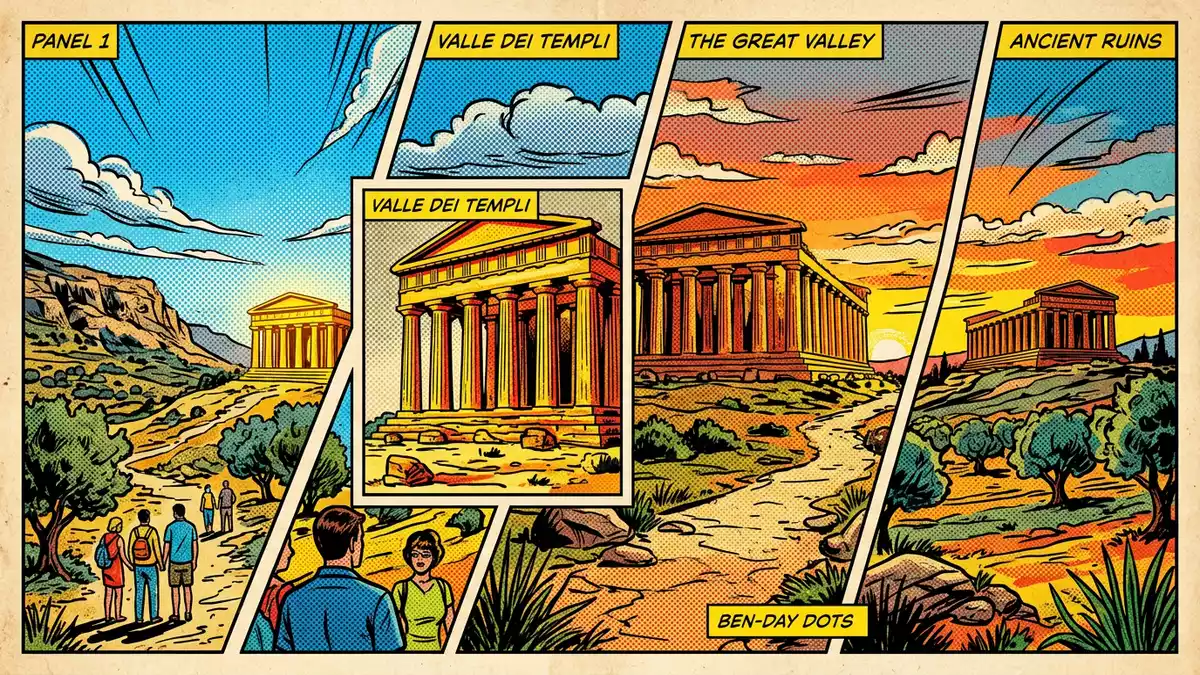
South of Agrigento on the Sicilian coast, Valle dei Templi stretches along a rocky ridge where ancient Greek Doric temples rise above fields and orchards, preserving the outline of the classical city of Akragas founded in the sixth century BC.ancient Akragas Since 1997 this archaeological area has been inscribed on the UNESCO World Heritage List as the Archaeological Area of Agrigento, recognising an exceptionally intact sequence of temples and urban remains.UNESCO World Heritage List
Doric temples aligned on the sacred hill
Valle dei Templi centres on a long scarp forming the southern boundary of the ancient polis, where a series of major Doric temples stand in a row facing the Sicilian countryside and the sea.great Doric temples The most celebrated of these is the Temple of Concordia, a fifth-century BC structure whose modern name derives from a Latin inscription found nearby and whose colonnades and entablature are preserved almost complete.Temple of Concordia
Nearby stand the remains of other temples associated with the main deities of the Greek pantheon in Magna Graecia. The temple traditionally linked to Hera, also dating to the fifth century BC, occupies the eastern end of the ridge, while the temple of Heracles, considered the most archaic of the group, preserves a row of standing columns marking its footprint.Hera and Heracles temples Further along the terrace lie the massive foundations and scattered blocks of the Temple of Olympian Zeus, begun around 480 BC to honour the city-state of Akragas in the aftermath of its victory over Carthaginian forces, together with structures dedicated to Castor and Pollux and to Hephaestus.Temple of Olympian Zeus
Akragas, Agrigentum and the long history of the site
The archaeological park covers the broad territory of the ancient city of Akragas, from the height known as Rupe Atenea through the acropolis and sacred hill down to extramural necropolis areas and sanctuaries outside the walls.territory of the ancient polis Founded as a Greek colony in the sixth century BC, Akragas grew into one of the leading cities of the Mediterranean world, a status reflected in the scale and ambition of its temples and urban planning.
After the Roman conquest in 210 BC the city became Agrigentum, yet large parts of the classical urban fabric remained in place beneath agricultural land, allowing modern archaeology to trace streets, walls and burial grounds alongside the better-known sanctuaries.Roman Agrigentum In recognition of this continuity, the Archaeological and Landscape Park of the Valley of the Temples was established by regional law in 2000 to manage both the monumental remains and the surrounding cultural landscape on the southern coast of Sicily.
Landscape setting and layout of the archaeological park
Valle dei Templi lies on a plateau outside modern Agrigento, with olive, almond and carob trees scattered among the ruins and paths following the line of the ancient fortifications.plateau outside Agrigento The archaeological area is divided into an eastern sector, where visitors encounter the temples attributed to Juno, Concordia and Hercules, and a western sector containing the remains of Olympian Jupiter, the Dioscuri and the garden of Kolymbethra, a historic green space nestled within the ancient landscape.eastern and western sectors
Beyond the main ridge, the park’s 1,300 ha encompass terraces, riverbanks and slopes linked to the broader city of Akragas, including the area near the Akragas river where a sanctuary dedicated to Asklepius, god of medicine, once stood.Akragas river sanctuary The scale of the site, extending from higher ground down towards the coastal plain, means that a walk through Valle dei Templi also becomes a walk across changing levels, with long views towards the sea and back uphill to the profiles of the temples along the horizon.
Visiting Valle dei Templi: what travellers from Western Europe should know
- Valle dei Templi stands just outside Agrigento on the southern coast of Sicily, with the main entrances reached from the Strada Panoramica dei Templi and other access roads leading from the town.
- The terrain within the archaeological park includes long, gently rising paths along the ridge and sections of uneven ancient stone surfaces, so walking between the main temple areas involves covering a substantial distance on foot.
- Modern Agrigento provides the closest urban setting, and the archaeological park occupies a belt of land between the town and the coastline, with views that take in both the cityscape and the Mediterranean.
- Italy is the official country, the official language is Italian and the currency is the euro.
Searching for Valle dei Templi on social platforms
These links open searches for Valle dei Templi on each platform.
Frequently asked questions about Valle dei Templi
Where is Valle dei Templi located?
Valle dei Templi is on the southern coast of Sicily in Italy, just outside the city of Agrigento, occupying the area of the ancient Greek city of Akragas.
What can visitors expect on a visit to Valle dei Templi?
A visit follows paths along a ridge lined with ancient Doric temples, alongside broader archaeological zones that include sanctuaries, necropolis areas and views over cultivated land towards the Mediterranean.
What makes Valle dei Templi distinctive among ancient sites?
The site combines remarkably preserved temples such as Concordia with extensive remains of the classical city in a single archaeological and landscape park recognised as a UNESCO World Heritage Site.


