
Vieille Ville de Luxembourg and its cliff-top fortifications
Published on 08/25/2026 at 06:08 | Editorial responsibility: Rafael Müller, Editor-in-Chief AD HOC NEWS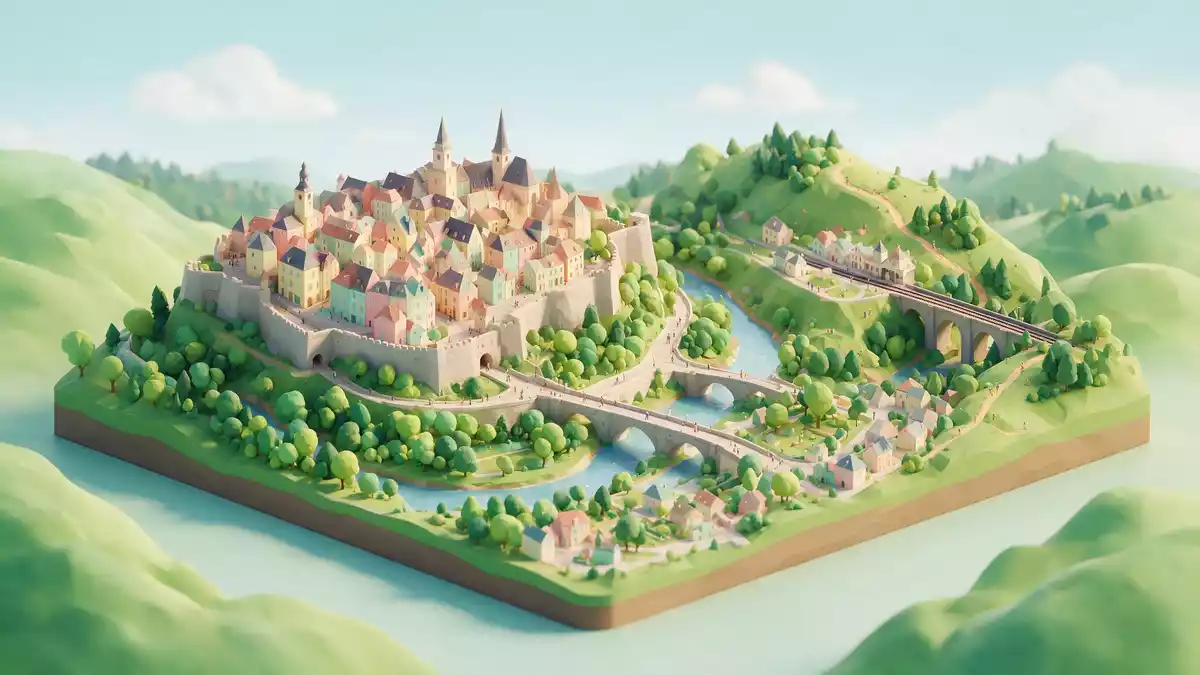
Vieille Ville de Luxembourg is the historic core of Luxembourg City, spread across a steep rocky outcrop above the Alzette and Pétrusse rivers. Its old quarters and fortifications form a single urban landscape, and that blend of stone, slopes and walls gives the area its character.
Luxembourg's old quarters on a rocky ridge
The site occupies an elevated position in the centre of the capital of Luxemburg. UNESCO lists it as “City of Luxembourg: its Old Quarters and Fortifications”, and the designation dates from 19941994World Heritage Site. The city website describes the old town as one of Luxembourg City's strongest contrasts, with historic fortifications beside eighteenth- and nineteenth-century buildings.
The geography matters because the town sits between river valleys and on hard rock. The World Heritage description notes that the old city lies on a very steep outcrop and that the natural relief already acted as part of the defencevery steep outcrop. That setting explains the tight relation between streets, ramparts and drops in level that remains visible in the old quarters.
From medieval castle to fortress city
The history of Vieille Ville de Luxembourg reaches back to the tenth century. The World Heritage text says a small castle was built shortly after the middle of that century on an almost inaccessible rock, and that the settlement around it was enclosed by stone walls in the twelfth centurytenth centurytwelfth century. The place then passed through Burgundian, Habsburg, Spanish, French, Austrian and Prussian hands, and each layer left traces in the fortifications.
One name belongs at the centre of that story: Siegfried, Count of the Ardennes. The castle associated with him became the nucleus of the city, and the later works by Vauban, the French military engineer, belong to the broader fortress landscape described for the site. The surviving ensemble is not a single monument but a layered cityscape of walls, gates, bastions, casemates and streets.
Walls, gates and the lower town
The old quarters are divided between upper and lower parts of the city, and that division is still part of the layout. The World Heritage description mentions the layout of the streets, public buildings, the Church of St Michel, the former Church of St Nicolas, and the ancient Abbey of Neumünster in GrundChurch of St MichelAbbey of Neumünster. These names anchor the old town as a lived district rather than a preserved shell.
The fortifications were dismantled in 1867, yet many fragments remain, including gates, bastions, redoubts and casemates. The Corniche promenade follows the old ramparts, and the city website places it within the heritage area as part of the historic townscapeCorniche promenade. The result is a place where the old defence line and the present street network still overlap in a visible way.
Visiting Vieille Ville de Luxembourg: what travellers from Western Europe should know
- The old town lies in Luxembourg City, above the Alzette and Pétrusse valleys. It is reached through the city centre and by the streets and bridges that connect the upper and lower parts of the capital.
- The terrain is steep in places, with deep drops beside the historic core. Streets, stairways and promenades reflect the rocky ground beneath the city.
- English is not the official language of Luxemburg. The official language is Luxembourgish, and the currency is the euro.
- The area belongs to the UNESCO World Heritage property “City of Luxembourg: its Old Quarters and Fortifications”. Its historic fabric includes fortification remains, churches and civic buildings from several periods.
Searching for Vieille Ville de Luxembourg on social platforms
These links open searches for Vieille Ville de Luxembourg on each platform.
Frequently asked questions about Vieille Ville de Luxembourg
Where is Vieille Ville de Luxembourg?
It is the old core of Luxembourg City in Luxemburg, on high ground above the Alzette and Pétrusse rivers. The historic area sits within the UNESCO property “City of Luxembourg: its Old Quarters and Fortifications”.
What does a visit involve?
Expect a city centre of slopes, bridges, narrow streets and surviving walls. The area includes churches, promenades and fortress remains rather than a single enclosed monument.
What makes it distinctive?
Its identity comes from the combination of medieval origins, later fortress works and the rocky setting between two valleys. The old quarters and fortifications remain readable as one connected urban landscape.


