
Vieux-Montreal: stone streets along the St Lawrence
Published on 08/23/2026 at 14:54 | Editorial responsibility: Rafael Müller, Editor-in-Chief AD HOC NEWS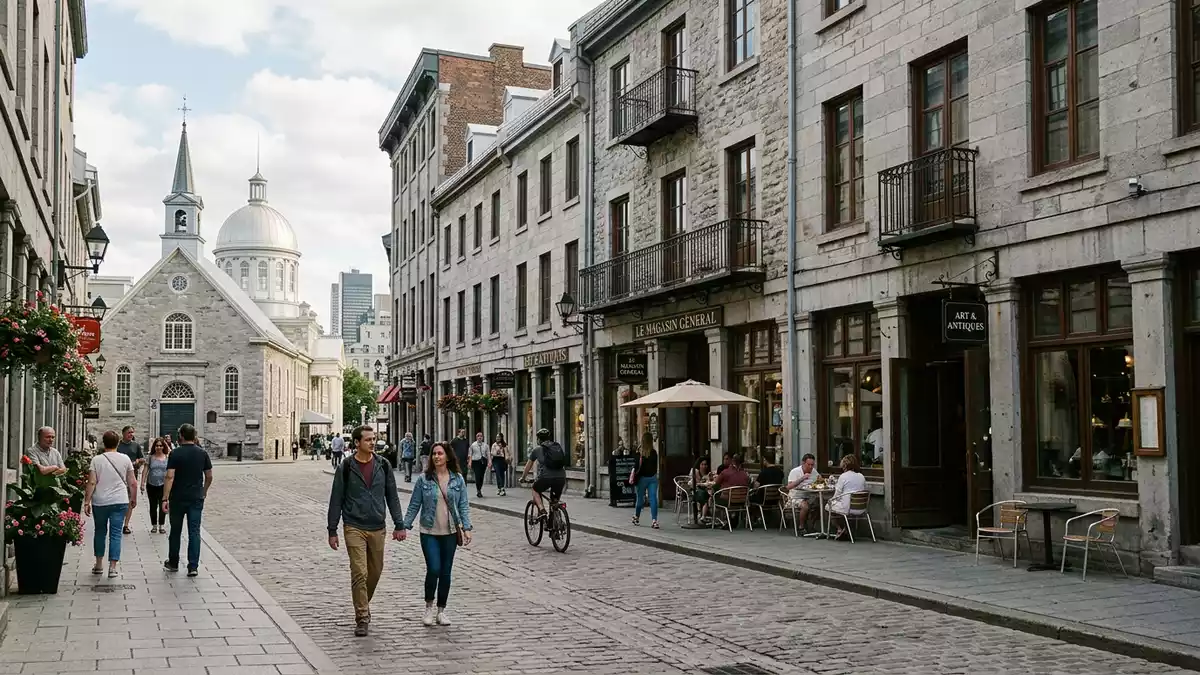
Vieux-Montreal, known in English as Old Montreal, is the historic riverfront district where the city of Montreal first grew along the St Lawrence River in the seventeenth century.Old Montreal Its compact grid of stone streets and squares, framed by the river and downtown towers, preserves several centuries of architecture within a walkable enclave.
Where Montreal began on the St Lawrence
The story of Vieux-Montreal begins in 1642, when the French colonial settlement of Ville-Marie was founded on the banks of the St Lawrence River at Pointe-à-Callière.the French colonial settlement of Ville-Marie The early town took shape as a fortified enclave aligned with the river, concentrating religious institutions, merchants’ houses and administrative buildings close to the waterfront.
The historic district occupies the southern edge of the Ville-Marie borough, between downtown Montreal and the St Lawrence River in the province of Quebec in Canada.Old Montréal and the Old Port Its perimeter broadly follows the line of former fortifications, with streets such as McGill Street, Saint-Antoine Street and Berri Street marking the transition from the old quarter to the newer city.perimeter formed by historic streets
Stone streets, riverfront quays and layered architecture
Walking through Vieux-Montreal means moving between narrow stone-paved streets, enclosed squares and the open waterfront of the Old Port, all within a relatively compact urban area.stone streets and riverfront squares Many buildings are constructed in grey limestone, giving the facades a consistent, subdued palette that contrasts with later glass and steel downtown.
The architecture spans several centuries, from seventeenth- and eighteenth-century forms to nineteenth-century banks and commercial houses that once made this the financial core of Canada.a dense concentration of historic streets and buildings Church towers, former warehouses, civic buildings and converted merchants’ residences line the streets, with the Old Port’s quays and promenades extending the historic fabric to the riverfront.the Old Port of Montreal
A protected historic district within a modern city
In 1964 the government of Quebec designated much of Vieux-Montreal as an arrondissement historique, a protected historic district recognising its concentration of early urban architecture.historic district designation in 1964 The protected area covers the former walled town, parts of the early suburbs, Pointe-à-Callière and the Old Port, creating a single heritage ensemble along the river.the protected arrondissement historique
Within this perimeter, the district retains a scale distinct from the surrounding city, with low- and mid-rise buildings and streets laid out to follow the river and the line of the vanished fortifications.the historic perimeter in Ville-Marie Public spaces such as riverfront squares, small plazas and church forecourts punctuate the street grid, giving Vieux-Montreal a sequence of enclosed and open spaces that reflect its layered history.
Visiting Vieux-Montreal: what travellers from Western Europe should know
- Vieux-Montreal lies along the St Lawrence River on the southern edge of downtown Montreal, within the Ville-Marie borough in the province of Quebec in Canada.
- The district is reached on foot from central Montreal streets, and by metro via nearby stations such as Square-Victoria-OACI and Champ-de-Mars on the Orange Line.
- Many streets in Vieux-Montreal are paved with stone and can be uneven, and the historic area includes slopes between the riverfront quays and the higher inland streets.
- The official language is French and the currency is the Canadian dollar.
- Entry requirements depend on your nationality; UK travellers can check the FCDO travel advice at gov.uk/foreign-travel-advice, Irish travellers the Department of Foreign Affairs at ireland.ie.
Searching for Vieux-Montreal on social platforms
These links open searches for Vieux-Montreal on each platform.
Frequently asked questions about Vieux-Montreal
Where is Vieux-Montreal in the city?
Vieux-Montreal occupies the historic riverfront area on the southern edge of downtown Montreal, between the modern city centre and the St Lawrence River.
What should visitors expect when walking through Vieux-Montreal?
Visitors encounter stone-paved streets, historic buildings in grey limestone, riverfront quays and a series of squares and church forecourts within a compact, walkable district.
What makes Vieux-Montreal distinctive among Montreal neighbourhoods?
Vieux-Montreal is distinctive because it preserves the site of the seventeenth-century settlement of Ville-Marie and a dense concentration of protected historic architecture along the St Lawrence River.


