
Vieux-Quebec and the city shaped by its walls
Published on 08/18/2026 at 15:00 | Editorial responsibility: Rafael Müller, Editor-in-Chief AD HOC NEWS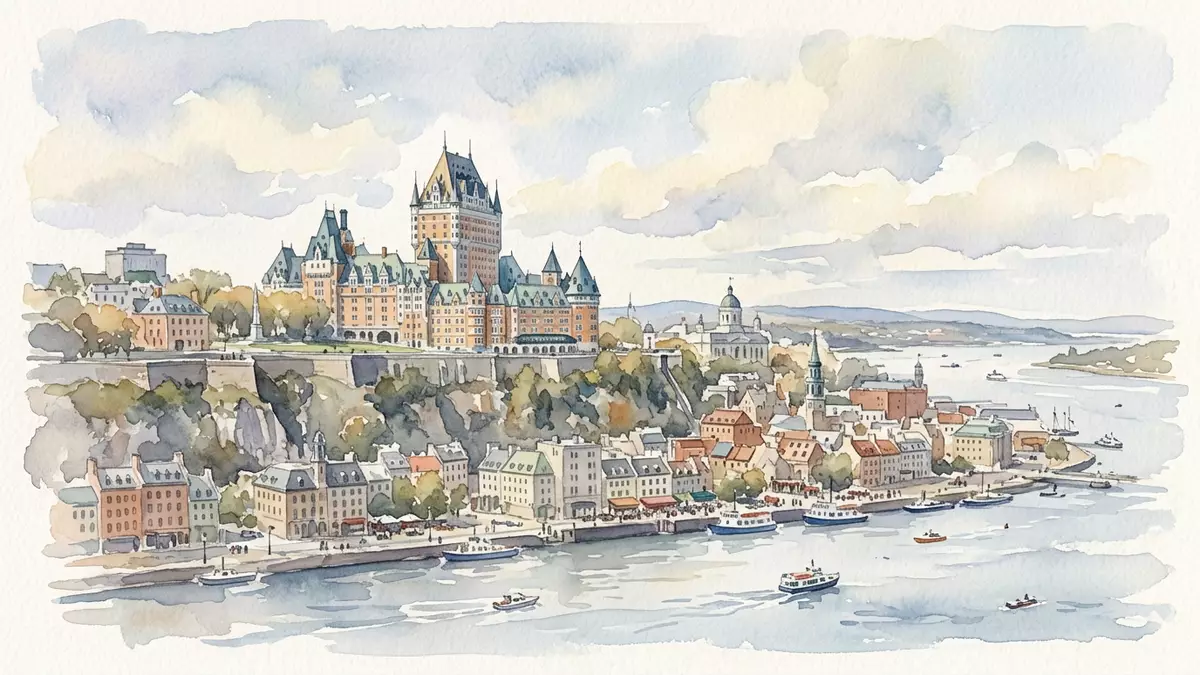
Vieux-Quebec is the historic district of Quebec City, and its most striking feature is the way the upper town and lower town still read as separate parts of one city. The district is linked with Samuel de Champlain, 1608 and the UNESCO World Heritage inscription of 1985.
Fortified streets above the river
The upper town sits on Cap Diamant, with ramparts, a citadel and other defensive works tracing the edge of the historic district. The lower town gathers around Place Royale and the harbour, where the built fabric lies closer to the river and the oldest commercial core took shape.
The district covers about 135 hectares, a size that gives it the feel of a compact city quarter rather than a single monument. That scale matters because the streets, walls and terraces remain legible together, with the fortifications framing the higher ground and the harbour side holding the lower one.
Champlain, 1608 and the French colonial city
Samuel de Champlain founded Quebec in 1608, and Vieux-Quebec is the setting most closely associated with that foundation. The place later grew into a colonial town with military, administrative and commercial functions, and the historic district preserves that layered urban form.
The district is a fortified colonial ensemble and a rare survival of French urban presence in North America. Its built character comes from the combination of ramparts, old streets and the division between upland authority and harbour-side trade.
World Heritage status and urban continuity
UNESCO inscribed the Historic District of Old Québec in 1985, recognising an urban area that remains complete enough to show its historic structure. The district is also formally protected as a heritage site in Quebec.
The presence of surviving fortifications gives Vieux-Quebec a clear outline, while the lower town keeps the city’s relationship with the river visible at street level. In that sense, the district is read not as a single attraction but as a lived urban fabric with walls, slopes and separate historic quarters.
Visiting Vieux-Quebec: what travellers from Western Europe should know
- Vieux-Quebec lies in Quebec City, on the north side of the Saint Lawrence River. The historic district is reached through the city’s streets, with the upper and lower town connected by local routes and stairways.
- The terrain changes quickly between the high ground of Cap Diamant and the lower streets near the harbour. Expect steep changes in level across a small area.
- The official language is French and the currency is the Canadian dollar.
- Entry requirements depend on your nationality; UK travellers can check the FCDO travel advice at gov.uk/foreign-travel-advice, Irish travellers the Department of Foreign Affairs at ireland.ie.
Searching for Vieux-Quebec on social platforms
These links open searches for Vieux-Quebec on each platform.
Frequently asked questions about Vieux-Quebec
Where is Vieux-Quebec?
Vieux-Quebec is the historic district of Quebec City in Quebec, on the north side of the Saint Lawrence River. It occupies the upper ground of Cap Diamant and the lower streets around the harbour.
What does a visit involve?
The district is an urban quarter with sloping streets, fortified edges and a lower town connected to the upper one. It is a place for walking through a historic city layout rather than for a single enclosed site.
What makes Vieux-Quebec distinctive?
Its combination of ramparts, a citadel, harbour-side streets and a World Heritage designation gives it a clear historical form. The link between Samuel de Champlain, 1608 and the surviving colonial city remains central to its identity.


